The full-length translation of A. Dovzhenko’s The Enchanted Desna will beavailable from House to Water in early spring 2006. For furtherinformation, please contact [email protected]
Photo of Dzvinia Orlowsky byMax Hoffman
more poetry
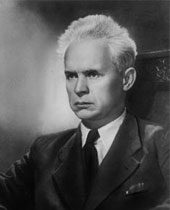
Alexander Dovzhenko
Translated by
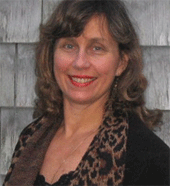
Dzvinia Orlowsky
Excerpt from The Enchanted Desna
But of all these paintings, therendition of the Last Judgement struck the most fear. Mother had tradeda hen for it at the fair, and she used it to torment her great enemies— Baba, Grandfather, and Father. The painting was both soterrifying and illuminating that even our dog, Pirate, was afraid tolook at it. Grandfather and saints resided in the top half. In themiddle, the dead crawled from out of their graves, single file, sometoward Paradise, others straight down to hell. A large blue adder,thicker than any snake we killed among the pumpkins, twisted in themiddle, along the bottom. Condemned souls and devils smoldered there. At the very bottom of the painting, separate scenes in cage-like frameslisted punishments for sins that had been committed. Those who lied ormocked others hanged on a hook from their tongues over a fire; those whoforgot to fast hanged by their bellies. Those who slurped cream orfried eggs with ham during fasts sat bare-bottomed on a hot frying pan. Others who had cursed were condemned to lick it.
There weremany different punishments for many kinds of sins, but no one seemed tooconcerned.
At first, I shuddered at the sight of the painting. But eventually I got used to it the way a soldier gets used to therumble of artillery.
In our family, almost everyone was asinner: our means were paltry, our hearts, passionate. There was plentyof hard work and hardship and we shared an inclination toward the sharpword. Although we dreamed about Paradise, we knew we’d probably end upin hell at the bottom of the painting. There, everyone had a specialplace set aside.
Devils poured hot tar down Father’s throatfor drinking and for hitting Mother. Baba licked the hot frying panbecause of her backbiting tongue and for being an expert sorceress. AsMother predicted, the devil himself gripped Grandfather for his sorceryas well as for reading the magic Psalter every Sunday during which hecursed her casting a spell that made her sick for three years, and forthe fact that when she secretly shredded the black book, scattering itspages in the barn, the cattle shed, the pumpkin patch and under theraspberry bushes, the pages seemed to fly back into the leather coverall by themselves. Besides, it was suspected many years ago thatGrandfather’s deceased father, Taras, was regularly visited by a serpentthat came down the chimney at night to bring him money.
Sureenough, in the right-hand corner of the painting, Grandfather sat in thedevil’s hands clutching a full purse of money. He didn’t look exactlylike our Grandfather because, banished, he was stark naked, and unlikeGrandfather, his beard was red from the scorching fire, not white; hishair stood straight up, crackling with flames.
My olderbrother, Ovram, had been condemned by Baba years ago and ever since hadbeen flying headfirst into hell from the upper left corner of thepainting for destroying the pigeons’ nests in the attic and for stealingpork fat from the pantry during fasts. His soul also craved cream thathe skimmed from the milk pitchers stored in the cellar and pantry.
Only Mother imagined herself destined for sainthood. A martyr,she’d fed her enemies — Grandfather and Baba — and been goodto them.
She prayed to Saint George whose steed trampled theserpent to drown them, as well as Father, for ruining her life.
Once, when she was young, she swore that Saint George, dressed inwhite vestments, riding a white horse and wielding a long spear, came toher in her dreams. When he heard her moaning in fright, he asked:
“Is that you, Odarka?”
“Yes.”
“Don’t be scared, it’s me, Saint George. I’ve come to giveyou a sign. Henceforth, Odarochko, you’ll carry out good deeds in myname.”
From that time on for about ten or twenty years, Motherconsidered herself a mystic. She began healing those who suffered fromtoothaches, the evil eye, or faintheartedness, although she herself wasalways sick.
“Take a look. There’s my place,” she’d say, pointingat some saint near the Holy Mother at the top of the Last Judgementpainting. “Do you see?”
Mother had poked that pious soul so often that instead of aface it now had a brown spot resembling a capital city on a geographicalmap. Later, Mother’s affairs took a turn for the worse. Once, shedidn’t give Baba anything to eat for a long time. So Baba bought a lotof church candles and placed them upside down in front of God. Aftersuch damnation, no one could hope to reach Paradise. From that time on,Mother’s health began to deteriorate. At nights, the goblin that livedin our chimney choked her more frequently. They said he never uttered asound and looked like a black sheepskin coat turned inside out.
The truth of the matter was that I was the only holy person inour household. And my holy status had just ended. I should’ve neverpulled up the carrots. Left alone, they’d still be growing. Now I wasa sinner. What could I do?
Entering the room, I quietly sneaked up to the painting of theLast Judgement. Diligently, as if with new eyes, I stared at theinfernal punishments depicted at the bottom. I was afraid to look atthe top of the picture, as I no longer existed in the top row.
What punishment did my recently damned soul deserve? For afirst sin, perhaps nothing too grim. Perhaps only the ankle-high flamein the left corner of the painting. Oh dear..!
I looked up at the full communion of Saints seated together forone last time. Overcome with sorrow, I recognized that I wasn’t amongthem. Banished from their company, I was doomed to eternal hell. Icouldn’t bear it any longer. I leaned my head against hell just belowGrandpa’s purse and bitterly wept.
AlexanderDovzhenko was born into a peasant family in the DesnaRiver area in Northeast Ukraine in 1894. Along with Sergei Eisensteinand Vasevolod Pudovkin, Dovzhenko is considered one of the SovietUnion’s greatest early filmmakers; his silent film Earth (1930),a poetic tribute to Nature and Ukrainian village life, is still oftenregarded among the top ten best films of all time. In addition to hislegacy as a silent film poet, he produced a brief autobiographicalarticle of approximately twenty-one pages and two hundred and forty-fivepages of notebooks that he kept from 1941 until his death. These recordan intimate account of the Ukraine during the German invasion andoccupation in the Second World War as well Dovzhenko’s inner developmentas film artist. Much has been lost; little exists in English printtoday. Dovzhenko died in 1956 after suffering two decades of Stalinistoppression. He left behind several scripts, most of which had also beenbanned by Soviet censors. His wife and creative partner, YuliaSolntseva, produced some of these including a 1965 Mosfilm and DovzhenkoFilm Studio production of The Enchanted Desna (ZachrovannayaDesna) based on his 1942-1948 autobiographical film-tale.
Dzvinia Orlowsky is the author of threefull-length poetry collections published by Carnegie Mellon UniversityPress: A Handful of Bees (1994); Edge of House (1999); andExcept for One Obscene Brushstroke (2003). Her poetrytranslations of contemporary Ukrainian poetry have appeared in numerousmagazines and anthologies including Leviathan Quarterly, A HundredYears of Youth: A Bilingual Anthology of 20th Century UkrainianPoetry (Lviv Press, 2000) and From Three Worlds: New Writing fromthe Ukraine (Zephyr Press, 1996). Translations of DzviniaOrlowsky’s poetry into Ukrainian by Natalka Bilotserkivets werepublished in Vsesvit-Reivew of World Literature 2003.
