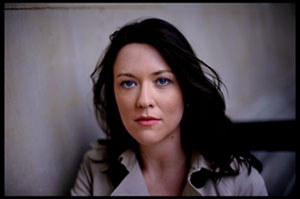
An interview with Emma Jones in this issueby Melissa Buckheit.
_______
Poems from The Striped World published by Faber & Faber 2009.
_______
Tiger in the Menagerie
No one could say how the tiger got into the menagerie.
It was too flash, too blue,
too much like the painting of a tiger.
At night the bars of the cage and the stripes of the tiger
looked into each other so long
that when it was time for those eyes to rock shut
the bars were the lashes of the stripes
the stripes were the lashes of the bars
and they walked together in their dreams so long
through the long colonnade
that shed its fretwork to the Indian main
that when the sun rose they’d gone and the tiger was
one clear orange eye that walked into the menagerie.
No one could say how the tiger got out in the menagerie.
It was too bright, too bare.
If the menagerie could, it would say ‘tiger’.
If the aviary could, it would lock its door.
Its heart began to beat in rows of rising birds
when the tiger came inside to wait.
Conversation
‘Oh this and that. But for various reasons’ –
(the season, and the change in season, theseason of grief
and retrospection, the rooftop pulled fromthe childhood
house, and the internal doll in its stuckseat,
that is, the fictive soul in its brutecathedral, and because of memory,
maybe, and organs in niches, and the beat tothings,
and the knowledge that the body is the souland vice versa,
but that false distinctions are sometimesmeaningful,
and that difference, all difference, is justdistance, not a state,
not a nation, and because nothing matters,not really,
or everything does, I don’t mind being ananimal, at all,
because a sentient thing is nothing else,and because toward matter
I feel neither love nor hate but the kind ofshuttered
swiss neutrality a watch might feel for time
if it had an animal’s sentiments, knowingitself a symbol
and function, knowing itself a tool, andbecause I feel
the dull culmination of various phenomenainforming me
and am that culmination, I feel ill in somesmall way,
though not ill really, just idle, and Iprefer, you see,
to keep an impassive inviolable pact withthings that tick,
with solitary, shifted things, and becausemy life’s approximate act
is the sister to some other life, withdifferent tints, I carry
and nurse, my diffident twin, I’m oftenmorose, and think
of those statues that lean above themselvesin water,
those fountains, stone, with commemorativelight,
with disfiguring winds, and becausereflection is an end in itself
and because there’s an end even toreflection, and an end to the eye,
that heated room, I prefer to keep myartifice and my arsenal
suspended, close; like an angled man; likethe stationed sun;
and because matter ends, or I should say,matter turns to matter,
and my small inalienable witness to this isreal, I can’t pretend
to wish to be a rooted thing, full-grown,concerned
with practical matters, in a rooted world,and careful of borders,
when an ineradicable small portion glints,my mind, that alma mater,
and says, make your work your vicarage) –‘I put off going back’.
Equator
On the old ships,
when they crossed the line,
the Captain became cabin boy
and the cabin boy
‘Neptune, King of the Brine!’
In curls and rouge
they’d play at this,
a contrary crew. Then the last bell rang;
the boy resigned;
and the Captain resumed his place.
He wrote in the log:
‘Today, on course,
we crossed the line, with usual incident.’
And he also wrote:
‘There is no line.’