In an earlier issue a chapbook by George Kalamaras: The Transformation of Salt
_______
More work by George Kalamaras at the following websites:
Elixir Press.
Ugly Duckling Presse
DIAGRAM
Arsenic Lobster
Calibanonline: Calibanonline
Hunger Mountain (interview and poems)
They Will Sew the Blue Sail
_______
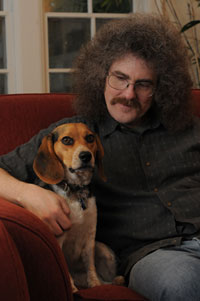
George Kalamaras
Letter to Ray from Livermore
Hey Ray. There are likely only two Surrealistsleft
who still read Hugo with any depth. Got a guess?
We know Breton and Desnos are dead,
though not in our poems. I was thinking today
how we love the West. The realWest where railroads speak.
Everything now is air. Rush here, fast there.
Our molecules jiggle enoughas it is
when we microwave our food. That baked potato
I ate last night stillstriving inside me to survive.
Of course you’ll visit inJuly and sleep
with your head to the north, aligning yourself
with the pines. You remember growing up
on the border with scorpions, the desert
and its sting. I recall Indiana fire ants
in the pump-house ivy. My boyhood
bites. Johnsays they’re in my wrist.
And I believe him, standingsome nights as I do
like the guy in Un Chien Andalou, staring
at my hand. I know. The wrist is not myhand,
but like those railroad tracks, our veins keep wendingWest.
Each yearfor me from Fort Wayne to Livermore.
I don’t know, sometimes, howwe’ve survived this long
with a moth wing for a mouth. Something is beating me
back, and I’m sure it’s me. Part fly, part sky. You named it
Luna, andstarted a magazine. You got thenight
just right. I’ve gone inside, my eye open to the spiritual
fly. Buzzhere. Land there. Let the breath
and with it the jittery monkey-mind release.
It’s surprising we still havewives, the way our parents left
one another with pain. We’re not unique. Someone
is always throwing someone out, even with a word
or curve of earth. Someone is always throwing
a bone to the dog. In your case, cats. Remember
when Punk and Whitey loved to eat cantaloupe,
as far back as Arvada? God, we’ve known each other
a long time, even before them, in Denver,
knowing what makes our secret strain
exact. When Desnos sleep-talked, he threw a thread
of speak that wound from the cosmic now into the lives
of human dread. That’s why they were scared
and barred him from the group. So there are strains
of purpose and strains of pain. Which brings me
to how you and I do. Which brings me back
to those two rails running West
and all the courage of the plains. Of course, Hugo
could be a sap. And he knew it. But hestands naked,
letting the wind. Like blood into a cup,
it pours out his mouth. And the trees
speak. Notonly booze, dark bars, and shame,
but the hope of how to survive in Red Lodge,
Missoula, or Butte. Desnos knewthis
too, stumbling back from the camp, typhus
so tight in his spine, the Second World War
pouring out through his teeth. As did Breton, by the time
he got to his third wife. I love them most
for their blurring and slurring of word. The how and why
my life. Aswe love Hugo too, perhaps most
for his shame in how the West was won
and keeps losing itself in the lost. Because living here
is pine-dead hard. The how and why we cry.
MeetingHer at the Plains Hotel, Est. 1911
Cheyenne, Wyoming
It had rained hard for overan hour,
as if from some cave inside.
Caught in the Western Wearstore, you tried
to convince yourself a sale was a sale,
as the petite twenty-something women
flirted on about the merits of fabric
that could stand fierce against fence.
Twenty-nine ninety-five wasstill twenty-nine ninety-five
you could shuttle toward books, you thought.
You window-watched the flood,
the street disappearing in a den of dark water.
Where’s the best coffee in town?
you and your wife had asked, when it calmed a bit.
The Plains Hotel was justaround the corner.
The distance between here andthere
is always across some swirling pond
or other, offering to drag you down.
Something is always floodingyour life,
clogging the drain. Built in 1911, across the street
from the Union Pacific, the hotel
had somehow brought Denver closer
to buffalo grass and pain. You could still hear cattle
shuffle inside the tile floor and elegant wood,
the mahogany moan, smell the thin
cigar-thread of cattle barons
staling down oil men from 100 years back.
She looked up from herhostess stand
at the hotel’s Frontier Restaurant
like caught-in-the-wind. You or her or both.
Certainlynot twenty and perky.
Certainlynot young. But deep
coffee-brown eyes from living hard.
Could it be the rain floodingback
through you her strand of loose hair? The bad
tattoo saddling her shoulder? The gorgeous sore
of her voice? The round child-or-two
tummy tucked in her jeans? The way
her arm hair lay there, beautifully exposed
as a new-born calf among the smell
of broccoli and soup and rib eye
medium rare? How could you eroticize
this chance glance over the eating of meat?
One body biting into another,so brief,
through all the possible strangers in time?
Surely her name must be Lynnanne or Lynette
or some form of Lynnethat rhymes with sin.
Your sin, ofcourse, of perpetual
hope. This thigh or that. Your wife’s
gorgeous ass as she unzips
her purse to cover the coffee to go.
How could those dark circles
staring back at you from the greeting stand
possibly compete with thirty-four years
together and the roundness of now?
She can’t be more thanthirty, you think.
Could be your daughter, infact, though life for her
was surely hard. And you get hard, with the thought of it,
reaching out, a moment, to her pain,
or all the years of loss you imagine
you could belly-kiss away.
It must be the rain, you tellyourself,
that today is reaching the ground.
The street, the flood, thepouring back
from the animal den inside. All the unwept fears
you’ve kept hidden, building up silt
against beaver lodge, snow-weight
bending good horse fence. Maybe the fabric in the store
could havehelped, though the perky slim-hipped women
there left you bland as a mis-sizedshirt on the rack,
the sleeve, the youthful fashion, somehow incomplete.
If only it hadn’t rained youcould have remained
faithful at the stand, even in thought, the denim
of your pants tightening still against all good intent,
reaching out into the lovely loss of touch.
But Lynnanneor Lynnette or any part
of her dark-circled self continues
to swirl out to you her pain—the give and dust
of serving never-enough-dollars
at the hostess stand of the fancy hotel,
of two children, perhaps, at home,
and a likely divorce, and an unclothed
ring finger calling to you your own great unclothing
in body, mind, and evenpoem, in which you
stand naked as any man.
You stare into the darkbeautiful curves
of honorable work and the certainty
of a great exchange you know will never be
more than you can imagine, more
than the longing of four coffee-drowned eyes
this sudden wet July
pouring a pain-soaked day through one another.
I Am the Unmistakable Verb Tense
This is how I conjugate mygrief.
If I loved you, a great voiceof trees would crack.
In my chest, only this : two Chinese poets’ competing chi lu verse.
Hangingblinds. A vexedcup. Eventhe melancholy of private bamboo.
The collective unconscious ofmy voice could never eroticize one of Hans
Bellmer’s dolls.
They do more than celebrate aperformed acrobatics.
Abracadabra. What sexy Surrealist puts on anostrich-feathered coat and even
after allthese years still has a remarkable ass?
I am her unmistakable verb tense, always unsettling the nouns encamped in
my chest.
And now, all I can recall areTao Kan’s willows and the handsome stance of a
bulrushreed.
I’ve thrown the yarrow andkeep emerging in Vallejo-time, stalk after stalk.
If I loved her fur-lined cup,if I loved a great voice of trees, my own dark
watermight llama-root and shift.
Thisis my how, this is my when, where, why. And how come.
Tongues : 18
I shouldlove the apple
with which I bite
that part of me
I thought hidden.
In the salt shaker,
there are remnants of dying
white crows. From Australia,
the ground of aboriginaldrumming
bays back all the way, here,
to that part of the moon
hidden in eclipse. I should
love your any and your all,
your completely with and your
most moist. Mouth
upon mouth, we invert
The Book ofTongues. We enter
one another, layer within
layer, from inside
out, as bits of star-scrape
flake out upon the plates
beneath us. We should eat
one another, eat one another’s
qualms, with the calm intensity
of those dead who, startlinglyalive,
have displaced the peculiar
rib by which they blame.
Anything different in touch shames
no one and nothing. And I should
love, over and over, that scar
given me in your kiss, in theaboriginal
musk, in the apple’s secretcollusion
with the way the worm
of our drumming
breath works heat from the sun
to mimic spoilings
of war. We should feast one another
dry as any dying crow, or
the porous salt of forgiving
our bodies for giving
in, as any river bend
about to embrace the sunken
wood of a late burning
summer. Elm-bone, antler-like,
floats downstream, bleached
barely visible as pliant tongues
or solidified tones we might eat,
might sound through one another
with our entire mouths and hands,
might touch, even, with theuncertainty
of a first forgivableintimacy.
_____________________________________
your any and your all
_____________________________________
your any and your all