
Traverse:songs
A sonnet sequence by Jill Jones
_______
Breath, the hours: collaboration of Jill Jones’ poetry and Annette Willis’s photography
_______
Photo of Jill Jonesby Annette Willis 2005
Interviewwith
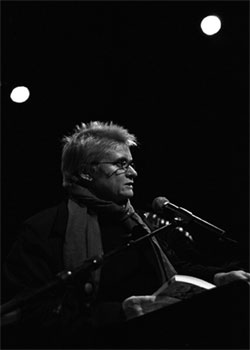
Jill Jones
By Rebecca Seiferle
Jill Jones is a poet and writer who lives inSydney, Australia. Her work has been widely published in most of theleading literary periodicals in Australia as well as in a number ofprint magazines in New Zealand, Canada, the USA, Britain and India. Sheis also widely published online. Her latest books are her fifth fulllength work, Broken/Open (Salt, 2005), which was short-listed forThe Age Book of the Year 2005 and the 2006 Kenneth Slessor Poetry Prize,and three chapbooks, Fold Unfold (Vagabond, 2005) poems writtenin response to paintings; Where the Sea Burns (Picaro, 2004); andStruggle and Radiance: Ten Commentaries (Wild Honey Press, 2004).
In 1993 she won the Mary Gilmore Award for her first book ofpoetry, The Mask and the Jagged Star (Hazard Press). Her thirdbook, The Book of Possibilities (Hale & Iremonger), wasshortlisted for the 1997 National Book Council ‘Banjo’ Awards and the1998 Adelaide Festival Awards. Screens, Jets, Heaven: New andSelected Poems won the 2003 Kenneth Slessor Poetry Prize (NSWPremier’s Literary Awards).
She has collaborated withphotographer Annette Willis on a number of projects, includingc-side, and also Sea Shadow Land Light, a multimediapresentation first delivered at the On the Beach conference held byEdith Cowan University at Fremantle in February 2004.
She was aco-founder, with Laurin McKinnon, of BlackWattle Press, and in 1995 sheco-edited (with Judith Beveridge and Louise Wakeling) A Parachute ofBlue, an anthology of contemporary Australian poetry. With MichaelFarrell, she co-edited a selection of Australian erotic poetry for a2003 edition of Slope online magazine. She has been a filmreviewer, journalist, book editor and arts administrator.
Shemaintains a weblogRuby Street, aswell as two websites, her home page and poemsextracted from her weblog off the street
Rebecca Seiferle: Usually I like to focus in the interview on the poet’s particular worksin this issue, but I think this is the first time that we’ve had afeature that involves two different series of work. So I’d like to beginwith the sonnet sequence, Traverse, in part because I’m aware from our previousdiscussions that you began with this series of sonnets and have beenworking on it for some time. I thought you might like to discuss the‘beginning’ and development of this sonnet series?
JillJones: Yes, I have been working on the series of sonnetsfor a while, intensively since the beginning of the year— though a fewpoems date much back further, as it’s been, as you say, on my mind for awhile.
I should say, before I talk more specifically about the sonnets, that I haven’t really been a poet of ‘projects’. In fact, I’ve tended to avoid them, as though I felt it was something forced. I can’t really explain why I seem to have changed though, on reflection, it’s partly pragmatic. I don’t have the luxury of a lot of spare time, due to my current working life, so a project gave me some focus. I’ve always worked well with constraints for individual poems, why not for a series? So, just as in the last few years I’ve worked with groups on projects such as ekphrastic poems, the snapshot project with poetryetc and image and text work with c-side, I set to collaborating with sonnets.
RS: Was it a kind of correspondence with other texts or particularauthors? Did you make a choice to engage with the sonnet, or did youfind yourself writing in that direction and then made a conscious choiceto develop the poems into a series?
JJ: It just began to happen. But that’s never true, is it? I realise, as an afterthought, that I was aware of a couple of poet friends writing sonnets, Michael Farrell and Peter Minter, for instance, so the idea was hanging around. I was also noticing that a lot of what I was writing was around the 14 line length, with the kind of turning you’d expect in traditional sonnet forms.
So, yes, I was writing in a certain direction, as well as reading around sonnets, particularly going back to the ‘classics’ which, for me, included Coleridge pere et fils , Samuel Taylor and Hartley, George Herbert, John Clare, but others as well. I became fairly promiscuous in my reading. Shakespeare, sure, but probably not as much as it’s too overwhelming. And, of course, I revisited Ted Berrigan, how could I not.
Again, a kind of collaboration grew out of this, the gesture to tradition and how it has developed, as well as a recognition of how I’d been writing lately, which is the more mysterious part.
So, why a sequence? I feel that, as most of the poems were written over a short time period, they were talking to each other in those odd ways texts do. I’m not sure the sequence is ‘finished’ but the writing in that direction began to slow by the time I assembled them into Traverse. I’ve written more since putting the sequence together so they may all be included in another kind of publication further down the track. I just don’t know at the moment and am happy to let this stand.
RS: Given that your work is somewhat dialogic, how did working with aform like the sonnet change the conversation for you? the process ofworking?
JJ: As you say, thedialogic way of working is conversational, which I see as collaborative.I even stole a few things, as one does: obviously rhyming schemes butalso actual rhymes, which I grabbed from all kinds of poets. Full rhymesand slant rhymes, whatever looked interesting. I sometimes used them asconstraints and sometimes just as suggestions. I got quite involved indevising various patterns, many of which I never ended up using for thisproject. But I never waste anything, so it will all have a bearing onother things I do.
RS: What formal elements of the sonnet did you follow? And was thissomething new for your work, to engage with a particular form?
JJ: The most obvious formal element is the14 lines. But I mention it anyway, as I did not veer from it as, say,Hopkins did, or Berrigan, for that matter, or the Australian poet AlexSkovron, who wrote a book of what he called ‘sonnetinas’, 10 line poems.Fourteen lines was the central constraint.
Mostly, I tended to converge on iambic pentameter, I do tend to do thatin a lot of my work, but sometimes purposely subverted it, with eithermore of a tetrameter line, or some very clipped lines and one instanceof some lavish Whitmanesque lines.
For most of the poems I followed my own version of the Shakespearean orPetrarchean or Spenserian. I played around with rhyme schemes but mainlytended not to get into too much rigid end-line rhyming as it threatenedto get a bit clunky. The sonics of a poem are always important to me butyou can get that going in so many other ways, rhymes within lines,repetitions setting up echoes, and the like.
RS: Has your sense of the sonnet changed as you developed these piecesor wrote new ones? Have you found yourself moving to a more fluid senseof the form?
JJ: At one stage, Igot a bit more tightly focused on the form, the traditional forms, thatis. But the words kept going in all kinds of directions, as of coursethey will. So there are some traditional dictions and registers mixingwith other registers, as well as non-traditional forms. I found myselfwriting nearly always in sonnet form, i.e. 14 lines, over a period ofmonths, even if some of these initial ‘sonnets’ had to be unhooked fromthat constraint to become another kind of poem. It was a littledisconcerting on the one hand, vaguely obsessional, but also quitedeliberate. I found a rhyming type of pattern which I liked — nottraditional at all but with enough singing in it — and it has given meideas of using it in other ways. I haven’t had the time to move thereyet.
RS: I’ve noticed in these sonnets in comparison to your previous work agreater freedom, range of feeling, more juxtapositions, and wonder ifyou found this in writing them.
JJ: I think that’s true, and I put it down partly to the waysconstraints can be liberating. I think I have been aiming for more rangeand fluidity anyway, in the last while. Though it was commented recentlythat “early in her career she [ie, me] hitched her star to the wonderful‘Go anywhere, write on anything, in any style’ tradition and this stillvery much sustains her” so maybe people see that I’ve always been a bitlike that. I’m not sure that I can stand outside of my work enough tosay, to now contradict what I said before.
Certainly nowadays, I find I’m even less worried about what even I mightthink about what I write, let alone the rest of the world. Life’s tooshort. Oddly enough, or perhaps obviously enough, it may be an agething. Going with a sense of not needing to prove anything to anyone inparticular, and that one has the various resources to go on into one’sown newness, aware that it’s never new in the great scheme of things,but a continuing dialogue with traditions and current practices.
And, mysteriously, I have been having some very strong dreams lately,dialogues with the past, and some of that feeling, if not the dreamsthemselves, is within the sonnet texts. I found things coming up Ihadn’t expected, everything from prayer to black grubs to dresses.
RS: In the text-imageseries Breath, the hours, the black and white photographs were taken by Annette Willis. Arethey taken of a particular trip or a series? Or selected out of a largergroup of work with an ‘eye’ toward poetic response?
JJ: Mostly, the photographs were selectedout of a larger group but it’s true to say that, for the most part, theones I selected to respond to were taken during a specific trip toEurope, though some were taken in Australia. They were rounded up byAnnette from her collection after we had spoken about what I wasthinking of doing. It was a case of both her suggestions, and herknowing my work, and me remembering certain photos of hers. Although inone sense I had decided on the types of image, we both made the finalfinal decision about the actual photos— and she definitely insisted onreplacing one I had fixed on with another one. She was, of course,right, it was better.
RS: How did the collaboration between your text and her photographsdevelop? I’d guess that you wrote the poems in a sort of dialogicresponse to the photos. Did you select the photos with the sense ofwhich were the most provocative in terms of a poetic response?
JJ: Your guess is pretty much spot on. Ialso had an idea of where I was headed, pretty vaguely but bubblingaway, before I chose the kinds of images I wanted to engage with.Annette and I both know how each other works and we have a number ofmutual artistic interests — streets, remnants, an archaeological pointof view, effects of light (obvious for a photographer, eh). Some of thephotographs followed as response but I knew that the right imagesexisted in her collection. We just had to find them.
RS: One of the things that strikes me is how interwoven the images andthe text are and yet how the poem does have an ongoing movement, a kindof flow, that eddies and ebbs and turns around the images. How would youdescribe the correspondence with Annette’s images in terms of theprocess of writing?
JJ: Thank you.That’s how I wanted it to work. The eddies and flows were also my ownprocess.
I wanted a form and played around with the hay(na)ku (I assume people are aware of Eileen Tabios‘s creation of this form). What I mean is thatI originally thought of using that form — a tercet of one word, twowords and three words — but found that, for this project, I wanted alonger line and a way of forming a hook or link between image andthought. So I developed a way of working with a six word line (in otherwords, a hay(na)ku written in a straight line instead of a steppedstanza), followed by a three word line, in a way I think works the waythat ‘things of three’ can interweave yet move along, and deliberatelyused repetitions but pushed them through definite changes. In reality,it was a bit more intuitive than that but the idea sort of worked outthat way.
The correspondence with Annette’s work comes through a close focus ontexture and detail, which is very much Annette’s way of working, a closeseeing with its implications for what lies outside or beyond the frame,so to speak. Annette usually works with a series or concept in mind andher work in one area usually has strong connections to other things sheis doing. I wanted to get that sense of connectivity.
RS:I’d guess most obviously that one of the similarities between thesonnet series and the photo/text is that they involve a sense ofcollaboration. One with a literary form that perhaps seemed ‘different’enough to seem like an encounter with another reality? And the otherwith a different art form?
JJ: Collaboration is the way of the poet, in my view. I’m not a greatbeliever in the garret. Of course, there’s collaboration with thelanguage, with the traditions, the various versions of the ‘canon’, withthe work of one’s contemporaries. But my own way has also beenspecifically collaborative in recent years. This includes the ekphrasticwork I have done with the DiVerse group of Sydney poets, who havewritten many series of works in reference to images, usually paintingsbut also other visual stimuli, in various galleries and museums inSydney and Canberra. We don’t collaborate with each other on individualworks but work alongside each other in the knowledge that we’re dealingwith the same group of images. We then do readings together in thegalleries in question.
Also there’s the multimedia work Annette and I have done that JamesStuart has curated through his ongoing c-side project, using writers,photographers and DJs for events in social spaces. I’m no technologicalgenius but simple tools like PowerPoint can be pushed a fair way. As aslightly off-topic comment, David Byrne is also fascinated byPowerPoint, for different reasons. I’m fooling now with sound stuff(yes, more laptop electronica geekdom) and would love to work more withcomposers and musicians.
One thing I have not managed yet is to do any extended collaborationwith one or even a few poets. I tried a long distance thing with afriend of mine once. The idea was that we’d write to similar kinds ofmusic (jazz, of course; for me, Miles Davis, of course) at the same timeof day and then marry it together somehow, but we figured it never quitehung together. It was a once-only thing and perhaps we gave up on it toosoon. I have also been involved in a few of those renga-type exerciseswith small groups of poets. They were fun and fine, though one did havesome controversy attached to it, which I’d rather not resurrect. And Ihave done other linked writing with email list groups which I haveenjoyed.
I remain hopeful that an opportunity will arise for something moresubstantial. I suspect you can’t force it but I’m always alert, just incase.
RS: Each of these series seems to be complete, or could be? Do youanticipate adding to either? Or do you perhaps anticipate extending someof the same formal procedures you used in writing these series in otherdirections?
JJ: The text-imageseries Breath, the hours is pretty much complete as is. Though we canalso see it as a starting off point for an exhibition project Annette isplanning later in the year. It could be, for instance, a limited editionbooklet accompanying the exhibition. It remains to be seen.
As I mentioned before, I have more sonnets than the ones in thisTraverse series, some of them older versions or poems already wellpublished. Others more recently written still haven’t been finished. Ihave also put together another much shorter series. So maybe it’s aseries within a series. I don’t feel that it’s quite settled. But it’sall work in progress, in a sense. I remain strongly interested indeveloping more formal procedures for my work, for the pragmatic reasonsI alluded to before and also because of that mysterious thing thathappens, an intensity and freedom with form that I am liking.
To order books by Jill Jones
From Salt Publishing:
Broken/Open
Screens JetsHeaven
From Vagabond Press:
Fold/Unfold
From WildHoney Press:
Struggle and Radiance
Reviews of Broken/Open:
By Peter Boyle in The Famous Reporter
By AngelaGardner in foam:e
Reviewsof Struggle & Radiance:
By Peter Minter in Jacket
By MariaChristoforatos in Cordite
Other on-line references to Jill Jones’s poetry:
Poetry International Web
Australian Literary Resources
