“I am not I.
I am this one
walking beside me, whom I do not see,
whom at times I manage to visit,
and whom at other times I forget . . .”
—JUAN RAMÓN JIMÉNEZ,
“I Am Not I”
(trans. Robert Bly)
_________
A complete biography follows the poems.
George’s work online at:
Four Way Books
Conjunctions
pavementsaw
Litline
Homepage
_________
To order books at bn.com by George Kalamaras
_______
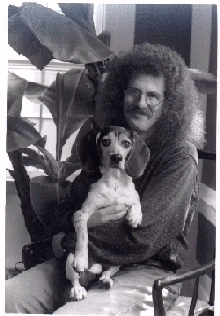
Photo of George Kalamaras by Jim Whitcraft. All rights reserved.
_______
_______
“Looking for My Grandfather with Odysseas Elytis” was first published in Luna.“Meeting Alison at the Malaviya Bhavan, Banaras Hindu University” and “The Resurrection of André Breton’s Ashes” were first published in The Bitter Oleander and “The Resurrection of André Breton’s Ashes” was nominated for the Pushcart Prize.
An Electronic Chapbook by
George Kalamaras
Heat
Hands made of cowhide
with a crack of saddle-soap sun.
A candlestick that could be your
singed spleen, swaging glosts of noon.
More like a hammer blow
than the plumage of an acetylene bird.
She said, Kiss me here, darling, where
it hurts, because it hurts all over.
Any ending is as good as the sum
of a Gobi rat revealing its intestinal moon.
He opened a fierce flower and discovered
how maroon saffron could actually be.
The ostrich swallowed a sizeable stone to grind
serpents grassed in the blue cobra fire of its throat.
Bury your head, then, in your own crotch,
if you can’t tongue my scar like you mean it.
I bend and kiss my sleeping dog. I love her
and she loves me and the world is wild with heat.
Kali’s Thigh
You survive the thighs of Kali,
camel blue, above you like a future
birth. Enter
the flower of sound
advice, agreeing to the blue hive.
To arrive as a vulture who continues
to circle is an arrival of place,
a porridge of bees already in your throat?
Is a bactrian sapphire
held by a wet nurse in a well?
Glass testicles rather than
a glass eye? You touch yourself
in the dark to make sure. Touch
the crystal goblet to that
of this seeming stranger, consider why
there are no other guests
than you. Blue walls, blue breasts.
Blue thigh that has survived centuries
of crashing worlds, even years
of your indifference.
How long is the orgasm
of a slow breathing tree?
A host of hoarfrost
on the windowpane
keeps your left eye milking her locket,
your stunned bee’s blood inside.
Cut of the World
All night wondering why you’re here,
what you came to find. Something
to do with the bruise. That hole you carry
and get sick of so fill with clotted
cream, or that canker sore you try to cure
even with a tonguing you know
will deepen the sting. Mosquitoes frustrated
with the bed net, as if through some secret order
they’ve come to know your skin all the way
from the States, now seem confused
to be kept off. But that’s the way it is
sometimes. You get pushed away
during an intimacy and realize
it’s not the stubble burning her cheek
but the ragged words, the urgent touch
that’s either too soon or somehow selfish
and remote. Or you get asked back,
but the hostess’s stutter flattens out
and jerks like a sick pulse
in a hospital ward, inhabits an edge, deadens
the guests like ice crushed into crystal
goblets.
So you come again
to this net, an edge untucked,
poise of wings and beatings and plots
above you formed from restless breath,
this heat that sends you at midnight
to the verandah of the flat
where it all seems so open
a moment, possibilities of stars
like lanterns prone on slatted
pallets, pigs finally grunting
the great sigh of what seems to them
ice, water buffalo hunkered
cool at last in their mud.
But the cut
of the world is still there
in your own yard, or at least
at its rented edge, ledge of sandstone stuck
by your landlord with broken bottles
of Thumbs Up and Gold Spot, clay
teacup shards displaying the jagged perimeter
slash of lightning as if the red earth will always storm
apart and never be enough, wicked wedges
of mango and lichi jars, recycled
Bowie knives that could take
the finger and kneecap off any intruder.
In the next yard, at least two families sleep
in a room the size of your den
back home. Men, women, and children
climb out when stars knock the heat
down a little, to lie on low smooth walls
like exhausted dogs who wait, half-alert,
for someone to return, unsure who
it might be, or if, or when.
Sunken into that underwater
twitch of paw, those submarine-sound
pleasure yelps. Yet, their shifting alert enough
to snatch a falling bone,
to wag a tail and soften
an ear if someone
were finally to come.
You’re shy
to look, have closed the amber-tinted glass
afternoons when you’ve changed,
but now watch restless
sleep, their almost-satisfied breath
like after making love. You lie
in the lantern spill of hay,
and wonder if it was lust
or the desire for love that drove you
to that shudder, that almost-stinging
moment, then the momentary glow
of ash before it is blown out
from above, or below, or from wherever
that great stirring seems to begin.
That brought you to the knife point
that makes the clotting come
later when you lazily swat a mosquito,
but it’s already sunk its pledge
unseen below skin.
Like trawling
for tonic from town to town, trying
to drain the rash with a wagon rut
and hose. Or carrying an empty mug
between rooms, arguing virtues
of coffee, mango pulp, or milk. Craving only milk
and its bond of bone growth, hay glow,
and moon, yet knowing it’s the caffeine jolt
of trying to love, of wondering why
you’ve come all this way, that stuns
entire families to crawl out their heat
and shift on a starlit ledge. That disturbs
the lip of a rented wall slicing off the rest
with sharp stars of Gold Spot and Thumbs Up.
That draws the cut out of its bed
onto the verandah, manic for salve or air.
And Finally, the Brides of Lust
As if this tongue.
As if the threshold.
Once a god.
Now only the cousin of sound.
And then finally there’s the cemetery
where you walk off down the aisle
with the brides of dust, a ring
of sun-burnt grass by the quiet pond
somehow pocked with ripples of rain.
Because moon blood lifts
and falls through the horse’s granite.
Because a simple crawling.
Because pig troughs
and the most sensuous oats.
To contemplate the vulva of a sow
and mean, Oh mother, where is my tongue?
As if a god.
As if pure sound.
Why are the underarms of every woman
in the world suddenly so terribly erotic?
A thousand stars exiled as scars?
To be forty-five
and finally discover the source
of fire?
Not breast or thigh
but hair stubble upon tongue.
Secret storage cut
of the cord?
Blood-light from inside
an ancient cave
corridor?
Rain in the pit
of a freshly dug word?
Once a god.
Once a god.
Now your cousin thunder.
That Scrotal Itch
Some say it was an
animal, raccoon
scratch for trash, love
locked as an argument
over this soup, over
that unwashed glass.
Never before had he bled.
Her tongue was in his mouth
once a month, for four, maybe
five, oranges at a time.
Down below, severe ice
was cracking, heat peeling
back, becoming vowel
or pouch, the small
of something dead
among the tiniest seeds.
Something red and swelled
and nocturnal and thrust.
Okay, it was animal
but not paws of chert,
not hawk or thigh.
Wings beat in his chest
whenever he went to scrunch
a saltine, a knickering
that thawed the dirt
like digging a grave, that rose
from tufts of wind
above all that passed
as this moistness, as that
lilac kiss.
Chiggers or nerves?
Juice of the pondering claw?
Her tongue in the cave
of his most moist month,
four oranges at a time.
At the Ashram of Trailanga Swami
The temple priest tells you he cannot recollect
being a silk trader nine years ago in Delhi
but can recall every detail of his last incarnation
when he wandered Calcutta as a cow,
vowing never again to nuzzle trash
for cabbage leaves and lichi rinds.
A sweeper woman hunched into a stick
of incense confides with downcast eyes that she sees
God in every ringlet of smoke
but not in the curl of her daughter’s
hair or in the evening lust her husband returns
with, sweaty from river washing,
musk of some Brahmin’s shirt
still clinging to him. Does the body
bring one closer to
or further from oneself? The reaching
of a tongue into the salt of another
steady your craving or substitute
moaning for sound? Trailanga Swami
taught that OM could be heard
in every cell if one could but turn
the tongue toward the nectar
that drips from the back of the throat,
but how can one learn to move from the body
into that vowel? Into a temple
pool’s luminous flash of carp? Into liquid
flesh, perfect dissolve? You chant a secret
mantra, pour water over the massive Shiva lingam
he retrieved 130 years ago from the bottom
of Ganga, touch its centuries of sexual longing
smooth from the clutch of many hands,
firm from cremation ash spinning electrons black
in your inner ear. Why is it you sometimes hear
a buzzing, get an erection when caressing bark
of a jack fruit tree, or when writing
a poem about a leopard, rich underbelly
of ribgrass? You bow to the statue
of the one you’ve come so far to feel,
the great Trailanga. Dead for 100 years, he vibrates
still in the stone. Mounds of marigolds
flower his neck in fiery ropes, luminous
snakes unwound into higher regions
where sadhus swear a cool wind from below somehow comes
all the way to the throat as Kundalini’s hot scales
unwind in the spine. 300 pounds of saintliness,
you think, yet gravity could not hold.
All that is moving is still, the temple
priest confides, turning a cabbage leaf
in his left hand, and all that is still
continues. You see a swirling atom
in his finger. Wonder what about being a cow
had left him fixated on lichis. Consider
your own former lives—a monk, perhaps,
in a fourteenth-century English Abbey, an Athonian
Hesychast, a janitor in Alabama, a wandering sadhu,
some insect or other crucified in the curious fist
of a boy shamed by the word Georgie
or Georgette or Georgina. Recall the ant
who crossed your desk this morning, certain
its ash carried your name black as it sifted
each poem for vowels, the photograph
of a Calcutta yogi on leopard mat. Its left
antenna prodding each paw-print blotch
like a hummingbird purling fur
for sugar water. Depth of a lover’s tongue
urging spasms of salt. A leptoscope
probing black and white cells
for bright, red divine milk.
Beloved Star
Beloved star, the world could die
from so much scraping.
The chiropractic elm with its bent cradle.
Boys sensing the moon in the waists
of every young woman with a belly piercing.
So you inherited the watchful eye
of your beagle. Fly-swat
against the dark lamp
nailed one of your breaths shut
as if your lung closed some lid.
A star could clasp a tree, lust
of every galaxy sparking the bark.
Your dog showing you the only true sound,
scent of cat-track through moss.
The world could force love
out of even the saddest plant.
Great hostas smalling toward the ivy
as if inspecting a sudden fatigue
in the color green.
So you’ve inherited the desire
to tongue another’s navel? To mouth
the sound, I would never kill a single thing
into a round, into a shallow star?
How could your own have ever fed you enough?
Firmed hair and bone? Filled you with blood
drawn in caves? Sun smear
of a bee entrail in dark rock?
Inside the crushed wing
of everything you tried to love
are young hands skilled with moss.
In moist belly pods,
a most minute lamp.
Bend your head below your knee.
Smell the sage
of sunken stars, inverted fire.
Kiss this sky.
Meeting Alison at the Malaviya Bhavan,
Banaras Hindu University
You meet at the Yoga Institute,
and then. And then, and always,
and maybe. Maybe there’s some purpose
for blonde hair tied in a bun
today, after a month of sensing the remoteness
of your brown curls amidst so much glistening
black. Maybe there’s a reason
the teacher’s late, that you’re the only two
except for the water buffalo who has wandered
into the courtyard looking for shade, that
you’re sweating through blue denim hearing
her stories of inoculations and premature
labor and rabies and the birthing of goats
in a hut with forceps meant for villagers.
Maybe there’s hope that she’s a doctor,
forty-ish like you, and from England, Leeds
in fact, which you know absolutely nothing about
yet feel you do because your second favorite Who album
was cut live there in ’70. And summertime blues
is precisely what you’ve got, and for which
Roger Daltry keeps wailing there ain’t no cure.
So maybe it’s destiny that you meet
the blonde doctor from Leeds today
when you thought you were over culture
shock and the desire to touch
anything remotely English. Your wife
and you collapsed beneath mosquito netting
just yesterday at three when the power again went out
and the air conditioner groaned
like a drowning cat and 122
felt not like electrocution
but death by sweat. You tried to joke
that your Lonely Planet guidebook
couldn’t have picked a better name if it had tried,
but it was a lie. Alison, she tells you,
as if stepping out of the cool smoky blue
of that Elvis Costello song—Alison, My Aim Is True—
extending her thin hand
like some pale strong bird, some rare
parakeet that you fear
you could crush if you shook
with what you were really feeling. Not fear.
Not loneliness, exactly. Not love. Not even
lust. But the pain of living
so close to what you always wanted
and so far from how it actually feels.
She says she forgot her water, asking
for maybe a sip. In this heat, you think,
she might just as well have closed the body,
suddenly realizing she’d replaced somebody’s kidney
with a clock. Which might not
be a bad idea if you wanted to track
the passing of snow geese through mineral deposits
of history, the tick tick tick of a migratory
stone bringing on queasiness, or the way
Phoenician yeast competes with Greek cheese
for the focus of the plate, or even that curve you take
for work back home when you’re late
and you wonder why you always go a little
too fast. You hesitate, considering cholera,
typhoid, meningitis, dysentery,
hepatitis—that litany of diseases
that your inoculants only partially protect
you from, the roll call your guidebook bugles
out then flags like taps over your stay,
how even the American CDC warns against
getting too close. But you give her some of yours
anyway, boiled by your wife this morning
over a propane stove like fresh blood
panned and washed from the river,
shaken loose from gravel and dirt, from
the pumping forth and arterial lift
of your daily bread. She drinks Indian
style, without touching lip to rim, the bottle
at least four inches above her upturned mouth,
eyes shut. Like a blind bird
fed a fat wiggly worm,
she knows each coiling drop
and how it will fall. The way jungle rain comes
great distances from mangroves to broad-leafed rubber
plants all the way down to bones, needles, and silt.
You’re relieved. You had hesitated
when she asked, knowing she’d been nine months
in villages with nothing but well water,
goat shit, and human piss. Yet
you’re sad now to take the bottle back
and not tongue the slight quiver
of her question, taste the rim sweat
of new lips, the first wails of infants
in huts you’re certain she carries, the labor of her
staying alive amidst cholera and typhoid and goats,
and strength of listening to the tick tick tick of so many
human hearts, which is enough itself
to kill anyone. Those lips which are lovely.
But which you know absolutely nothing except
that she’s from Leeds and textiles
and doesn’t really like The Who and doesn’t seem
that blue anyway and, oh, you’re married.
You wait together in the comfortable silence
of those who have touched. Of those who smoke
afterwards in the quiet glow and know
they’ll touch again, even if they don’t but will
only maybe in dream. You wait for the man
with the keys, for Dr. Tripathi,
for his lecture at the Bhavan
about the transformation of human salt,
about the yeast catching on
even through the thunderstorms
of our lives. You wait for note taking
and questions and, oh, how she might sit
four inches from you and hold her pen
in her left hand with awkward purpose. Will she
scribble like a physician? Will her notes be
decoded only by those who pour potions
and pills? Will you meet again, so she can
borrow your bottle and without stethoscope
listen closely to the drip drip drip
of your heart? Will you find yourself
scouring desk tops, book covers, secret palms,
for her scrawl in India ink,
for her diagnosis of why we suffer
and how to finally fix things
and make it right? Will she teach you
how to cock your arm and work your lips
so that what passes between you
will remain forever clean, suspended
in air like a great untouched waterfall?
Like a moment of boiled untapped power,
begun at home at the propane by your wife,
almost withheld, yet given at the last instant
out of compassion or loneliness or clutch,
and then, and always, and maybe?
The Resurrection of André Breton’s Ashes
Not in the wind or in the swan’s belly. Not in the brush fire of a woman’s hair. Neither shoulder-length red nor secretive pubic brown (with perhaps a hint of moon-slip silver). Not on the subway of the water-filled stairwell. No. Certainly not there. But, further, not even in the sky’s murder. The clue without a hammer. The nail’s carnival where the axe walks off to become an apple. Not even in the salons and endless opium talk while a lionreclines on green velvet, and definitely not in the roughage of linen, or in the part in some woman’s hair he does not know but has walked with for decades and now shifts to kiss, abruptly, by the Seine.
But in the horse’s belly. In the neck curving under-scratch of a foal. In the mare’s spurt of urine and sudden stare just before grass. In the cinch around the belly, like the unknown name and function of a woman’s undergarment. In the stirrup-frozen star on which to step. In the leather love grasp and, oh, how the horn of the saddle might massage. In the blankets bathed in salt. Andthe intensity of the eyes—those slow and spacious eyes—approaching the slightly curved slope of the salt lick. And the upside down swan for a bridle. And still, mostly, the belly. The lovely storage space for the most sensuous oats. And still, yes, the cinch around the belly. What is the name of that most secret holding?
This is what he wanted to know, where he knew he must ultimately sleep. Graze. Become water. Become well. André Breton never questioned his ashes, assembling themselves each night to walk around in his dark brown suit as fingernails, chest hair, nose, even the oiled wave of a pompadour. Never considered coals of the rising river moon filling his nose with rosewood, patchouly, and fish stench. Never thought—that is—to interrogate that lion lounging on the sofa, or the smoke populating blood vessels of the brain with shifting clouds the shape of poppies in reddening wind-grass. Or the way he himself desired every woman who—even years after his death—ever included his name in a poem, every woman who looked in the mirror and while braiding her hair saw the heat of his hand unhooking a snap, felt his tongue entwined with hers.
It was the ashes that perplexed him. He thought he was dead. Surely. Knew it when he looked in a mirror and saw only the moon, not even sky or cloud. Had read the certificate and even studied the coroner’s report, which cited several interrelated theories, something about calcium deficiency and horse-milk toxicity and an overly-tight bridle and sleeping in a horse’s belly and blood supply to the brain .
Still, it persisted. Almost nightly. This nagging conglutination of extinguished fire. Tongue. Wrists. Brain. As if some great cloud in the shape of a horse’s head had craned its massive floating neck into the vase anddispersed its smoke, blowing his charred bones back into place. A peculiar alignment of breathing and hair that sent him nightly to the canals in search of a kiss. In search of unknown ropes with which to terrify the grass. With whichto call the salt and cull the tongues. Moon-slip over the snout as a way to harness the brown river silt of someone’s eyes. Any woman’s eyes, known for decades or perhaps minutes (hair, shoulder-rinsed red or pubic brown, triangulated, and perhaps secretively silvering with age), who dared cock a hip and offer her lips to the incessant slapping of the Seine. Was she named Suzanne? Simone? Or something less solid like Canal du Midi or Auburn Braid?
Only fragments remained. This troubled him. Wind-rustled flakes. Bits of floating ash. An odd itching within the skin whenever he passed burning trash or an open cooking fire. Burlap. Leather. Calcium sleep. Bridleblood. Tight deficient brain. Milk belly. These were textures familiar and remote. Terrifying and soothing. Like sensing, after many years, a spear slit in your side or a burning of spurs. Would a drop of water really emerge from the blood? Would it be passed in a cup? André Breton looked into the mirror and saw not just the moon without sky and cloud but every woman in the world who ever included his tongue in their grooming. This confused, even conflated, his brain into something resembling water and the desire to drink. Which arrived first, he wondered, the cinch or soft underbelly? What held or what was to be held? The touching, or a fullness of form? The widening hips, or this spur beneath the tongue? Body or ash?
He did not know, he realized. For once in his life he did not believe in swans. He did not trust the lion or the opium green fog consuming Rue Saint-Martin. Maybe René Daumal was right. Perhaps the pistol has no hair, only asoft white flutter of measured yogic breath through the chambers, dismantling them toward song. He sat on the edge of his bed in a decade he did not recognize. Did mares really wink with their vulvae and blanch the grass withurine that originated in rivers and wells? Did stallions actually have twenty-inch penises when erect and ejaculate within six to nine seconds of entry? Who were the women, and why did they carve the letters of his Christian name into their poems, calling him back night after night by standing naked, alone in their bedchambers, continually braiding and unbraiding their hair? The painful and perplexing moon-slip assemblage of ash? He looked in the mirror and trembled and wept, sensing only the oil of leather, scent of belly burns beneath the cinch. He was fluid and he was firm, the molecular weight of a match. Hisashes continually glowed and dimmed, as with the coming of intermittent wind and its excruciating absence.
Looking for My Grandfather with Odysseas Elytis
I’m walking through the narrow lanes of Athens and Elytis is at my side, his right arm looped through my left. His bald head, involved in some secret triangulated message-sending with the full moon and sunken sun. We are searching for the grandfather I grew up with, George Avgerinos, though he has been dead twenty-three years. Not here, not here, Elytis says, gently patting my hand, when I lean into a corner, when I crane my neck into the retsinascent of a taverna, salivate on the street near a woman in black and the open spit for a lamb, remembering my Nono, my brother Perry, and me dividing the tongue into three even parts. And though I don’t believe him, I know he must beright.
Then we’re in Zakynthos, the island of my grandfather’s birth. “The Poet’s Island” Dionysius Solomos made famous in 1822 and that now forever holds his name. Somehow we’ve left Athens and crossed the Ionian. Moonlight resembles an asphalt bridge, lava floes of solidified sulfur at Minerva Terrace in Yellowstone. I look back and watch them dissolve in lapping caps and leaping hagfish. A Greek Orthodox priest emerges from a glass coffin. He has seaweedon his slippers. He wears a tiny gold cap, I sense that he is bald. He’s Saint Dan, greeting us in Demotic, saying something about hair-shirts and stones in the mouth at Mount Athos and retsina wind carving cliffs and lamb’s tongue tucked safely in the chest of every newborn foal. His censor floats through Elytis, and Elytis’s cigarette suddenly catches moon-flint and lights. Not here, he coughs, that hearty, tuberculous cough of the many-smoked, thick clouds soaking us both, the lava floes reemerging then disappearing within the rasping strokes of the hagfish.
We thank Saint Dan, kneel and kiss his feet. I hear something about my son and good boy and mind that tongue in your own chest now too. Somehow both he and Elytis know of my secret. That solstice night in Colorado sixteen yearsago when I kissed the back cover photo of Elytis from Maria Nephele before writing poetry, before logging the first vowel. And then, before sleep kissing it again, slipping it beneath my pillow and holding my right index finger over the outline of his mouth as I curled into the darkness. Drops of light, drops of light, I had silently chanted, echoing Elytis’s core, into moon-folds of sleep, into the sunken yet persistent sun. And now both Saint Dan and Elytis look at me, each clasping two hands together in air as makeshift pillows and, standing, rest their heads upon them, saying in chorus, Drops of light, Giorgos. Vowel without end, Giorgos. Tongue in the chest.
Saint Dan returns to his coffin, caressing the hasp, seaweed stains on the stones. Elytis takes me deeper into the island to a small village, a two-room hut. My great-grandmother, Angeline, on the floor, the midwife spreading olive oil on her crotch. Pans of boiled water. The lantern carving out notches on the wall. Here, Odysseas?, I ask, self-conscious that I’ve called him by hisfirst name. First the kiss, now sixteen years later assuming the liberty of his Christian name? He pats my hand, saying only my name in Greek, Giorgos. I remember the gamey taste of tongue, eating it with my grandfather, asking why it was I who got his name. My great-grandmother moans, moon-flint again catching Elytis’s cigarette. Something like a lava floe stains the birthing rug. It is beautiful and terrible. My great-grandmother’s face tightened as in orgasm or broken bones. I want to cry out, save her, but I have no voice. Each time I go to speak, the ash on Elytis’s cigarette glows more brightly and something in my chest elongates through waves of saliva, crushing my heart, caressing my esophagus, flairing pinkish folds against my lungs. The midwife is now a giant fish, black shawl clasping the damp. Fierce gills pumping night wind, forcingsome rasp in the shape of, Push, push! Elytis holds my hand, measures his breath to mine. He gently undoes my trousers, the buttons of my shirt, dabs sweat from my brow, rubs olive oil on my groin, in slow circles at the sensitivetip of my penis, on my chest just above the nipples where the crushing begins. Push, push, he says. Vowel without end in the chest, he says. Soon you will speak, Giorgos. Soon you will speak.
George Kalamaras is Associate Professor of English at Indiana University-Purdue University Fort Wayne, where he has taught since 1990. He received his Masters degree from Colorado State University and his Doctorate from SUNY-Albany, both in English.
His poems have appeared in a variety of journals and anthologies in the United States, India, Japan, Greece, Canada, and the UK, including Best American Poetry 1997, Boulevard, Chariton Review, Epoch, Hambone, The Iowa Review, Manoa, New American Writing, New Letters, Stand Magazine (UK), Sulfur, TriQuarterly, and others, including Web Conjunctions. His poems have also appeared in numerous national and regional anthologies. The Bitter Oleander and Spoon River Poetry Review each devoted substantial sections to presenting his work, each feature including not only his poems but also an interview with George. He was also featured poet in Pavement Saw (#5).
His first full-length collection, The Theory and Function of Mangoes, won the 1998 Four Way Books Intro Series in Poetry Award (selected by Michael Burkard) and was published by Four Way Books in 2000. The book chronicles his months in India during 1994, where he spent several months on an Indo-U.S. Advanced Research Fellowship from the Fulbright Foundation and the Indo-U.S. Subcommission on Education and Culture, with university affiliations at both Banaras Hindu University (Varanasi) and Deccan College (Pune). He is also the author of two poetry chapbooks, Heart Without End (Leaping Mountain Press, 1986) and Beneath the Breath (Tilton House, 1988). Among his awards are a 1993 NEA Poetry Fellowship, a 2001 Indiana Arts Commission Individual Artist’s Grant, the 2000 Abiko Quarterly (Japan) Poetry Award, and two writing residencies at the Hambidge Center for the Arts.
A long-time practitioner of yogic-meditation, George Kalamaras has also published a book-length study on Hindu mysticism and Western discourse theory, Reclaiming the Tacit Dimension: Symbolic Form in the Rhetoric of Silence (State University of New York Press, 1994). His articles have appeared in The International Journal of Hindu Studies, and other scholarly venues.
George lives in Fort Wayne, Indiana with his wife, the writer Mary Ann Cain, and their beagle, Barney.
