Randall Horton’s poems
_______
www.randallhorton.com
Link to Horton’s publisher and book: mainstreetrag.com
_______
Niki Herd’s poems
Niki Herd’s God’s Graffitti: Cave Canem 1996-2008
_______
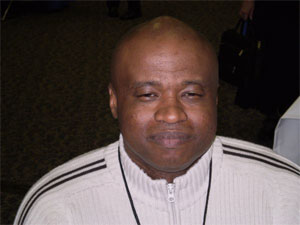
Poetry As a State of Becoming: An Interview with RandallHorton
By Niki Herd
“Rosetta Merrill: We Are Everyperson”
when sky is filled with sawdust
and pine trees stand tall
there is a song in my throat, a sound that fluttersthrough me soft as hair ribbons tracing ripples in a southern breeze. My familyis a strong spirit. Our rhythm is the current of ruffled ocean and moves acolorless sea. Our lives pull the sun across a ridge of pine each day. Mypeople are the windsong, the meek that toil unseen to eyes whose stomachs arefull. At night, when coal whitens in a potbelly stove, and the impossible isour only hope, I close my eyes and feel my feet pulled from red clay and knowmy footprints will be here long after we have sung these everyperson blues.
Niki Herd: The poem“Rosetta Merrill: We Are Everyperson” is one of the opening poems to TheDefinition of Place which is appropriate since this collection isabout the lineage of regular people—your people to be exact— who haveexperienced a particular place in history. These folks are hard working,whiskey drinking, black-skinned, rural, proud and American, though America hasyet to accept them. What was the impetus for crafting these voices into ablues-in-verse family tree? How did the stories come to you—was thereresearch done, are they fictional stories, or both?
Randall Horton: Iwas initially working on a project totally different from The Definition ofPlace, dealing with more pastoral experiences from a very difficulttime in my life. When I showed some of the poems to a fellow poet whosecritique I value tremendously, he told me something lacked in the poems, thatthere was a certain disconnect from the poet to the reader, which I did notwant. Around the same time, I had written a couple of poems about my family fora workshop that I was taking and when he saw those, he was like “you shouldreally explore these more.” What I began to realize was that I had never known toomuch about my family. I began to understand that I needed to rediscover my pastbefore I could truly scratch the surface of the things I wanted to write aboutpersonally. I needed to know where I came from. About this time I was alsogetting ready to enter a MFA program at Chicago State University. It was there,under the encouragement of Sterling Plumpp, that I began to craft the poeticstories of my family. This book was my MFA thesis project.
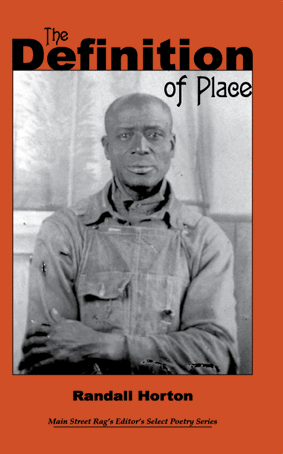
The story began to take shape with an actual eventdocumented in the Guntersville Democratin 1912. This story would end up the “Backstory” section. [In it] I recreatethe scene where my family members were coming home from church in a horse drawnwagon and attacked by a white man named Major King. His main purpose was tointimidate, frighten and possibly rape. A shootout occurred. This is fact anddocumented. Major King was killed by an “unknown” assailant. That “unknown”assailant appears on the book cover and his name was Bud Merrill. Althoughcertain family members served time on the chain gang, the person who killedKing was never captured. It was a story no one in my family repeated untilafter Bud died, for obvious reasons. African Americans during the turn of thecentury were hung for crimes lesser than that offense.
These stories are true. However, I must say that I felt likethese great-great family members were speaking through me to tell their stories.I wanted this to be about regular everyday people, not someone famous or withname recognition. I did not want to hide behind a made up persona. This is whatI hopes attracts the reader to the poetry and ultimately the story. I traveledto Guntersville, Alabama and did some research at the museum and library there.I spent time at the Birmingham Civil Rights Museum in Birmingham. I read everybook I could that dealt with African Americans in the South. Zora NealeHurston’s “Characteristics of Negro Expression” and her book Every TongueGot to Confess, where she recorded originalstories from Florida and Alabama, were invaluable. Also, without one of my oldestliving cousins, John L. Murray, who knew about the story and also knew mygrandmother and grandfather when he was a little boy, this collection would nothave been shaped the way it was.
Niki Herd: You talkabout the Birmingham Civil Rights Museum. There is a section of the collectiontitled “Colored Water: 1963” which overtly addresses the racism in Birmingham duringthat year. The section is kind of “segregated” from other poems that address,perhaps more between the white space of each line, the limitations blacksendured under white rule. What were you trying to accomplish by setting thissection apart from all else?
Randall Horton: Inthe “Colored Water: 1963” section I was looking for a way to segue fromnorthern Alabama to central Alabama where I grew up. “Colored Water: 1963” becomes center to the book in a couple of ways. First of all, my parentsmarried and moved to Birmingham in 1960; a year later I was born. My mother isfrom Birmingham and my father from Guntersville. I wanted to show a generationalshift to my pending generation. We lived eight blocks from the Sixteenth StreetBaptist Church in a small apartment. I was still in the crib when the groundshook from the bomb that took four little girls’ lives. These girls are talkedabout to death, yet two little boys lost their lives the same day. Their voicesare silent. I had to tell their story. I wanted to recreate the climate in thecity of Birmingham that day. Also, I wanted to show the struggle with white andblack children growing up and wanting to play with each other, but theirparents’ hate was so deep this was not possible.
While I do shift from first person persona to third personnarrative in “Colored Water: 1963,” I like to think of all the sections asbeing interrelated. The family strength I display in the preceding sectionssort of manifests itself in the way I tell the story of Birmingham from anative son. My ancestors still managed to love in all that hate. The concept ofplace is the central theme. People who have never visited the South tend to getmisconceptions. I come from proud people who didn’t want to “flee” up Northduring the Great Migration. They loved the smell of pine trees and the openspace. They found happiness in their own aestheticism, whether that was partyingat the Boogie Shack or drinking some homemade “sploe,” or going to church; they lived and played hard.The second thing about “Colored Water: 1963” is that it sort of sets theparadigm to the coming of age poems that are in my voice. I tend to think thepoems in the last section, “Scrapbook,” are merely Elvie, Rosetta, Dennis andBud Merrill extended. I become the fruition of their “place” and the Birminghamof 1963 helped to shape that.
Of course this was the section that I felt I had to remainthe truest to poetry. I had to find a language that wouldn’t seem rhetorical,yet at the same time, unashamed of the hard truths that come with exploringsuch a racially charged subject. In this section what I wanted most of all wasto teach something old in a new way, to unearth that which had been dustedover, and at the same time, I wanted there to be hope.
Niki Herd: Yes. . .yes,this notion of hope and the technical concerns a poet faces is interesting tome, especially when there is so much left unsaid. But thinking about the latterright now reminds me of Czeslow Milosz saying something like ‘language is the only homeland.’ Language meaning not only what one says —to paraphraseanother poet, Louise Glück— but the style of one’s thinking. In “TheCozenage of Mary Elizabeth” we are faced with a letter poem that illustratesthe ingenuity of the narrator and the poet. Can you speak about the role ofpoetic form in The Definition of Place? Were there any poets or other artists that influenced the work particularly in relation to formalconcerns?
Randall Horton:That’s a very good question. I think most poets who attempt to write a book inmostly persona will face this subject. When you start thinking about acollection of work in book form, something that a person is going to read frombeginning to end, and then too, writing in other voices, you always want thework to remain fresh and innovative as possible. After I became comfortablewith each person’s voice, I used poetic form as a way of getting the most out of someof the poems that seemed to demand more than just conjuring the voice. Take forinstance the poem you opened the interview with, “Rosetta Merrill: We AreEveryperson.” The first stanza of that poem is in haiku. The last poem beforethe generational and sectional shift “Elvie: The Summation of a Life,” which isin the voice of Elvie, begins with the first stanza in haiku. So Elvie andRosetta are the bookends to the story, as they should be. In between thesebookends I used sestina and the unrhymed sonnet to tell the most intricate ofstories.
To tell the story of First Street, which was the main streetwhere everything took place, sort of like theatrical drama, I used the lineendings and structural set up, not only for rhythm, but to get at the blues ofthe atmosphere. Although I do not talk particularly about the blues in most ofthese poems, I think it important to mention that the blues is very much a partof this book, along with cultural memory and the black aesthetic. These peopleare living America’s first authentic music in their lives. They are Americanliterature personified. The irony is that they are in the truest form American,yet unable to share in the American vision.
Also, I used the sonnet for irony as well. The section“Sydney Merrill” is written mostly in unrhymed sonnets with a syllabic count often. It tells the story of his escape from the chain gang in Alabama andswimming the Tennessee River and ending up in Chicago, again, a true story. Hewasn’t a nice person. So I wanted to take this very pristine and Eurocentricform and envelope it in a persona that was mean and bad to the bone, so whatyou have is a very precise metrical account of his journey and inner thoughts.In this collection, I also introduce the poetic form called the skinny, which was invented by my good friend Truth Thomas.I used the form twice and combined them from opposite sides to make dice.
In relation to formal concerns, Gwendolyn Brooks is the poetI depended on the most. Miss Brooks was a great formalist and language practitioner. Jean Toomer’s Cane provided good context too. I have to mention that Iwas inspired by A. Van Jordan’s M-a-c-n-o-l-i-a. Thepossibility that a book could come to life in the form of a story was appealingto me. As a matter of fact, the title poem of the book is written after one ofhis definition poems. Right after reading Jordan, I met Tyehimba Jess who wasworking on leadbelly, and heoffered me some great advice on completing the manuscript. I have to say that Idid not read Rita Dove’s Thomas and Beulah until I was deep into my project—almost finished. When I read the book I realized that Thomasand Beulah were Elvie and Rosetta. The stories are different, but the oneconstant between the two projects is love. Rita Dove did an excellent job andwhat I got most of all out of that book was how to place poems so they talk toeach other. There were other writers who influenced me with poetic form likeSterling Plumpp, Kelly Norman Ellis, Nikky Finney, and Quraysh Ali Lansana. Thesepoets either wrote about the South, or in persona. I think poets just startingout have to understand that we stand on the shoulders of others who have doneit before us; that inspiration comes from the past and the present. Poetry is alife long conversation with language. I like to think of myself as a studentfor life, so I am constantly exploring, seeking modes of expression.
But this isn’t about me or him.
We are flagpoles of something
bigger than the voices in this stadium.
from “An Amazing TwoMinutes and Four Seconds. . .”
Niki Herd: This istaken from your poem about a Joe Louis fight, fought the summer of 1938,against Max Schmeling. How does the notion of blacks and whites being“flagpoles of something / bigger,” and your desire for hope intersect? In otherwords, the poem represents one era, and then we fast forward to now—70 years later— and Barack Obama may become the next president of the UnitedStates, yet there is still the face of black reality in places like Jena,Louisiana, Jasper, Texas and New Orleans. Do you believe that the places/spacesyou have written about have changed for the better?
Randall Horton: Wellactually when I wrote that poem I was referring to Max Schmeling and Joe Louisbeing flagpoles for their respective countries, Germany and the United States.You have to remember during this time period there was a deep disdain betweenthe two countries. Hitler was in power. These boxers became bigger than whothey were. The Schmeling/Louis fights were about national pride. My father toldme stories of how when he was a little boy everybody that lived on his streetwould be hugged to a radio, listening to the broadcast fight. Nothing in theAfrican American community moved when Joe Louis fought. Joe Louis appealed towhites as well. The fact that these two boxers had epic fighting events,created a national pride. That’s why in the poem, when the persona of Joe Louisspeaks of the bigger, he means that they have transcended boxing in the physical, that thefight is no longer about the personal, it’s about nationalistic pride andsymbolism. Joe Louis understood he was a real peoples champ. The same thingwith Jackie Robinson. The African American community saw these athletes as away into Americanism. If somehow white America could accept this boxer andbaseball player, then maybe there was hope in the face of Jim Crow and otherlaws of segregation, which brings us to the interesting debate about Obama.
Obama has a chance to do something no person of Africandescent has done in this country, and that is become president. In AfricanAmerican communities today there are various debates centered on Obama becomingpresident. People of my father’s generation see this as an election to win atall costs. He is of the generation that saw Louis and Robinson as nationalheroes. Obama is no different. Obama is showing us that he has what it takes tobecome president more so than I could and other African Americans I know aswell. Obama has to distance himself from anything that appears threatening towhite people; it’s almost as if they are telling him the terms in which he canbe elected. My question is how many concessions does one have to make to keeptrying to be accepted? It’s like why do I need you to validate who I am, if Iknow who I am? I’m sure Obama is smart enough to understand all this. He had toknow it going into the election. He is not running for the United States ofBlack America, but America. And if Katrina, the James Byrd dragging in Jasper,Texas, and the unequal treatment and blatant racism of Jena Six, have taught,if they have not taught a thing, is that there are still a lot of disparitiesin America. We have not gone as far as we think we have.
But let me back up a minute. . .[w]hy are we trying to move to apost-racial society when we haven’t properly addressed the issues plaguing us now? I can only think that some people are in denial. . .To answer your question,yes things have gotten better. But they are not where they need to be. . .[a]nd aslong as things are not better, poets will write about them, consciously andunconsciously. Writing, especially poetry, is a by-product of societalstations. I believe it is inescapable.
Niki Herd: Preach itreverend. . .preach [laughter]. Okay, The Definition of Place leaves readers in 1970s black America with the funk andfilm icons of George Clinton and Superfly. What place will you transportreaders to next, and do you have any words of advice for poets trying tofashion a first book?
Randall Horton: [laughter]. . .Okay. . .[t]hefirst thing I had to learn when putting together [this] collection is that somepoems, no matter how dear they were to me, would not make it in the book. I cutout entire sections for clarity and integrity. The manuscript was originally110 pages. The one I sent to Main Street Rag was 80. If I may, I just want toacknowledge Main Street Rag as a wonderful press whose editor, Scott Douglass,is committed to giving poets a voice.
Don’t be in a rush. Remember, good poetry won’t go bad. Youhave to turn a blind eye to your own brainchild. The poems should speak to oneanother. You should know your manuscript backward and forwards. I mean sleep with the words in your head. Dream the manuscript at night. Know your poems so that when you hear or read a word that you have been looking for to replace a weaker word in one of your poems, you will be able to go right to it. Titlesare important. Don’t settle for the easy title. Make the title work in relationto the poem. I know it may sound odd, but you must learn to thrive off of rejection. Choose the contests you are going to enter carefully. Who are thejudges? What kind of history does the press have in publishing minorities? Thisis important because the majority of the presses out there stick to a more conservative mainstream type of existence. Their record as a whole is terrible when publishing people of color. I know too many great poets whose work has notfound a book cover. Don’t waste your money, and most importantly, you have tobelieve in yourself and your work. Study, read, and look for mentors.
Before I started writing poetry and taking literatureseriously, I was one of the statistical black men caught up, rebelling againsta society that didn’t seem to love me. I won’t make any excuses though. I madethe choices and I dealt with the consequences, or the state helped me deal withthem. You could say I lived fast and furious in the underbelly of America. I served prison time and these were the poems that I tried to write previous to TheDefinition of Place. I went back to schoolupon release and got my BA, then my MFA, and now I am on course to get my PhDsoon. I recently finished a collection of poems tackling these demons of mypast. In a way, the next manuscript is an extension of The Definitionof Place in that, after leaving the South,I find it inescapable. The South appears and reappears in a lot of my poems. Iam forever southern. After having written in narrative for a while I am turningmore experimental in my approach to poems. I think Bob Dylan said it best whenhe said, “An artist should always be in a state of becoming.”
Niki Herd: Thanksfor this.
Randall Horton: Ithas truly been a wonderful experience. Thanks.
Randall Horton, originally from Birmingham, Alabama, resides in Albany, New York. Hispoetry manuscript The Definition of Place was a finalist for the Main Street Rag Book Award andwas published in their Editor’s Select Series in 2006. He is a former editor ofWarpLand: A Journal of Black Literature and Ideas (Fall 2005) and co-editor of FingernailsAcross the Chalkboard Poetry and Prose on HIV/AIDs from the Black Diaspora along with Becky Thompson and MichaelHunter (ThirdWorld Press, 2007). He received his undergraduate education at both HowardUniversity and The University of the District of Columbia (B.A. English). Hehas a MFA in Creative Writing with an emphasis in Poetry from Chicago StateUniversity. He is currently a doctoral student in Creative Writing at SUNYAlbany and a Cave Canem fellow.
Niki Herd has been published in forums such as Just Like A Girl: A Manifesta!, Fromthe Web: A Global Anthology of Women’sPolitical Poetry, The Ringing Ear: Black Poets Lean South, Autumnal: ACollection of Elegies on compact disc, Kalliope, PMS:poemmemoirstory, 10×10.8, Xcp:Streetnotes Biannual Electronic ExhibitionSpace, and Black Issues Book Review.She has served on the board of Kore Press, an independent feminist publisherand was nominated for a Pushcart Award. Currently a Cave Canem Fellow, she wasrecently a finalist for the 2007 Astraea Emerging Lesbian Writer Award from theAstraea Lesbian Foundation for Social Justice.
