To read Dana’s poems in this issue
To view Dana’s cemetery photos in this issue
Dana’s work online poetryinternationalunder Israel, beginning May 25.
______
To view Nekoda Singer’s art in this issue
_______
To read Lisa’s interview with Shirley Kaufman also in this issue
_______
Lisa Katz is Contributing Editor for The Drunken Boat
An Interview with
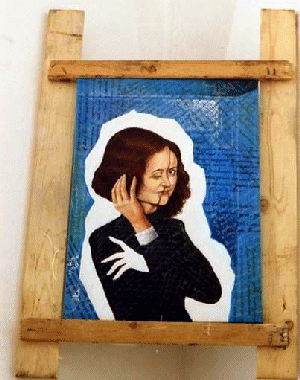
Gali-Dana Singer
I interviewed Gali-Dana Singer in the apartment she shares with her husband, the artist and writer Nekoda Singer, and their dog Deca, in the Nachlaot neighborhood of Jerusalem, its narrow residential streets with their narrow two and three storey buildings bordering the center of town. One enters the kitchen and moves through the tiny sitting room to the bedroom, which also serves as a work studio, and as a dining area, when guests number more than a few. There is no television or computer but there are hundreds of books. Outside, a table for four fits neatly into the garden space. They have lived in Jerusalem since 1988, when they emigrated from St. Petersburg, where Dana was born; Nekoda grew up in Novosibirsk. Two books of Dana’s poetry have appeared in Hebrew and three in Russian; Nekoda’s work is regularly exhibited in galleries around the country. An art installation which they produced together, the Procrustean Bed of Israeli Art, is part of the Israeli Object exhibit currently on view in Haifa. Dana will be participating in the Moscow Poetry festival in the fall. [Israeli poet and translator Rami Saari, national editor of the Israeli pages of the Rotterdam Poetry International web site, participated via email.]
Lisa Katz: What is it like for a poet to switch from one language to another? Can you describe the process? Perhaps there is something essential about poetry, and it doesn’t matter whether you’re a poet in this language or that one: you, Dana, are simply a poet in any language.
Gali-Dana Singer: I always emphasize that I haven’t switched from Russian to Hebrew, rather that I am always moving back and forth from Russian to Hebrew and Hebrew to Russian. Yesterday I spoke with someone making a film for [the French-German cable channel]Arte on exactly this subject.
Lisa Katz:Poets who write in second languages?
Gali-Dana Singer: About mother tongues. I tried to reconstruct how the transfer took place, I was sure that the process was still vivid in my memory. It seemed to happen one way, but then I remembered that the process actually began much earlier, when someone tried to translate a poem of mine [into Hebrew] and I didn’t like the result, started to write it myself, and saw that it was impossible to translate it as it was in the original, and not worthwhile, because what works in Russian doesn’t work in Hebrew.
Lisa Katz:You wrote it anew.
Gali-Dana Singer: You have to. I got involved [in writing Hebrew] rather early, around 1992, when I’d been in Israel only four years. I wasn’t sure of myself, and I didn’t feel the need to express myself in Hebrew; I didn’t think that writing in Hebrew would be a solution but I simply got involved in it. Whenever I begin to speak about this subject I always begin from the later stage, when a poet friend, who’d lived here 30 years and wrote in Russian, for some reason decided that I had to translate his work into Hebrew. I was surprised because I was certain that I couldn’t. I translated from Hebrew to Russian and not in the other direction. After I had convinced him that I couldn’t, and it’s no easy matter to convince a very stubborn person, I began to think, why not? Why shouldn’t I try? I sat with his books and began with the less complicated texts and I started to translate. Afterwards I showed them to [translators] Peter Kriksunov and [the late] Moshe Singer, who encouraged me, and the translations were published, which gave me a bit of confidence. Then the idea of the bilingual Poets’ Dialogue was born.
This project began when the Zionist Confederation House [a Jerusalem cultural center whose small hall features music and literary evenings-LK] appealed to Peter and to me to do something for the writers who had lived here a long time and wrote in Russian. I immediately thought that what was necessary was to translate them, but there are very few good translators of Russian poetry into Hebrew and they were very busy. It occurred to me to use a method common in Russia— that translators of poetry should first of all be poets, and they don’t even have to know the source language. They receive an exact word-for-word translation with all the possibilities; if the poem rhymes or is particularly musical, they get a phonetic version too. In our case it is possible to bring the Russian poet together with the Hebrew translator and so the idea of the workshop arose, and in the end a bilingual anthology was published. A few of my poems were also translated during these meetings; the fact that I had to prepare word-for-word translations, that is, to strip the poems of everything, leaving the content shapeless and lifeless, confronted me with the question of what a poem really is. It wasn’t a new question of course, but more thoroughly examined. As long as I was murdering each poem anyway, simply destroying it completely to make a word-for-word translation, I was able to touch on this issue; I survived the process and was able to try to give the poems new life. Then I won the prize [for immigrant writers] which also provides for a translation. Uzi Shavit at the Kibbutz Hameuchad publishing house wanted to bring out the translations in a book and I saw that too much was missing. In the beginning Peter Kriksunov thought he would cooperate with an Israeli poet but the idea didn’t pan out. I started to work, even dragging out the old text which was my first try at translating and it is the poem which closes the book [“To Return and the Lightness” in To Think: A River].
I saw that what I was doing was rather strange. On the one hand my translation of myself is close to the original but I always add different associations—it’s a rewriting and not a translation, more like the original writing process.
Lisa Katz:You allow yourself more freedom?
Gali-Dana Singer: Well, there’s always some freedom; it’s the necessary oxygen of translation. If you don’t take that freedom, the poem never lives in the new language. For me the meditative process during which you sink into the text and begin to reconstruct it is slightly different; it’s more like writing where you don’t know what’s coming next. Even if I have a raw translation in front of me I don’t know exactly which way I’ll go.
Lisa Katz: It’s also a sign that you fit in here, that you can bring yourself into Hebrew poetry.
Gali-Dana Singer: Possibly, because the language has entered deep inside me and taken control. After the first book I continued to write in Hebrew rather than translate. Things started rolling along in Hebrew, and that dictated what followed. [A poem] isn’t an idea but a sentence, a word, and if they are already in Hebrew they go on in Hebrew. And so my new book was written, Blind Poems. [The Hebrew word for “blind” in the title (ee-vreem) sounds like the word for “Hebrew” (ee-vree-eem), although the V sound in each word is in fact produced by two different letters. —LK] I always used to say that my Russian poetry was untranslatable because it was so rooted in the language —with word play, not for its own sake but because that’s the essence of language — until I learned that perhaps this isn’t so.
Lisa Katz:So it’s possible to translate?
Gali-Dana Singer: It’s possible, but only if you can create something parallel.
Lisa Katz: Create a parallel universe?
Gali-Dana Singer: Yes. And I think that, paradoxically, the fact that I am so close to language in my Russian poems is what caused my proximity to Hebrew. I accepted the new language in exactly the same proportions. Of course I’m the same poet but I write different things in a different language. What moves me to write is mainly the experience of language. If I wanted to express only my personal experience, my life, I wouldn’t need to write in a different language (other than Russian).
Lisa Katz:What is being written in Russian these days?
Gali-Dana Singer: Very interesting things are happening after a decade in which not that much was published of the new generation of poets. That is, before perestroika there were some poets who were not associated with the regime who were published and well-known in a sort of underground; afterwards they became famous, but for a long time no new voices emerged. Now things have, suddenly, changed; there are many interesting writers, interesting in unequal amounts of course, but it is possible to perceive different voices.
Lisa Katz:Are they really different from American poets?
Gali-Dana Singer: No, no. You can’t say that. Not long ago I read Robert Hass’s introduction to The Best American Poetry 2001. What he says about American poetry surprisingly describes what is going on in Russian poetry. “There are roughly three traditions in American poetry at this point: a metrical tradition that can be very nervy and that is also basically classical in impulse, a strong central tradition of free verse made out of both romanticism and modernism, split between the impulses of an inward and psychological writing and an outward and a realist one, at its best fusing the two; and an experimental tradition that is usually more passionate about form than content, perception than emotion, restless with the conventions of art, skeptical about the political underpinnings of current practice, and intent on inventing a new one, or at least undermining what seems repressive in the current formed style.”
Gali-Dana Singer: Yet what really interests me is poetry that lives and is nourished by different poetic traditions, including classical and futuristic.
Lisa Katz:Intertextuality.
Gali-Dana Singer: Not because of a desire to be conservative or traditional but it just happens.
Lisa Katz:The previous texts just enter…
Gali-Dana Singer: …into consciousness. What’s also interesting to me is how much one can play with ungrammatical language, with errors; you can imagine someone writing Cockney English, that’s more social or satirical, and perhaps musical, and it oints to the situation of contemporary language. In fact most people on the street don’t have a good command of their language.
Lisa Katz:Language poetry is more or less what you are writing.
Gali-Dana Singer: It is like language poetry, but I was writing it much before I knew the language school.
Rami Saari: Most of the Hebrew poets for whom Hebrew wasn’t a mother tongue arrived in the country when they were very young—Yehuda Amichai, Nathan Zach, Agi Mishol…
Gali-Dana Singer: Meir Wieseltier…
Rami: Yet the modern Hebrew language was created by people for whom Hebrew was their second, third or fourth language—Chaim Nachman Bialik, Shaul Tchernikovsky, Rachel, Leah Goldberg…
Gali-Dana Singer: But you know even in this earlier generation some of these writers learned Hebrew at home even if they lived, or were born in Latvia or Lithuania, some to parents who were Zionists, who spoke Hebrew. I came to Israel as an adult but for me the musical and syntactical elements provided the impetus to write. The words began to speak themselves in the new language.
Lisa Katz: I don’t know exactly how to explain this but your first book is very different to me from the second. In the first, in the Letters to Ona—I don’t know if she’s a real person or not—
Gali-Dana Singer: (Laughs). She exists.
Lisa Katz: Well, in any case, in her fictive existence in the book, it seems to me that she exists in order for you to convey your new culture to her at the same time that you convey your past to us.
Gali-Dana Singer: It’s a two way street.
Lisa Katz: Your second book seems more Israeli.
Rami:Have the deep sources of your poetry changed since coming to Israel? Or is the change reflected mainly in new faces and different landscapes?
Gali-Dana Singer: No, the sources are the same. Only the Hebrew is new. The sources are so deep that it’s impossible to say they’ve been deepened. My sources are what’s inside me as well as what is around me. And what surrounds me is the entire world.
Rami: The small and jealous “community” of Israeli poets has received you with open arms and a warm hug. Do you think outsiders are usually so warmly accepted, and, if not, why are you the exception?
Gali-Dana Singer: It’s nice that someone thinks I’ve been accepted, but the truth is that the Israeli poetic community doesn’t seem small and jealous to me. I’ve been treated well and with interest. After the fear of the Other subsides, it is followed by interest in the Other, and if there’s a common language…
Lisa Katz:You don’t think you’re an exception?
Gali-Dana Singer: I was translated because of the workshop together with my friends writing Russian in Israel. It’s not that so many people took an interest in me. Most of the poets in Israel aren’t involved in translation, and as you know this is a different kind of interest.
Rami Saari: Modern Hebrew poetry has been influenced by Russian poetry much more than Russian poetry has been influenced by Hebrew poetry. However, over the last forty years, poetry written in English has affected Hebrew poetry much more than Russian has. Do you think this is a temporary trend? Will the nightmare of the Tower of Babel come true and all mankind use English for poetry as well as other purposes?
Gali-Dana Singer: I’m not so afraid of the influence of English because I think everything comes in its own time; there have been periods with other poetics and aesthetics. The main impetus for poetry is the language that a person feels. Chaim Lensky wrote in Hebrew in St. Petersburg and in exile in Siberia. It doesn’t matter where we live or even which language we hear.
Lisa Katz:When did you start to write?
Gali-Dana Singer: When I was 14 or 15. Real junk. I showed it to Ona and she really was hard on me, for which I’m thankful, not only did she tell me it was crap…
Lisa Katz: Surely she saw some talent there.
Gali-Dana Singer: Nothing but childish prettifying. And not only did she make me face this but she made me see what poetry is by quoting lines that were really the essence of true poetry, paradoxically, from poems by amateurs, her acquaintances.
Lisa Katz:A lot of people start that way. I take it you didn’t study Creative Writing. But were you perhaps a member of a writing group?
Gali-Dana Singer: No, it was a strange time. I belong to a generation that isn’t. People my age simply didn’t feel part of a group. Perhaps if I’d gone to a better school, but even there people would have been estranged. Not that they didn’t make friends, but there was no common language, no common experience of a generation.
Lisa Katz: Who read your poetry?
Gali-Dana Singer: I read my early work to my father and to Ona. It was quite enough and then Nekoda arrived.
Lisa Katz:Who published it?
Gali-Dana Singer: It was never published in Russia. In 1985, someone wanted to publish me, but I remembered the experiences of the people who had nurtured writers who then left the country. Those who helped them had problems at work. I knew I wanted to leave, and I didn’t want to put people in this difficult position. When I arrived in Israel I quickly became part of the small group of Russian writers and began to publish.
Lisa Katz:Why did you leave St. Petersburg? To me it looks like a poetic city. Why did you come here?
Gali-Dana Singer: That’s a complicated question. In Russia I was a Zionist. [The dog barks as Nekoda enters the apartment.]
Lisa Katz: How long have you two been together?
Gali-Dana Singer: We’ve been together an enormous amount of time, twenty-three years; that is, we’ve been together much longer than we’ve been apart.
Lisa Katz:Where did you meet?
Dana: At the Institute of Theatre, Music and Cinematography in St. Petersburg. I studied theater, including history and criticism, but I didn’t really like it. Nekoda was also studying theater and we met there. On the one hand, it’s pretty clear why I left but on the other I ask myself …There’s no place like Petersburg. I think a lot has happened to me because I did leave—good and bad—I learned a lot I never would have learned.
Lisa Katz: I once said to Rami that in a way it’s beneficial, the way the Jews are often sitting on their suitcases, ready to move from place to place.
Gali-Dana Singer: I always imagine what it would be like to be born in one place and live your whole life there but our world is so imperfect that we can’t expect to have this perfect experience; maybe in the world to come.
Lisa Katz: Nekoda, what is the point of translating from Russian to Hebrew or vice versa?
Nekoda: Well, Hebrew is an eternal language… (laughing).
Translating, as Dana has said, is the way we read. Not merely to read but to read deeply is to translate into your mother tongue.
When I translate I really read, to the end, I understand more.
Lisa Katz: But you don’t do it only for yourself. You publish a journal, Nekudataim [Hebrew for the punctuation mark “colon”].
Gali-Dana Singer: Apparently we have too much energy. (laughing) The third issue is coming out now.
Nekoda: At the beginning we thought that even Russian speakers who read Hebrew are a little lazy about reading entire books in Hebrew. They might read newspapers but they need help to be eased into this world. The minute they see a translation (into Russian) it interests them; mainly just short pieces because there are many texts in the journal, and then they begin to get interested and afterwards read the original.
Lisa Katz:What about the internet?
Nekoda: Dana’s on the internet in Russian: http://www.vavilon.ru/texts/zinger0.html
Rami: Do you feel that your poetry and Nekoda’s art fulfill each other in any way, or are they two thoroughly different means of _expression which exist in a parallel manner but have nothing in common?
Gali-Dana Singer: There’s no connection. Nekoda’s into his painting and I’m into my poetry; they don’t mix or connect. These are two areas that we do separately, while there are some things that we do together—the magazine, and sometimes translations, or illustrations, for which we have a special mixed technique. Nekoda does the drawing and painting; I do collage.
Lisa Katz: Dana, why have you been photographing in cemeteries?
Gali-Dana Singer: The answer is simple- it attracts me. I’ve tried to answer this before— you’re not the first person to ask. It’s quite magical and grips me. I don’t know, maybe it releases me from fear, but I think the period during which I felt such a release was actually parallel to when I started taking these photographs.
Lisa Katz: Do you have anything to add?
Gali-Dana Singer: No, I think I’ve talked a lot.
Gali-Dana Singer was born in 1962 in Leningrad (St Petersburg), where she studied at the Institute for Theater, Music and Film, and immigrated to Israel in 1988. Poet, translator and editor of literary magazines and anthologies in Russian and in Hebrew (currently of the bilingual magazine Colon, and of the radio program Bi-vocality), she served as a workshop leader in the “Poets Dialogue” series in Jerusalem, and as editor of the bilingual anthology of the same name. Currently she is the organizer of bilingual poetry evenings at the Co-Art center in Jerusalem. Her work has appeared in every major literary magazine in Israel, in magazines in Russia and the US, on the Rotterdam-based Poetry International web site, and is forthcoming in a University of Iowa anthology of English translations of Russian-language women poets. Three volumes of her poetry have been published in Russian in Israel, and two in Hebrew; she is the recipient of the Absorption Ministry Prize for Israeli immigrant writers. Shalom Aleichem, her anthology of translations of 50 years of Israeli poetry, appeared in Moscow in 1998. Singer has participated in the Israeli Poetry Festival in Metulla three times, winning the Poetry 2000 prize awarded there, and in the International Jerusalem Poets Festival, and will appear in the Moscow Festival in the fall.
By
 Lisa Katz