Rachel’s work online:
poetryinternational
www.biu.ac.il
uapress.ua.edu
_______
_______
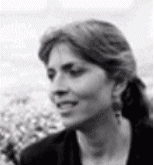
Rachel Tzvia Back
Rachel Tzvia Back, born in 1960 in Buffalo NY, is the 7th generation of her family in Palestine. Her grandfather left Palestine in the 1920s, looking for the “golden medina” on America’s shores — in the 1980s, Back returned to Israel, to make her home here. She studied at Yale, Temple and Hebrew University in Jerusalem, where she wrote her PhD dissertation on post-modern American poetry.
Her collection of poetry entitled Azimuth was published in 2001 by Sheep Meadow Press – a Hebrew version of this collection was published in 2000 by Kibbutz Hameuchad Press (translated into Hebrew by Aharon Shabtai). A new chapbook entitled The Buffalo Poems , a collection which records the heart-breaking cycle of violence and loss defining Israeli and Palestinian lives these last years, was recently published by Duration Press. In addition, Rachel Tzvia Back’s poetry has appeared in numerous journals in America and abroad, including The American Poetry Review,Sulfur, Bridges, Tikkun and Modern Poetry in Translation, and in several anthologies including the Suny Press Anthology Dreaming the Actual: Contemporary Fiction and Poetry by Israeli Women Writers. In 1996 she was a recipient of the Israeli Absorption Minister’s award for Immigrant writers, which included a grant to have her collection of poetry translated into Hebrew. Her own translations of Hebrew poetry into English have appeared in various volumes, including the Feminist Press anthology The Defiant Muse: Hebrew Feminist Poems From Antiquity to the Present and in the recently published biography of Lea Goldberg entitled About Lea. Back’s critical work Led by Language: the Poetry and Poetics of Susan Howe was published in January 2002 by The University of Alabama Pess, in their Contemporary and Modern Poetics Series.
In February 2002, Rachel Tzvia Back participated in a reading series of Israeli poets presenting their work in America. The series, entitled “Poetry of a Punished Land,” hosted Meir Weisletier, Aharon Shabtai, Taha Muhammed Ali, Peter Cole and Back at various venues, including Wesleyan University and Princeton. She was also guest writer at Rutgers, Hofstra, Makor (NY), University of Alabama, and NYU and, in February 2003, she was scholar-in-residence at Cabrini College, Philadelphia, as part of their globalization project.
Rachel Tzvia Back works as senior lecturer at Oranim College, Haifa, and in the MA Writing Program at Bar-Ilan University. She resides in a small village in the Galilee with her life-partner and their three children.
Peter Cole wrote of Azimuth: “With grace and gravity, with a gentle, quiet tenacity, Rachel Tzvia Back brings the poetics of indeterminacy to bear on Israel’s over-determined landscape. Her verse hurts as the land itself has been hurt: its rippling music is delicate and achieved, its evocation of intimacy stunning. As political as it is personal, Azimuth shows us, again, how history and linguistic horizons meet, and who we are or might be before them.”
On the Ruins of Palestine
7
I live on the ruins of Palestine
Slow to speech thick
of tongue quick
in anger ancient
parched
fear
In the ruins on a land
through a night
ignited
By a single
singed vision
and another
single spark
Cradled close in a charred palm
chiseled in a stonedream
carried across history
Through the dark beneath our bare
feet
Strangers all
On the ruins of Palestine
8
Saplings on the hillside
first to burn
Most slender most eager and frailest
hope
Eastern straw winds
sweep flames across our
dislodged doorstep
Into a spoken first-fire
first-command:
Take of the water of the river, pour it
upon the dry land; and the water
which you take out of the river shall
become blood.
The bush unconsumed all-
consuming my child
hot with fever
cannot hold his head up
to see
fires
beneath his bed
room window (wandering
white buffalo
frozen in flamelight
behind our clenched eyes –
imagined marker
of near-by
water)
“Blessed is she
who in her lifetime has seen
the most water”
Who has seen has not seen
blessed is she
9 (a middle-eastern fable and nursery rhyme)
The children were missing limbs
In the southern sand region they
were missing:
a leg a foot an arm
I sent my northern children out looking
The moon was full the paths were white
night
was smooth just the ripple
of my children’s high voices
skipping stones in the dry wadis:
Hunter horn berry and bird,
hunter horn berry and fish.
Hunter clover nut and bird,
Whisper a secret, make a wish.
Daniel led the way said
he was unafraid and held
his brother’s hand
Beneath an olive tree they stopped
to eat treats I had packed and to play
echoes and acorns
Hunter horn berry and bird,
Tell me, child, what have you heard?
The sky at sunset is redder than red
And buffalo-robes will be your bed.
In the southern sand region
under starched white sheets
the children reached
for missing legs that ached
and called to them
to leave the fevered body behind
Hide and seek in buffalo-clover,
You’ll wake up, child, when the hunt is over.
Hunter horn berry and bird,
Tell me no more of what you have heard.
My children went looking for
limbs the other children would no longer need
My beautiful children came back
flushed
empty-handed
10
when we no longer care
who or how many
are dead
our own
running through sprinklers
in the still
ablaze
afternoon
when we are too weary
too hot too bored
to read even
one more name or
that day’s favorite
tale:
two teenage daughters dead in a day
two bodies on two stretchers
their mother
fallen upon them her mouth
mangled open
in agony
as she strokes their lovely long legs
now covered in flags
one more bomb
in a season of many
when we cannot remember the name
of the smallest baby girl
carried through narrowstreets
amid crowds of mourners
curled in her father’s arms she is
tiny
slightest bundle
of cloth bread wild
flowers
in her father’s arms
carried to the graveyard to the crumbling
edge of driest dirt
in a season of stray
bullets
noone claims someone
aimed
when we count our days
by which bloody “incident”
killed whose children
in what village or city
while we travel
to work
and back home
and we no longer care
so long as our own
can still run through sprinklers
in the late-afternoon
blazing
heat
15 (April invasion)
What stands between us
impenetrable
Lumbered from distances
ice-crystals still in hooves
Tracks tars tanks
rumbling where starred
Roads made ragged ribbed
chests bared ammunition
Residue on hearts inside
beating
Horns of bone cannon metal
covered in dust down
Dirt paths blind blind alleys
demolished walls
Reveal eyes all I
can see crushed cinder-blocks
Concrete cement and stone
hearts beating
Beating dark fur red rugs
still draped by gaping holes
Herd a heap heard the whole
loss lost
To bodies left in the rain
rot in the sun
Will no one cover console
carry them away
They are evidence
of what was
Here home school street
what has
Obscured the beloved’s face
I hear a heart
whose
voice like my own
is asking:
How fast can you bury your dead?
16
What stands between us
a girl
Her hair black long
her eyes
Lovely.
This is not suicide
she says
in the grainy video-taped
interview This is
Sacrifice
Selfless spirit to sustain
Hope Kill
as many as she
can this beautiful human
bomb I’ve been told
How the Buffalo stepped forward
during the time of famine
Worship
its selflessness they say
with explosive belt strapped
around her belly she looked
Pregnant
she looked lumbering larger
than one self
in a moment the moment before
deafening stops up time
and space with nails bolts glass
splinters what is left is
mangled
metal blood flesh
to be scraped off the street
collected in sandwich bags
so the whole the whole
can be buried
whole:
Howl!
O gates; Cry, O City!
The whole
of Palestina
art dissolved into tears
of mourning.
