“The ear makes its own temple of hearing in the soul.”—Rilke
_______
Pamela’s work is available at:
Wings Press
Flume Press
alleo.it
raintaxi
_______
Email [email protected]
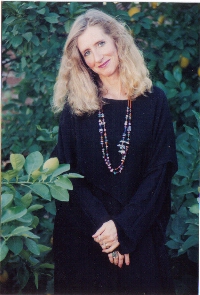 Pamela Uschuk
Blood Flower: A Chapbook
A Siberian Cold Front Takes Over the Last Week of April
Siberia, I do not need your clouds today,
impaling me like a fork in a cheek.
Not that you don’t feel free to crowd my life with ancestors,
memories of bear paws and shrill white distances
cracking the civilized seams of my brain.
Today, Siberia, my head aches with your steel humidity,
cold as a slug’s mucous skirts,
slick as the stone pipe of a shamanka.
I’d like to refuse your telegram.
I am not the she-bear taken as wife by a man.
I will not give birth to the bear boy hero
who’ll save the tribe.
Take back your message
to the grandmothers who poke at the ashes
of my end-of-the-century thoughts.
Tell them to pack their travois of Arctic wind
and haul away the dull gray blades of these clouds.
Hurry on. Skip my generation of stars.
At the lip of spring
chapped by your kisses,
the numb thud of your heart stunning wisteria, tulips,
the bulging red buds of peonies,
time is short.
I fall daily in love with impossibilities- –
the screech owl flying in front of the new moon,
the rufous hummingbird who puffs his throat
like a lung of electric carnelian
through the window,
the man shaped like a grizzly bear
but I know that
just as I feel my womb contract
troops are massing on the other side of the globe
for another war
too quick for even their long talons to stop.
Red Menace
for my family
Now I know why teachers refused
to pronounce my name.
They knew.
In their very simplest syllables,
they knew—
Jones, Pierce, Drew—
Russian rides roughshod,
a Tartar horseman across
the tongue, dances
tranced as the bear
Siberian shamen become.
Too many consonants befuddle,
breed fear in the ear
of the English-speaking host.
Even our alphabet’s a schism
intoned by Orthodox priests
with long white beards, half-pagan,
signing their backward cross.
It’s in our blood, high
cheekbones, unbobbed noses,
the only ones
in our small Midwest town—little Ruskies!
Teachers and classmates called us
Commies for a joke,
so I learned
“Wait till we take over the world!”
For that, I was deported
to the empty hall
or the principal with shaved eyebrows.
What was a Commie to me?
A bear painted red, sickle
on his forehead, missiles
pointed at America’s vulnerable heart
where I, too, lived?
My father farmed like the Germans
who surrounded us, like the Swedes
down the road and the English
who owned most of those
flat Michigan fields.
“Foreigner. Half-wild.” they said,
when down the runaway road
my father ran after our mad bull, Ike,
then grabbed the lead rope.
With a punch solid
between the bellowing eyes,
father stunned Ike docile.
Just what they feared.
When they painted Red, Commie Bastard
on my father’s machines,
it hurt us all.
An Air Corps hero
who fought in both theatres
of the Second World War,
this man who refused to sign
McCarthy’s loyalty oath
taught us to salute the flag.
In school, they tried—
I give them that—
to take the Russian
out of my head.
But my cheekbones knew
and my tongue’s Cyrillic rhythms
and my heart
with its rebellious beat.
Movies were the final straw—
films clicking like locusts
through the afternoon
doze of history class, listing
the dangers of becoming a Red.
Your family would be stoned, your father
locked up, your mother
sent to die in a psychiatric ward.
Every time, the children shamed.
At the sorry end of the show, Commie kids
stood alone, orphaned
with the Star Spangled Banner
snapping over their heads.
I was no Red, no Commie
but I loved borscht, Tolstoy
and the Bolshoi ballet,
adored the Slavic way
Grandma rolled her r’s,
her Oriental eyes
and Indian face.
After all these years
it’s clear what it was
those teachers couldn’t name—
not just the consonants
but the roots,
the skin drums,
feathers hung
from the horse’s manes,
the gypsy gait
of the troika over snow,
icon candles
dripping and thick,
the longing for the sky
wide above the Steppes.
I forgive them, forgive them all.
They didn’t think but to accuse
what is oldest in us.
I give them back
their colonial history
and Republican votes,
their medium-range words against fear.
They will never learn
to pronounce our allegiance
to what survives,
a wilderness of passion
thicker than the veneer of a few hundred years
charging our blood
red and free.
The Horseman of the Crass and Vulnerable Word
For J.H.
The Hemlock loses the Tanager,
a bright blood streak
in a whirling gauze of snow.
Where do we go?
You told me the eye was lose,
old lens in a dish of milk
going to blue-veined cheese,
a lens that sneezed
when you laughed the mockingbird’s laugh,
the horse’s white laugh,
saying your brother accidentally
shot it out as you crawled
under barb wire, hunting.
I was young and fell in love
with your wounds, your tongue,
half-song, half-glands,
strong as the Calvinist hands
that whacked and fed your swampy youth.
I was young and drank Vermouth
while you fell to your knees
in the Ford’s back seat where you teased
until I laughed too much
when you begged please,
and your one-eyed touch
stared up at the night jar sky,
blinked at Orion, your
archer, saying good-bye.
I laughed but I feared your tongue,
your thighs. I was young.
I had heard.
Never love a poet at his word.
You were the man who could maim me
in those days when whiskey
clarified any dark thing.
Like Bobby and Annette we’d sing,
Baby, you’re my beach blanket;
I’m your Mickey Mouse coquette.
You knew my crippled heart, my blind side
but I’d ride ride
on that edge where the heart’s not given,
can’t be taken
or lost to an archer or poet with one eye.
Oh, the heart has a spongy hide
believing in love’s bromide.
Mine found its bed unmade, undone
when you left with your joking tongue.
But I tell you this now,
horseman of the crass and vulnerable word,
love is damp as a cloud-blown beach
and crawls in your bones
that never lose their ache.
When I dreamed your face- –
so blindly polite, just the glimpse
of a lens of a face, just before
the horse, the dark and slippery horse I rode
so far out to sea
that the shore was a crumb the gulls couldn’t eat- –
I went numb in my sleep.
Even numbness passes.
I am half-blind in this half-blind night
but I’ve learned to ferment
wine from ash.
And you, its always late- –
you’ve broken your horse,
now lie under it.
With Its Toll of Char
after hearing Ted Hughes read
All sounds bassoon in haze.
Trees stretch shoulder deep
in fog breathing up from the slow river,
where the courting of frogs booms
under the moon’s waning halo.
To vague stars turning over sky, black limbs
hold up their devotion of autumn leaves.
Inside midnight’s sleeve
the architecture of imagination slips
from its routine mooring
in an earthquake of dreams, and the car
jars you awake
as I skid to miss the fox
sniffing its mate dead on the freeway.
What shapes irony? Coming home
late from the City after the Laureate’s story
of the fox-faced man who peeked at him from the kitchen door,
then placed his charred hands over his poems,
I start at the overwhelming red tail
as it brushes the rushing bumper.
This fox is real.
It’s dangerous, you say, to swerve
for animals caught on the ice.
Event becomes myth. How
often we drift, safe in our faith
something will get us home alive,
though we risk everything.
Night gathers details we forget.
What it says comes true.
In fog, frogs never give up their insistent courting
and stars chart careful courses to dawn.
In the unkempt church of desire,
sometimes we pray for flame
that becomes its own fuel
charging the heart with its toll of char.
That fox must have watched his mate cross the pavement
like a stream parting their known woods
in the nightly routine of their hunt.
What he couldn’t name split her side, flipping her once
as he snapped at the monstrous shape
even as it was swallowed wholly by dark.
The fox might have started sooner
from my oncoming car, but he stood
taking in her scent a last time
that commonplace night
none of us could any longer take for granted
as his red fur ignited, guard hairs
flaming spikes.
Red Cat Near Old Snow
- “I used what was left of a burned matchstick and wrote on a bar of soap in my cell. I would read it and read it until it was committed to memory. Then with one washing of my hands it would be gone.”
—Irina Ratushinskaya, Soviet dissident poet
In the milk-shuttered light of knowing
what’s to come, of being
what’s passed before,
snow’s shorn close to ice, fire sinks in the stove.
No breezed branches,
just locks and the cat, red tabby,
its white patches passing like snow.
In sun, he rubs
against my calf,
dreams his claws
in a warbler’s throat.
Under river ice, the slow current fingers stones,
silt puffing like clams blowing,
takes carp and their common cargo of gold
despised by the sportsman’s line,
to riversmeet, then to the sea
washing blood from the City’s shores.
Each March, runoff is the tyrant that collapses bridges
wherever it goes.
Spring is the dream of the self
split by the Dogwood bud,
ruby Tag Alders that peel back to green,
to the fragile white petal of desire.
You are a moon inside bars,
a new Cerulean Warbler in the cat’s moon eyes.
The old country seduces
but matchsticks char my plans.
What begins the wren?
How does the bear end?
The soap is hard, holds
passion frothing in ash.
How chapped those hands!
Under ice, the river blows
the old husk of Dogwood to silt.
And the cat, from shadow
to shadow, washes prey
from its chameleon coat.
Brewing Borscht
I cube chunks of slick beef,
slippery meat I toss to the werewolves in the pan
where garlic shimmies and steams
in rosemary, fresh feathery dill.
The beets are crisp, green
stalks held high, a bouquet I deliver
like Marie Antoinette’s stiff collars
to the chopping block.
Oh, to palm the red cabbage head
the way my grandmother must have cupped
my infant skull while she laughed,
so wrinkled she dubbed me Prune,
her honey girl. I am
in her kitchen again, lemon
with white sills and an enormous stove
where she cooked borscht,
vareniki, peroghi, apple
fritters, rich duck blood soup,
where she learned to share food
with the wolves of sorrow
the heartsick afternoon
her handsome husband took his life,
fragrant suicide in her oven.
I am making borscht today
absurd though it is in desert heat
to steam the heart of my kitchen
with this savory soup of memories.
Somewhere outside Prague, my great-grandmother
unfurls her auburn mane,
purrs, half-closes her almond eyes
after stirring the flame
under the smoky pot where she’s chopped
roots from her winter cellar—
carrots, beets, then
the shank of spring lamb that mouthed
their tender leaves. When
I cut beets, the platelets of centuries
flow from their concentric rings
staining my hands.
I marvel at how we fit like Matryoshka dolls
inside each other’s lives – – Grandma, Great-grandmother,
and me brewing borscht thick as mating musk
to heal all grief, to wake
this house from fitful dreams.
Blood Flower
- If I were taken beyond the ocean, into Paradise and forbidden to write, I would refuse the ocean and Paradise.
—Marina Tsvetayeva, Russian poet
Tonight I should be dancing with my best friend
in some monsoon-humid Tucson bar,
swinging my hips to memories old
as the diamond pictographs of stars.
Instead I read your poems, holding desire’s profane
name like an icon blistering my hands—
your eyes are black as ice
smearing the vast spruce forests of the Siberian taiga
you were banished to. About to ask,
your lips fade to ghosts. What stubborn metal
melted to tears around your feet?
It’s quiet but for crickets in this desert studio
far from the sulfur racket grinding the city.
Did you have music at least, a piano
or stray balalaika to buffer your exile?
That silence must have tasted liked rusted tin
and roared like a wolverine so starved
it could not gnaw through
grief’s thick walls.
Did one friend come to breathe laughter
into the mausoleum of your room? To punish
you who dared write out a woman’s hunger, Stalin
stole every last ruble, denied you
even bread. You who called
love a flower watered with blood,
were abandoned by every lover.
Marina, the three syllables of your name knock
hollow as a necklace of bird bones.
You were alone except
for your forbidden poems scratched
on paper scraps beneath your bed, verse
clandestine as passion burning through
the aging whorls of your skin.
There wasn’t even a river
to sing to you—just stallion memories
stampeding your blood until longing
silted your veins and choked
the last images you would compose.
How could you survive such amputations—
your husband shot as an enemy of the state,
one daughter starved in a Moscow orphanage,
the other daughter, then your sister
turned to ash in concentration camps?
With nothing left but the hollow flower of your blood
you bent into the noose.
Now in the arroyo, your tree,
a mountain ash, dances
beneath the healing wheel of stars, and I
offer these words as scissors to cut you down
from history’s cruel rafters and loose
your forgotten tongue.
Autumn Eclipse
Even behind the slush of clouds
you know the moon is full.
Your heart is a familiar well
the world falls through.
No wind sweeps night
but walnut fronds drop
like snapped wings.
You remember a fondness
for sunny stumps,
the lonely smell of lightning-felled trees,
a clearing in the woods
where you picked Bergamot
and Forget-Me-Nots
that wilted before dusk.
Everything is going fine,
no hitches, just middle age.
Now, bear and swan disappear
in the sad amphitheater of sky
and what you hear is the swamp
attended by a gushing flume.
You might mistake a shadow
for a Bittern, its head
thrown back, camouflaged
by upthrust reeds.
Everything is a quick ghost,
even your feet, kicking
through memory, unbidden leaves
falling from dreams,
the still-green stalks of lilies
gone to seed, raspberry
bramble, cranberry bog,
lamb’s tongue, goldenrod,
slabs of wet blue slate, back
to the glaciated land
you grew up with.
Then you see again
the sudden owl, eyes
red spears, wings
on fire, trailing sparks
into the dry woods
the day you became a woman.
Bloody coals blew to flame.
You can feel the moon,
the shadow of your own earth
pulling across its broad silver.
Even tree frogs cease
their harmonic thrum
while geese oboe south
through the echoing sky
until there is nothing
but the empty cover
of your skin, softening.
More manic in this silence,
the flume bursts its course
and you laugh at the mechanics of fate,
the way, no matter how far you travel,
you always come back to this —
the world swallowed gradually by dark,
its dramatic recovery of light.
Faith
for Regina de Cormier
I
Some nights everything hangs
from the hooks of faith,
even the moon, old
hatchetface, cheesy blade
flat as a gravedigger’s shovel.
You are every woman who writes
against silence so huge
your heart is volatile as gasoline
at desert noon that explodes
every ring of language
conceived by your blood.
You’re alone so often
that the keys of your typewriter knock
like an engine about to throw a rod,
and every image is a broken tooth
cutting your mouth or
an arm that hugs your stomach warm
in a dream of your present
you had as a child.
II
Once in a bad time, my friend advised,
“your work is your angel.”
Sometimes the heart is that angel
stepping from Dante’s flames.
“I must go on with my burning,”
it cries as its crepe wings char.
Woman, you compose poems
stealing fire from the sun
held hostage by some invisible coast
until the flame-blue pony of imagination bolts
and hauls grief from your bones.
Outside of connections and literary parties, you
compose in your heart, where
poured steel and honey conjure song.
III
Some days sky fades to the color of axes
and abused aluminum pots
as it drags its fingernails across the roof
and nothing appears
in the mail but debts.
You watch smoke seep from your fingertips
as dusk takes your last cigarette.
It is then you’re plagued by the fly,
its fat black leg ripped
from last summer’s moon as it buzzes your studio.
Greasy glutton of windowsills, it
sticks to your hair, bumps
your forehead with its inevitable thud.
And you wonder at this discordant singer
with its thousand-paned eyes,
its ultrahuman sight,
lyric thief, sweat monger,
emerald common as bread,
a quivering brooch even the poor,
whose lives you chronicle, can afford.
IV
Today, playing with Oscar,
the tiger-striped puppy, I understand
what real poets learn.
Over and over, he fetches the ball,
tooth-pocked and dripping spit.
His delight is total,
faith inexhaustible as
he drops the ball at my feet.
Grinning above his black lips,
his eyes dilate into gold flames
until I throw it, and he spins
across the lawn, all electric leap,
then snaps it up in his white teeth
to offer the prize for another toss.
I love his wide laughter,
his unquenchable desire.
It isn’t the ball
but the language singing between
my hand and his mouth
that consumes him.
It is new for him every time.
Every time this unabashed communion
of infinite familiarity and variety
ending in joy.
V
A blue map of the world is pinned
like a window to my studio wall.
On it I see where friends, scattered
across the continent, write.
On the opposite coast, snow
breaks from Montreal
to the city, breaks over you
who have such a hard time staying warm.
I know how it will drive
its fists into your heart,
blasting its buds.
So I send this poem, a char
to shatter weather and distance
for all women who write
against the silent ear of the world,
a charm of blood and memory
to break the blade of tonight’s moon.
Faith is simple as dreams.
Regina, your one sure power is language
that feeds all need.
I close my eyes and hear
your songs magnify the lunar tide,
oldest of sisters,
that muses just beyond my door.
ACKNOWLEDGMENTS:
Another Chicago Magazine: “The Horseman Of The Crass And Vulnerable Word”
Calyx: “Brewing Borscht”
Commonweal: “Red Cat Near Old Snow”
Iris: “Faith” (Iris Poetry Prize, UVA)
Parnassus Review Of Poetry: “Red Menace” and “A Siberian Cold Front Takes Over The Last Week Of April”
Pequod: “With Its Toll Of Char”
Bridges: Poets of the Hudson Valley, ed. David Appelbaum and Regina de Cormier: “With Its Toll Of Char” and “Autumn Eclipse”
Russian-American Poetry Anthology, ed. Anya Krugovoy Silver: “A Siberian Cold Front Takes Over the Last Week of April” and “Red Menace”
