More poems and contributor notes inChinese feature
_______
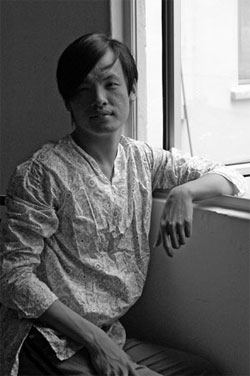
Cyril Wong
The Object Of Loss
My toenails are stunned bald again.
I cradle a mess of milkycrescents
in my palm, then empty it out the window,
wondering where the windwould
take them. Fallen strands of my hair
stand out against the white ofthe floor,
the morning I thought my sideburns
had grown too long. A new tooth
burrowed out of a corner of my mouth,
which I later had removed.
The friendly dentist returned it to me
in a plastic cachet I kept inmy wallet
and forgot all about it, not knowing
what to do with what was once
a part of me. Later, the anesthetic
wore off, and like any loss Iwas made
to bear — that long wait for the ache
to end. The year I fellin love with you
was the same year your mother died.
We sat in the first pew watchingthe priest
pray for her soul, while I prayed too
that I would always make youhappy.
I imagine that when we die, the body
spirals like a top in slowmotion,
disintegrating into uncountable atoms
that fly out from the momentum
in every possible direction, lodged
back into the earth or scatteredwildly
across pages of air, other people left
to wonderwhere the wind will take them.
Anxius
“Other seed fell among the thorns, and the thorns came up
andchoked it, and it yielded no crop.” — Matthew 13:7
Blame the self, blame you — few do both.
You are the room I flee with the door flying shut behind me. If I comeback, it is from exhaustion, not regret.
Inevitable how my mother lost me in the middle of a sentence about ahappy life, amidst ‘marriage’ and ‘the Christian faith’.
Beware the taxi-driver with his color-printed pamphlets about God andThe Way. Two miracles, he claimed, in a life without miracles, when luckvisits the unlucky at any time, and eventually.
Beware the evangelist whose mind is buried like a bookmark between thepages.
The mind must be an interminable rush of clouds, the occasional goodweather.
Walls are you. Any loss of light is also you.
Takes time to accept this is how I find you. Only this or inside a houseon fire do you regain my full attention.
Nothing stopped Mother Teresa, not a broken collarbone, not two heartattacks.
Isn’t it like you to prefer the gift not given with great emotion, butwith great discomfort — the act of kindness no kindness to us.
Happy the atheist that buys the poor man a meal, no thought of yourkingdom in her head.
Let’s return to that chair, the dark room encircling it like asuspicious dog, your whip drawing my body to its reaches, followed by aslow, nearly tender settling of the self, that moment when the bodyrediscovers sensation — so this is why I let you do this, this iswhy you did not heed my cry and stop…
Let’s talk about endings. Some I ask for, some you inflict upon me. (Notsome. Most.)
You arrived stomping upon the void’s wide roof, proclaiming ownership,spinning out the world on the loom of your laws, laws you had in you allalong without question.
When did you first perceive the need for your pale shadows, childrenborn thirsty for your light?
Is the cliché then true, that the point of conflict was to charge thelight with meaning — not just hope, but also reward?
Or is the mystery not a mystery after all, that you arrived withoutreason, like a seed with its singular purpose — purest want —needing us to fail and keep failing in the light of your originalsuccess?
I kneel to respect you, the you in the altar, the sculptural cross, theyou that hangs in the air for as long as incense can hold a church inits atmosphere.
The stories contradict not just each other (Jesus healed two blind menafter Jericho, according to Matthew; Mark claims it was only one), butalso themselves (“Not be judge, lest you be judged,” as opposed to “ , ,, judge the twelve tribes of Israel,” in Matthew’s account).
I enter your house, a spy committing the sign with a finger kissed bywater.
Already, altar boys send a frisson down a thigh; clenched eyes upon thebrink of something spiritual, my head bobbing under the cloak (“hard andrough” as Simone Weil described of the test for what is real).
My throat is lined with weeds. If it sounds like I am choking, you arewrong.
I am back in a room that has given up its light. The chair is you. And Iam also you. At last, I admit this.
This also means you are a fool and full of holes.
Admit this is not going anywhere. Admit you never meant for any of us totriumph.
I Didn’t Expect To Write About Sex
Did you know that after I came, I imagined my pelvis had emptied out
into a dark cave you could crawl into, lay yourself down and fillmy body
with your sleep? This isn’t really about sex, is it? Yet Icould write
about your tongue, how cleverly you rotated it like akey to slip
open every lock of resistance under my skin, musclesloosening
like a hundred doors creeping open across theconservative,
suburban town of this flesh, desire stepping into theopen like Meryl
Streep in that film with Clint Eastwood, a windcalling forth the stiff body
from under her dress so wholeheartedlyhow could she not help but
undress, welcome it in. I could alsowrite about your hands, tenacious
dogs of your fingertipsunearthing pleasure from every pore, jumpstarting
nipples with theflick of your nails, each time you pushed in deeper
from behind. Imust not forget to write how much I love you when you
warn me notto swallow; I love how I take you anyway into my mouth
like tugginga recalcitrant child back into the house, even though he
realizesdeep inside himself that he would always long for home;
I love howyou taste, what was inside of you now inside of me, sliding down
mythroat like the sweetest secret. I could write about how when you fell
off the peak of your mounting hunger, your hands stayed anchored
upon my nape, as if to keep from drowning, as if to let me know,
“Even when I’m this far gone, I’d want you here. I’d want youwith me.”
