Anachronistic Night’s Dreampoems
SubterraneanVerities
_______
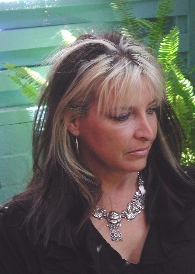
Photo of Gail Wronsky by Gary Goldstein [email protected]
_______
For more poetry
One Woman’s Jonesing for Wonder
By
 Gail Wronsky
I want to dye the world red for aday. I want to read the nonpoems of a gray parrot, the nunpoems of thesecret, underground sisters of the night, the gleeful jerkings off ofthe crazy gay men with wild beards who haunt the freeway offramps of VanNuys. Dye me, die me, lie to me, lie with me, words, swords, wharves,scarves—see it can be endless, all mind-phucking rosie-colored andsquawk-mouthed if only we lissen, listen, hasten, and piss on what’sgiven . . .
I love poetry. I even love the language poets but why do they so often put me tosleep? Because staring at a page is not at all like staring at apainting, or watching dance, or listening to music, no matter howfervently we wish it were. Words go to a different part of the brain. A part ruled by logos, where meanings are nattered out even when we tryto escape them—even when our souls are horny and want only what issensuous. And so, even Gertie Stein is boring sometimes. Repetition,repetition, repetition that’s simply not as viscerally pleasurable aslooking at, say, Warhol’s “Cow Wallpaper,” or listening to a piece byPhillip Glass. The brain will want to know what the language, in itsessence nominative, is naming. And Wittgenstein, the other hero of manybrainy contemporary poets, well, in the end he’s just a bit tooinaccessible to be widely of use. I mean you can’t read the TractatusLogico Philosophicus, which is beautiful and dense like a poem, withoutreading what comes before, without reading his PhilosophicalInvestigations, in German if possible. You’re just not getting it. You’re getting maybe a whiff. And even if you do get it, getting itdoesn’t guarantee that your poems won’t be so obtuse, irrelevant,cryptic, wink-wink, masturbatory, insider—which is to say so dull as todie quietly inside some utterly unread journal with which the scabroussurvivors of nuclear holocaust might some day bandage their blisters. Okay, that’ll probably happen to all of our writing . . . all but what’spublished online in the light and ether of this glorious neither/norland.
Thus assuming wewant to escape the romantic contours of the poetry of loss and sex sobeautifully limned in the seventies by Kinnell and Co., their poems thesoundtrack to which so many of us fell in love again and again and whichis now so dated, we look elsewhere. And although we deeply admire thecontemporary intellectual force brought to the page by people like JorieGraham and Joshua Clover (it saves us all from looking likehearts-on-sleeves), we find that postmodern poetry, much of which Iregard as faux—the work of scholars posing as real poets— doesn’t feedour more primitive hungers. And although we admire, too, even love,even translate, the urgency and significance of testimonio poetry, whenwe try to write it we feel perhaps a little disingenuous—we still feelourselves slamming our shoulders against the walls of our unrealprisons, including the one which North American poetry incessantlybecomes. What do we do? How do we find that space/time where pleasure,pain, the brain, the world, the word, and the self dissolve?
Two-three years ago, I looked for itin art, art-talk, art theory. I looked for it in the shape of a prosepoem. I looked for it underground where the Surrealists lie—their coybedsheets draping like ivory curtains in a dream, their bones full ofsky, their cups lined with fur and vanity. And I wrote the“Subterranean Verities” poems, which appeared here in The Drunken Boat.
And then I moved mywriting space from a musty, condemned cabin in Lower Fernwood, TopangaCanyon, California, where I live, to an airy shed-with-windows high on ahill above the Theatricum Botanicum in another part of the canyon. Irent the space from Ellen Geer, a brilliant actress and director,daughter of Will Geer who bought the land and opened the Theatricumduring the McCarthy Era so that blacklisted writers, directors, andactors, like himself, would have a space to work in while they couldn’twork in the film or television industries. It’s gorgeous here, full oflive oaks and rose bushes. Woody Guthrie built himself a little houseon the property and lived here for awhile, and signed his name in aconcrete staircase I see every day, which gives me unaccountabledelight. Every summer Ellen produces a theatrical season with a fairlyclassical repertory—Shakespeare and Aeschylus, Lillian Hellman, ArthurMiller. But every year because of the enchanted-forest setting of theplace, regardless of what else is scheduled, she produces A MidsummerNight’s Dream. Other things go on there too, so now when I write Isometimes hear actors rehearsing, or sounds from the children’sShakespeare camp, or from sword-fighting lessons, or from Peter Alsop’speace gatherings. The words and music float up in fragments or simplyserve as a rhythmic murmuring background to my working.
After moving, when I got back towork on “Subterranean Verities,” I found that my surroundings,among other things, were changing the poems. I began to hear Meret, thecharacter I’d based very loosely on Meret Oppenheim (fur-lined teacup),as Titania and Motherwell, based on Robert Motherwell (black balls andphalluses on white), as Oberon. I turned Calixto, based on no one inparticular, into Bottom. I added Puck, and then some of the othercharacters from the play—Hippolyta, Moonshine, Hermia, Lysander. Puck,always for me a figure of black magic and deception—a potential evilspirit as well as mischievous—neither hermaphrodite nor androgyne butquite possibly a symbol of “genital disorder” (as is the dollin the poem “Being, Having, and Lacking)”introduced aninteresting darkness. A flipside to what could have been read as aflippant midsummer.
Theshapes of the poems seemed to be not quite right anymore. Earlier I’dworked in prose poem form to emphasize the synthetic-genre aspect of thework (that they are poems which have characters in a non-linearnarrative which also engages theory of art, drama, and language). Asthe space around me expanded, I began to crave more space and want it onmy pages. I wanted the poems to resemble sculpture, one of the artforms I address in them. I wanted words to float up off the page andsurround readers the way that bits of plays were floating up andsurrounding me as I worked. So I began writing the poems of“Anachronistic Night’s Dream.”
I’ve kept Surrealism as inspirationand frame of reference; it is simply iconic for me—no getting around it. For me Surreality is the true turf of poetry—the space where thingsturn into other things, where language creates meaning, new meanings, bycelebrating accident, randomness, whimsy, and wonder, where dreams aretaken as literal reality, where a pair of gloves becomes an unfigurableand totally captivating object, where the logos is always outwitted andundermined. I like thinking of Meret Oppenheim as an immortal, as afairy queen. And Oberon is larger, more powerful, more magestic andmagical than Motherwell was. Bottom, I think, interestingly replacesCalixto as the lover—the third party in the dramatic triangle. Hebecomes Larry Fortensky to Titania’s Liz Taylor. Or Oliver Mellors, thegamekeeper, to her Lady Chatterly. Even without the magic spell, in mypoems there are times when Titania really desires him. I suppose shedoes in the play, too, though Shakespeare protects her social positionand pride with the device of the nectar dripped on her sleeping eyelids.
Engaging Shakespeare inthis way, inviting him to dance with Bunuel, with Breton, with Toyon,with Oppenheim, has been deeply pleasurable. I hope the poems are, atthe very least, not boring. I want them to resonate sensually anduncannily, to have political significance (as feminist,anti-authoritarian, anarchist), and to pay homage to artistic polish,beauty, and intellectual respectability. None of us would be doing whatwe do had it not been for Gertrude Stein. (The thing I like best abouther, frankly, is that she didn’t become famous until she was sixty.) But let’s also remember that she often referred to the people who readher work not as readers, or audience, but as “buyers.” Avant-garde Modernism has its faults. As does any artistic movement. As do my own poems. Finally, I suppose, one can’t dye the world red fora day, or make it read for a day. But one can invent strategies forfinding wonderfulness—even through the awfulness which sometimes has tobe confronted—and one can, armed with inspiration and the constraintsof art, through language, attempt to satisfy our deeply neglected needfor the strange, for the fabulous, for the bewildering, for theunsettling, for the revels of the mind.
Gail Wronsky is the author of Poems for Infidels (Red Hen Press), Dying for Beauty (Copper Canyon Press), The Love-talkers (a novel, Hollyridge Press) and other books. She is the translator of Volando Bajito, a book of poems by Argentinean poet Alicia Partnoy. Her poems have appeared in journals and anthologies including Poets Against the War, A Chorus for Peace, The Poet’s Child, Pool, Volt, and Runes. The recipient of a California Artists Fellowship, she is Director of Creative Writing and Syntext at Loyola Marymount University in Los Angeles.
