
Melanie Braverman
Photo Credit: Dan Alder
_______
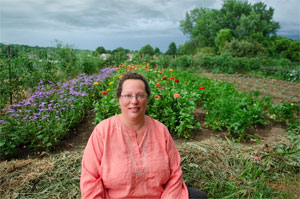
Melanie Braverman
Twelvepoems from The World With Us In It
All daywe’ve been waiting for the wind to come, the rain or snow to begin so we canstop waiting. All day I’ve watched the boats come in, their riggings lashedagainst the wind. The outsidestairs are swaying like grasses, wind filling the treads with air. I have my scissors, my tape, my handinessbut it is difficult to remember how to do things. Soon this belly of mine, thiscup, this bell will be full.
We have a fire in the grate all day, the sky a monochromatic panto the cruise ship that has pulled into harbor for the day to be out of thewind. Hulking on the horizon thatboat looks lonely out there. Weweren’t on its agenda, I think, there have been no happy throngs of peoplepouring down the gangplank to look in the windows of our shops. There has been no sun, wind thrashingleaves from the trees as if to bypass fall altogether, cutting right fromTechnicolor to black and white without so much as a backward glance, aget-ready, a good-bye. Mollypulled the chairs off the deck while I went to the store for food, buyingthings that would fill our bellies and keep us drowsy and not anxious: beans for soup, collard greens,meat. All of a sudden the blue andred kayaks tied up outside look as if someone abandoned them here, the gullsfloating backward on an updraft along the sullen beach. The papers today described soldierswho, two weeks into the current war, are already so weary of waiting to seewhat will happen they’d rather just get it over with and fight, which meansthey are ready to die. I listenedto a writer last night speak of the importance of leading a “dedicated life”. I thought of her when I read aboutthose soldiers, and I wondered if they knew what it was they were dedicatingtheir lives to, righteousness or their own impatience, because they are young,and they cannot imagine a life made up of waiting. Adulthood, if there is such a state, seems to be organizedaround the acceptance that there are things we can’t know: when will the peopleget off that boat and come ashore, and what will they bring with them, and willthey stay.
Can you believe this? LifeI mean, velvet curtainsand beneath them scrim to let the sun in when it comes, trying to imaginesummer with our noses so cold, black ducks, eiders, buffleheads split at thecrown with white, snow at low tide, the sky far away now, dusk replacingafternoon after we have spent the morning speaking our separate languages,phonetic, pictographic, at a loss falling finally into bed, hands and mouth andeyes transcribing one for the other after which it doesn’t matter that we stoodseparate again in our own countries, flags snapping at our heads. Agreement resides in the body, line ofstomach on white sheets, her clavicle mid-morning, one hand stroking my thighlightly as a woman sighing which I do each time she moves her hand, indexfinger, middle finger, thumb the ritual listing reaching into the longafternoon of snow.
It must be the fog causing me toworry about the state of my memory slipping in and out the way the tide engulfsthe stairs to the beach and recedes. I catalog my daily chores: replace hardware, do laundry, stackwood the way everything seems to feel, lone trawler at work in the bay. We keep the fire all day when we’rehere, breaking periodically to go to work, to buy food. I cook. I take care of things. Can we have a tree inside all year, she says. Why not,I say, laughing.
. . .as ifmaking love at the water’s edge, the ghost a handful of sand sloughing us cleanuntil I thought I’d get pregnant for sure, not until much later rememberingthat what made this impossible was the fact that we’re both women. Oh, that. So what was the ghost there for, what was it trying to give us? What didit want from us, feeding on love, hungry for it.
I am in an old house, amansion; I am wandering around in it trying to find my way. I come to an enormous kitchen withpolished wood counters the size of a dance hall, a ballroom, and as I enter Inotice that every drawer and cabinet is open, scores of them ajar at exactlythe same distance and I think, This is the proof of ghosts people talk aboutwanting but never get. And I’vegotten it. And now I know. Walking past my own window, startled by my reflection in the glass thisis me and this is me and this is mecarrying a white blanket between rooms, scaring myself. For days my love and I dance throughour own little house together, rubbing against one another like cats. Morning of fog, what is visible closeas childhood, the voice of my mother rolling in on it like a specter though shelives, her breath sure on the other end of the phone, Did you get thepackage, the pearls I sent? Lifting now, the grey horizonseparating itself from the water, same grey and not same, white stairs liftingaway at their funny angle, my view, a jug of unseasonable tulips at the glass. Spent the day un-boxing my things,setting them in place, arguing with a friend about a woman we know whom shejudges for being attached to her diamonds because they seem too meaningful toher. Who’s to say what we loveand why, I argued, saythe diamonds were from a grandmother, haunted by war and surviving in the giftof a ring to her child, surely this would be something different. To which my friend replied, But they’re not. Hard the way my friend can be hard, and shiny even on days without sun. I am waiting for the pearls my motherhas sent, the fog everywhere. I ambeginning to love my house. Isthere evil in the world, I don’t know. What are the ghosts here for, are they benevolent, no, they are neutral,bumping up against us, as we inhabit, more deeply, this house. You know, I said, I’m just tired of judgingwhat people love; that they do at all seems like enough for now. You’ve got a point, my friend said.
The trawler has slipped intothe fog as if injected, as our friends described their insemination Howathletic, to conceive a child that way, I thought, the fog is sexual, not clinical, and if she could just once god makeme pregnant, just oncethe child I want floating toward us like that boat out there visible on thehorizon but further away than we imagined.
Every fewdays we find another bird dead in the wrack, neck broken in the waves, aneider’s breast flashing white in the glare, a gull’s spanned wing arrayed toshow how majestic it really is. Was. Wind! Molly said, “If I could punch the wind,I would.” I dream of people I used to know and walk my dog when I get up. Leaving the house is like pushingagainst will. The part of ourbeach with no building on it receives the brunt of the tide’s wash, as if thepetulance of the human world cannot bear to let it sit empty: tires, bottles, timber, sails,fishnets, buoys, shoes. That spotdrives my poor dog wild as the men who sleep their drunks off curled inoverturned dinghies beneath the town pier. The pier itself will not stand in such a wind.
What hadseemed infinite feels limited now; though I cannot yet see the end of the line Ican feel it coming, the way midway through a long train ride one feels thedestination though the car has yet to slow. So history appeared in my dream last night, a thousand birdsand whales along the shore “so thick you can walk across their backs,”something I heard about this bay when the first white people came, though Ibelieve they were referring to cod then. I woke up thinking, It’s the future now, there outside my window, boats still atit but less fruitful in their trawling.
I was wandering a houseagain, this one vast with enormous rooms full of elaborate beds and huge, tiledbathrooms. I was new to the housebut I lived there, perched on a rocky promontory above the ocean in whichthrongs of sea animals tossed in the waves: seals, dolphins, killer whales. A dream of riches, but I couldn’t tell if they were mine ornot.
Mollypasses her hand across her face to erase whatever dreams have been depositedthere. Mostly she doesn’tremember, letting my chatter fill the space in which she might be able to, mylife with her like a flower that seems exotic in the field but turns out tohave been growing there all along: poppy, lupine, mallow. Whenshe turns to me, so be it, I’m happy.
