Also, in this issue, Alison’s poetry andtranslations of Rainer Maria Rilke
_______
Alison has a new chapbook Mnemosyne available from Wild Honey Press
_______
Alison’s website
_______
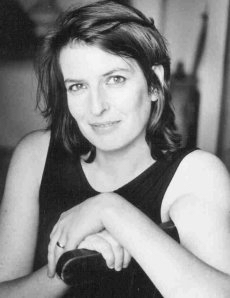
Photo of Alison Croggon by Jacqueline Mitelman 2002. All rights reserved.
“The Pleasures of Poetry” was first presented at the National Word Festival, Canberra, April 23, 1997.
“Speculations on the poetic” was first presented at the National Word Festival, Canberra, March 1995.
Alison Croggon: Two Essays on Poetics and the Erotic
Speculations on the poetic
— Charles Baudelaire
1
To begin at the beginning.
Who is the poet?
Firstly, the poet is a fiction. The poet has nothing to do with the quotidian self who bears children,buys the milk, scrubs the cupboards, yells at her partner and forgets to do the tax return.
That person is irrelevant to literature, although it might appear that the poet writes about nothing else.Allen Ginsberg’s “Kaddish” is not a great poem because it tells us about his mother, his homosexuality,the Diaspora, his childhood, madness or loss. If he wished merely to confess these things, he couldmore easily have written a diary. But he didn’t: he wrote a poem, and a poem obeys other, less easilydefined imperatives.
The conflation of the quotidian self with the poet is the beginning of the death of understanding.Poetry is not therapy, nor autobiography, nor documentation, nor politics, nor a theoretical arena:although of course it may disuise itself as all these things.
The poet is the self who writes poetry. The link between the poet and the quotidian self is the body.The difference is poetry. Although one is not the other, it is impossible to separate them. Neither ofthese putative selves have anything to do, yet, with the idea of a reader.
The quotidian self is of minor interest and is nobody’s business except the poet’s. I should like toconfine my speculations to poetry and the body.
2
First, a glance at the poetic.
The poetic is the embarrassment of contemporary thinking because, no matter what cultural hygienistsdo, it stinks of a metaphysics. Since Plato, philosophers have continually plundered poetry, whileproclaiming their rational superiority over those “liars”, poets. The contemporary proliferation oftheory, and its bid to wrest the crown of poiesis from poetry, might be read as the symptom of a giantpanic: for the destruction of truth means that philosophers have lost their traditional argument forsuperiority over poets. But, as Rimbaud might have said, theory is too slow. Guiseppe Ungarettianticipated Derrida by half a century, summing up differánce in a poem of two lines:
Between this flower picked and the other given
the inexpressible nothingness.
Poets have been as eager to thrust poiesis at the theoreticians as theory has been eager to take it:perhaps similarly to how the Incas initially welcomed the Conquistadors as gods. “Contemporary”positions on “poetics” are colonised positions, where poets touch their forelocks to their theoreticalmasters, forgetting that it was poets who gave them their ideas in the first place. And that is their fault.Theoreticians do not possess the swords of the Conquistadors. On the other hand, poets are entitled touse what tools they like, and theory gives us some useful springboards. We would be as foolish toignore it as to take it seriously.
3
And what is this poetic, which disagreeably refuses to die despite the best efforts of mediocre poetsand timorous thinkers? Perhaps one should talk of love, a word which has been also abused. Let uspick these poor, soiled rags off the floor and see if body can be breathed back into them.
. . . I urge you . . .
. . . taking . . .
the lyre, while desire again . . .
wings around you
It requires a barbaric exercise in enchantment: but poetry is a barbarous activity, persisted in by foolsand children. The Romans named the Barbarians so because their languages sounded to them like –baa baa.
Baa baa black sheep ….
Rhythm is the first sign of the poetic.
4
Rhythm is the signal that language is produced by the human body and links us to the world outsideour skin.
RHYTHM. A perceived pattern of repetition in time. The term has wide reference, from the cycles ofthe seasons to the pulse of an atomic clock. As applied to language,“rhythm” refers to a timing whichis not exact, but rather fluent, like that of the heartbeat, breathing and walking.
Prosody, the formal regulation of rhythm, stems from the Greek word meaning words sung to musicand governs breath and tone. Rhythm reaches into and out of the body: it is both analogous andliteral. It shapes the movement of the eye over the page, the emotional, intellectual and physical beingof a poem.
Rhythm is carnal. It gives us the immediate, unrepeatable present of language. This carnality,combined with poetry’s encounter with otherness, is the source of the eroticism of the poetic.
5
Poetry does not forget the etymological link between veneration and venereal. Despite itsdebasement, the desire for the poetic persists. Subliminally alert to its subversive possibilities, cultureturns a primping face and sells the poetic, deodorised and neatly plucked, to a dwindling populationdesensitised by a promiscuous mania for explanation. This degradation of the poetic to the banal,commonly remarked on as a result of two decades of creative writing courses or seven decades ofacademisation, can be seen as a symptom of prurience, as Madonna is of puritanical America: theasexuality which, in adopting the forms of erotic activity, eviscerates them of their powers to appal, tohorrify, to compel reverence or delight. The poetic, like sexuality, is rendered safe, containable,explicable, easily commodified: it is disincarnated and so removed from either authentic pleasure orgenuine pain. We live in the era of the fake – or perhaps the theoretical – orgasm.
6
According to Herodotus, the god Eros was the third born in the world, after the Earth and the Sky.Eros is almost exclusively represented by the Greeks as a child.
The child as a dimension of the erotic has been forgotten or perverted: Georges Batailles for instance,otherwise hardly a typical thinker, places childbirth and child rearing in the anerotic arena of work.
The child is the immeasurable, irretrievable risk of love, incarnated. Its anarchic challenge to hygieneopens the possibility of the world to us, outside our conditioned reflexes: are faeces so filthy? is urineso disgusting? is the breast, engorged with milk, so distasteful? is nakedness as exclusively genital aswe are led to believe? and is this unorderedness, or, perhaps, this unculturated response to carnalstimuli, as opposed to aesthetic pleasure as is conventionally thought? Or is it, perhaps, betterconsidered as the (to be sure) unevolved origin of authentic sensation – that is, aesthetics?
Too literal an analogy between the child and the poem is not tenable without trivialising both. But Iwish to retrieve for the erotic, and thus for the poetic, the unanaesthetised reality of birth. We oftenhear of the place of death in the erotic but the spectrum cannot be whole unless we include beginningsas well as endings, the opening of possibility as well as its closure. We must remember that in itsperpetual destruction and restoration of language, its serious play and playful seriousness, itsfoolishness and fragility, its derangement of dualities and smashing of unities, in its acceptance andimplicit rejection, finally, of mortality and finitude, poetry is a making of love.
How do we restore the wholeness of our desires? We must firstly imagine the cunt with more claritythan as“a hole with indeterminate borders” and the cock more fully than as a defining phallic pen tostick in the hole. We must remember the child, the ambiguity and mystery of our fertility. Eroticismmust be liberated from its desolate obsession with copulating genitals and embrace, not only thewhole of our bodies, but of our experience and being in the world.
But does this not return us to the hovering banality of the quotidian self and banish us from thedomain of literary imagination?
7
What, then, of form?
The true subject of the poem is a life that recovers its form – a finitude that becomes limitless.
This might function as a definition of beauty. We are used to thinking of beauty as a limitation, aseries of ideals, or stereotypes, which art, confined by its historicity, assimilates and perpetuates. Butis this in fact the case? Might not the terror of beauty lie in the fact that everything is beautiful: thatbeauty is not a matter of idealisation, but of attention?
Perhaps, to use a Lacanian model, beauty is the chaotic self, the chaotic body, the chaotic world:fragmentary, diffuse, unassigned to meaning. One might think of consciously defined form as anarmoured aesthetic, the integrated self aggressively defending itself against the chaos within andwithout it. Against this consciousness, art then is a means, not of containing chaos, but of releasing it,of shattering the pre-existing aesthetic/self and simultaneously remaking it. All true art contains theterror of obliteration, which lies at the core of beauty. It admits the reality of death, of human finitudeand failure, it admits that the world is not us and that we do not control it. This admission is love: thevoluntary renunciation of self-tyranny, the ascension to the place of ordinary beauty, which redeemsnothing.
8
In poetry, or any art, it is impossible to talk of form and content as if they are two separate qualities.But most discussion about art, and much art, implicitly makes this distinction.
A formless poem is an oxymoron. Formality is the proper realm of the poetic imagination: those whothink of form in terms of a narrow set of conventions from which poetry must be“liberated” or withinwhich poetry is defined are refusing the necessity of its limitless possibilities. A poem is not a vesselfrom which a subject can be poured out, any more than the human body is a container for the soul.
Poetry is“about” nothing except itself.
For poetry makes nothing happen; it survives
In the valley of its making where executives
Would never want to tamper, flows on south
From ranches of isolation and the busy griefs,
Raw towns that we believe and die in; it survives,
A way of happening, a mouth.
The fact that poetry has no justification is a sore trouble to many people and is why it is so often askedto be something else. One of its most essential qualities, as Hans Magnus Enzensberger points out, isthe freedom not to read it. Poetry, that most severe of disciplines, is about nothing if not freedom:even from itself.
It can matter only on its own terms, which are radically without use. If it incorporates the terms ofother agendas, they must be secondary to the imperatives of the poetic. Poetry requires the courage tobelieve in nothing except the infinite possibilities of the poetic.
9
All poetry depends from the impossible.
The actual, the present, the now are the only things that matter in poems: and they are everything thatis not in poetry. Love is presence attending to the present. Poetry is a confession of love’s absence,where the self is nourished by its own effacement. How often are the words “I love you” a despairingadmission of emptiness? What are most of our lives but a series of still births, aborted moments? Andwho has a heart vast enough to encompass these failures in our selves and our language?
Yet poetry, if it does not recall something like faith in our broken language, is not poetry at all. Itsdemand is that we are constantly reborn; and such nakedness requires a courage that invites us,continuously, to failure. “For us,” as Eliot said, “there is only the trying. The rest is not our business.”
The Pleasures of Poetry
In her work The Life of Poetry, Muriel Rukeyser says that poetry is, above all, an approach to the truthof feeling. Poetry for Rukeyser is a meeting place where meanings may be found and extendedthrough their relationships with one another, a dynamic place in which consciousness finds a way toexpress its complex relationships to the world. She talks of the necessity of this expression, and of theresistances, personal, political and social, that mitigate against it. Feelings, as we all know, are notnecessarily pleasurable. Even the most joyous of perceptions carries beneath it its shadow. As Rilkesaid when someone suggested that he undergo psychoanalysis to free him of his demons, “If I get ridof my demons, I may lose my angels as well.”
Pleasure releases us into the fullness of possibility, and sometimes those possibilities are dangerousor frightening or painful. I associate the pleasures of poetry with those of erotic love, although ofcourse they are not the same. But in poetry I find the humility, the pain, the delicacy, the mortality, thespiritual challenge, the desire for truth, the violence, the sensuality, that are exchanged in erotic love.There is a painting by Bruegel called The Triumph of Death which expresses something of what I feelis the significance of this. The painting, which looks enormous, is almost wholly a nightmarelandscape where armies of skeletons are completing their conquest of life, torturing, killing, layingwaste. The horror is unrelieved except in the bottom right hand corner, where two lovers are sitting ona tiny patch of green. They are playing the lute and a book is open before them. Their backs are turnedon death. It is an ambiguous image, for of course they cannot escape it. But they alone in the paintingare not defeated by death. Their humanity, in its beauty and absurdly poignant futility, is stubbornlywhole and alive, thrown into relief by the defeat that they will not acknowledge. For there are manykinds of death, and some of them are not physical. It is this pleasure, this profound, difficult,courageous pleasure, that I find in poetry.
In discussing erotic pleasure, the Mexican poet Octavio Paz says: “Modernity desacralised the body,and advertising has used it as a marketing tool…. Sade had dreamed of a society with weak laws andstrong passions, where the only right would be the right to pleasure, however cruel and lethal it mightbe. No one ever imagined that commercial dealings would supplant libertine philosophy and thatpleasure would be transformed into an industrial machine…” The reduction of Eros to the service ofMammon, and its subsequent banishment to the realm of the material, is the basis of Paz’s anguishwith the 20th century. Never before has the idea of pleasure so impoverished the human spirit. Sexualpermissiveness has turned us into slaves of sexuality, negating the freedom it was supposed toherald. Against this, Paz holds up the idea of love: it is, he says, the only way that we might reforgeour spiritual strength, our fidelity to human profundity. Implicitly, for Paz also makes the linkbetween poetry and erotic love, poetry is a means by which we may resacralise our lives.
It is impossible to escape the fact that poetry is, by its nature, to do with the unseen, that is, withthings that in material terms do not exist. It is a secular act that is, nevertheless, inhabited by god.Poetry is the invention of gods, secular gods, that we call meanings. The meanings are the truth of ourfeelings, which are, in the context of our social and political realities, futile and absurd. In a world asdisembowelled as ours is by its dominant material reality, in which god, whether Islam, Christian,Capitalist, Hindu or Buddhist, is almost always a synonym for brutal power, it seems to me thatpoetry’s impotence, its futility, becomes a site of radical disputation of the idea of power. The potencyof poetry lies in its abrogation of power, in its direct communication to feelings that are ours and thatwe deny at great cost to ourselves and those around us. It is, as Les Murray says, a way of speakingwholly. It is a language that marries the profane and the sacred, feeling and intellect, Eros andThanatos, that fuses a fragmentary self into a single complex, multifarious voice. It offers, as lovedoes, the full pleasure of being.
2. 9, Sappho, Sappho’s Lyre: Archaic Lyric and Women Poets ofAncient Greece, trans. Diane Raynor, University of California Press,1991.
3. “Rhythm, Form and Metre”, Seven Centuries of Poetry in English,third edition, ed. John Leonard, OUP 1994.
4. Differánce, Jacques Derrida, 1968.
5. p 133, The Act and the Place of Poetry, Yves Bonnefoy.
6. “In Memory of W.B. Yeats,” Collected Shorter Poems 1927-1957, W.HAuden, Faber and Faber 1966.
7. “A Modest Proposal”, Mediocrity and Delusion, Hans MagnusEnzensberger, trans. Martin Chalmers, Verso 1992.
8. Four Quartets, T.S. Eliot, Faber and Faber 1976.
