
Sealey’s poemsin this issue
_______
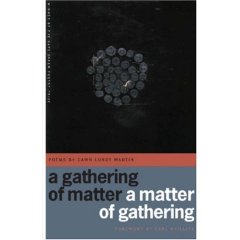
A Gathering of Matter/A Matter of Gathering
Reviewed by Nicole Sealey
Dawn Lundy Martin
The University of Georgia Press
ISBN-10: 0820329916
ISBN-13: 978-0820329918
Just as the great American folklorist Zora Neale Hurstonencouraged readers—through her mother’s words—to “jump at the sun,”so does poet Dawn Lundy Martin urge in A Gathering of Matter/A Matter ofGathering. It is the leap, not necessarilythe landing, that forces risk and invention. Martin has taken such a leap and,in the process, invented new ways in which to engage and experience language. AGathering of Matter is an ambitious debutbook of poems that does not consult with convention, but rather vehementlyargues with it. And, there is something very elegant, ugly, honest, unpleasantand right-minded about Martin’s reasoning.
In the poem “Mirror, Mirror,” Martin writes of a girl wholiterally jumped towards the sun, or what she believed it to be. The girl paidno attention to the sun’s distance, vastness and intense heat; instead, shetook a risk, a bold leap only to find that the object to which she leapt wasimaginary. Before she dismissed the sun’s greatness, however, the girl twirledhopelessly in circles trying to see herself. Martin writes,
Beforethen.
Stigma Etched. What the water cannot drench orsalvage. Had it been
here before this descending form, this wretched girl,spun in a desperate
attempt to see her own face?
The playful, yet daunting, irony of the girl’s pursuit ofdelusion and that which appears to be within reach describes—by way ofexaggeration, metaphor and symbolism—the self-awareness and esteem thateludes many.
Martin’s crisp and peculiar word choices in “Mirror, Mirror”and other poems in A Gathering of Matterare not accidental or surficial. Martin does not coddle—she coaxes. Thereis no easy entry into the collection. Readers must throw themselves into eachpoem, cross their fingers, and hope for the best. The “best” is feeling as comfortable and complete aspossible in a comfortless and completely (and beautifully) mutilated body ofwork. In “After the Death of aYoung Poet,” Martin writes,
Blood shed and wasted. Blood resonating, a sting.Found them in a puddle
of it. Positioned as if they had beenplanted—had placed themselves—so
that the puddle made a pond for them to lie in.
Much like the blood to which she refers, Martin’s poetryresonates and stings, and like the lifeless bodies that found their position inthe pool of blood, so will readers discover their place amid her authenticallyferocious voice.
As it should be, no subject—or methods to discussthem—is off limits. Martin does not minimize, romanticize or sanitize,she unmistakably plays with sensitive issues and the ways in which societytreats those issues in an attempt to redefine them. Her writing is absolutelybewitching. Chaotic, but tranquil in its truth, Martin’s approach to death anddying, race and racism, personhood (womanhood in particular) and other topicsare thorough in their treatment and guileless in their presentation. In “AfterDrowning,” for example, Martin writes:
What ismumbled after the act? I—Uh. After the craving empties.
Whenviscosity permeates a life before. Magenta. And, falling there,
throughsound, through tape, a voice ghostly, saying blackly, I bleed.
This iswhat it takes. I hear it now. Know it. There was once a time
whenthe bridge ended and the girl leapt. There was once a singing
somewhere.
It is no wonder A Gathering of Matter was awarded the 2006 Cave Canem Poetry Prize by CarlPhillips. Dawn Lundy Martin, as Phillips notes in the book’s foreword, “existswithin literary traditions, even as she pushes those traditions further, viaher decidedly original, arresting, no-holds-barred vision.” With ingeniousforms that will test the patience of the most delicate reader of poetry, hersis a persuasive, alternative vision void of pretension and artificiality. Theauthority with which Martin writes will astound readers and reviewers alike; and,by the looks of A Gathering of Matter/A Matter of Gathering, we can expect many more surprises from thispromising poet.
(Originally published in the Spring2008 issue of Mosaic).
Nicole Sealey is a writer, editor, and poet. Her interviewswith acclaimed writers Sapphire and Nikki Giovanni can be found in Artistsand Influence: Volume XXV and Mosaic literary magazine, respectively. In May 2008, shewas selected to participate in the 13th annual Minority Writers Seminar inNashville, Tennessee. She is the Readings/Workshops and Writers ExchangeProgram Coordinator at Poets & Writers, Inc. and a Cave Canem fellow whosepoems have appeared in a number of print and online journals. She lives in NewYork City.
