These pages are best viewed in Firefox or Safari; Internet Explorer does not properly reproduce the Arabic characters
_______
Adrian’s Introduction to Maltese poetry
_______
More poetry from Malta
_______
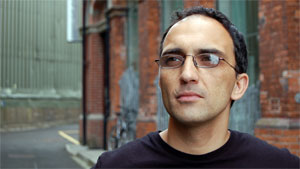
Adrian Grima
Translated by Maria Grech Ganado
Seas swimming in your eyes
Samwel, 2 1/2 years, Żejtun Beach
You always want to walk beside the sea,
observe the depths, the blue from everywhere
and you persist in jumping above the edge,
although you’re old enough to have known fear.
A lover wishing to tease, with stone in hand
you look to see where it will sink, after it flies.
You long like it to meet the sea’s beginning,
to walk bewitched, seas swimming in your eyes.
The tremulous water has now usurped the moon,
distance and silence no longer keep you content.
There’s an entire sea splashing its waves around you,
and now new depths and swish of stones torment.
As Another Voice in this Confusion
There’s all my guilt piled up on top of me
in the middle of the street before my wounded home.
My hands wait at my side
they are heavy, uselessly bare.
Already, in the middle of the street
that blackness slices through my breath
and I’m aware of lots of faces staring to see what I will do.
Instead of waiting for the silence to spread slowly inside me like expired sedation,
or collapsing, jacket and all,
in the abandoned corridor smeared by this black curse;
instead of passing my limp fingers
over the tortured veins of the door panel
languishing on the ramp of our garage;
instead of wandering from room to room
pausing, in each one,
to grasp thoughts of the children and the woman I love, sleeping,
suddenly fleeing from the ferocious fog,
growing confused by the hatred inside me;
instead of babbling to myself,
I listen to muted phrases offered by all and sundry,
pretending I know what they’re on about,
understanding what’s going on
while they let on that they believe me, I know. . .
and when out of the blue
amongst so many faces, spaces,
you appear
as yet another voice in the upheaval that is my mind,
and I hear another sequence of details and decisions,
instead of hugging you and blurting out my guilt
I try and hear in your voice the years we’ve lived together
your butterfly hands, your curling hair
and I think I hear the silent break
of love.
Ramallah
for Khaled, Noora, Najeh, Husain and Maher of El-Funoun
who danced in Malta*
١
On the bridge on the river Jordan they humiliate her
they think
and she freezes and turns green and calms down between her teeth
because she needs a stamp from them on a paper on a morning
to dance upon their vacant heads sitting in a stamp
in a stamped room.
Like Noora, beautiful.
A lovely smile like Khaled
piercing,
this firm pressure
in his hands always silent
and keen.
He is telling how they are locked in a cell, standing,
how you pray that you’ll die rather than betray your own
how your broken back bursts in your head and your neck and your back
longs to lie on your back
but where? in a concrete coffin standing upright
for people who smile on their land.
Like you.
He is telling how armies close down halls
where they dance,
that amongst them are steps that could never take to
the rhythm;
he is telling how each dance, each chant, each painted picture
bursts them alive — this, this is life, this wounded dance,
this dark pirouette;
he is telling there is no place for soldiers with stars
and no place for
dictators.
٢
On the bridge on the river Jordan
he smiles a subversive city;
and they shame him more than usual
they think.
But he has a wife at home
and children,
and he carries the story everywhere,
in his eyes, his hands, his skin,
like the taste of olives,
like the scent of mint,
like thyme.
He has a history carefully archived;
a distinctive imprint;
his verbs and nouns interflow like a river,
like cadences and consonants,
like echoes and vowels.
When you wish to, come over, he says,
and I know that now it is also my home.
٣
Noora waits for messages sent by her friends,
and she knows they will see them,
she wants them to read them,
they can’t raise any fear
by spying, outside,
inside, or on top,
who are they? who brought them?
of what use are these emails?
are they forms of amusement?
what churns in their guts while they turn them over
like lifeless chewing gum,
like unsavoury kisses?
These are words without memory,
graphemes with no narrative. . .
And Noora revives
as she thinks of her friends
though the eyes of her spies
are vacant.
٤
Maher spins the girl in the wheelchair
with a laugh in the room lit up by the morning
by the dabke, by the turning of shoes with her friends
in a tightening circle;
And Najeh smiles in the wake of paces of his wife and his children,
of a village remote from the city of
Ramallah, in which they were born, they dance
with his mate Husain at the other end of the circle,
they close, they open every time he raises his hand.
And the centre’s the girl in the wheelchair,
Maher swaying to the beat
and to the girl in her chair and dancing wheels.
٥
You tell me the story of Najeh’s wife,
the waters which burst after curfew that night,
the family voices ignored at the checkpoint,
the fear of damage, the frustrated anger,
the youths with their rifles obeying their superiors
as their superiors obey their superiors in a dark pyramid
of spleen.
You tell me of a night in 2002
afraid, disheartened,
of an adamant life in a spring that’s been wrecked.
You tell me of Yamen, of a labour that’s make-shift,
unstable,
of week after week in an incubator
of a critical state
of months.
٦
And you tell me a story
of a mother embroidering
on the porch of her home;
and the shots that came raining
without their explaining
and the distracted dance
of her daughter in trance
and her mother embroidered by guns.
“No pretence. No apology. No explanation.”
٧
When you dance you look up at an opening sky;
you turn like a siren alight in an echoing night;
you defy the vacant eyes flitting through your Inbox.
Because your steps are mischievous,
taunting darkness and limits.
٨
Everytime she crosses the bridge on the river
she expects to find unguarded events
waiting to be burst.
Because there’s a vacant night on the bridge,
and a birth announced in a stubborn ambulance.
There’s a dabke alight in a shattered cell,
a hold, already silent and bold;
there’s a soldier primed and a dance rehearsed;
and as soon as she crosses there’s a stage installed
and a packed hall.
*Two of these stories were told by Omar Barghouti of El-Funoun in “Dancing Tragedies and Dreams” (The Daily Star, Lebanon, Wednesday, October 27, 2004)During a rehearsal in spring of 2002, a male dancer of el-Funoun received a telephone call telling him that his pregnant wife was in early labor but all the roads from their village home to the city hospital were blocked by military barricades. He was stuck in Ramallah as his wife was about to give birth a few kilometers away. Feeling totally helpless, he cried. The newborn spent weeks in an incubator, followed by months in critical condition, but survived. The other story is that of one of el-Funoun’s choreographers who was in the middle of creating a dance about a massacre that took place during the nakba when she was interrupted by news of her mother’s death. The mother had been shot repeatedly by an Israeli soldier while she was embroidering on her front porch in Nablus. No pretence. No apology. No explanation.
