
Melissa’s interview with Eleni Sikelianosin a previous issue.
Melissa’s chapbook, Arc in a previous issue.
_______
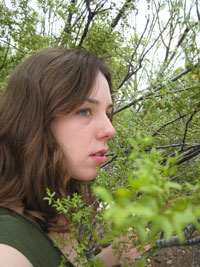
Photo of Melissa Buckheit by Rebecca Seiferle
_______
Six Poems from, Wish For Odysseas

Ioulita Iliopoulou
Translated by Melissa Buckheit
I first began translating the poetry of Ioulita Iliopoulou (ΙΟΥΛΙΤΑ ΗΛΙΟΠΟΥΛΟΥ)from her book, ΕΥΧΗΝ ΟΔΥΣΣΕΙ,of which these translations are a selection, in 1999 when I was anundergraduate, under the study of Olga Broumas at Brandeis University. There, Iwas introduced to ΕΥΧΗΝ ΟΔΥΣΣΕΙ,translated as Wish or Prayer Toward Odysseas, which was written by Iliopoulou and published in 1997, after thedeath of her lover and companion, the Greek Nobel Laureate and poet, OdysseasElytis. I had previously studied Latin, much more extensively French, and verybriefly, Ancient Greek. Independent Studies and later a Fellowship, while I wasat Brandeis, allowed me to learn Modern Greek through immersion in poetrytranslation, perhaps a very different method than most, which favor purelanguage study or an immersion method. I chose translation, supplemented mystudy with grammar textbooks, and I benefited most by working closely andoften, collaboratively, with Olga Broumas, a native Greek from Syros and thelumescent translator of the late Nobel Laureate, Odysseas Elytis, and now, KikiDimoula.
I found learning and speaking Modern Greek this way akin tosuddenly being thrown into a body of water—the music now familiar, now asurprise, the imagery lifted from the Greek landscape, Greek history, culture,national identity, sensibility; my brain filled with the sounds of words andtheir sensibilities I was only beginning to comprehend. In Iliopoulou’s denseand embedded, powerfully emotional yet controlled, and intimately visionarypoetry, I felt a kinship with my own writing, especially in her use of syntax,how etymology echoed in associations with other words and toward otherlanguages. When I first began translating, and her poems began to appear on thepage in English, in the early versions which soon lead to a final poem, hervoice—its fierceness, presence, boldness, subtlety, sensuality anddepth—floored me. The music of her Greek is gorgeous and the greatestchallenge has always been to bring that music along with meaning, as well asthe density of her use of language, which is compounded by the density andefficiency of Greek grammar, as compared to English, in my opinion.
As is necessary to translate a writer from one languageacross to another, you must enter into that writer’s language and world in thesense of being a shadow beside their poems. As a result, you feel they are yourpoems, these translations, when you are done—but of course they are not.The humility of that reality is a welcome relief from the experience of writingone’s own work, which can often become fraught with the presence of thetroublesome self at every step. In this sense, translation is a lovelyoccupation, allowing a sense of play with language, meaning, music andinadvertent collaboration, whether across oceans, great lengths of time orbeyond the grave.
In this brief selection of six poems by Iliopoulou, from WishFor Odysseas, you will receive a slightimpression as to the arc of her book, its movement forward and backward throughtime, beginning with “Angel” which is placed after Elytis’ death, to poems placedin the midst of their relationship far before that event, which emerge in theGreek landscape, recur with specific imagery and are imbued with eros,complexity and a sense of their own history. In the last poem, “Nouni” you’llsee this vital reality merge with the reality of Elytis’ passing. Always,imagery, music and syntax communicate meaning first, as Iliopoulou rarely justmakes statements. Poems avoid cliché, the triteness of black and whitedepictions, to arrive instead at a true complexity of emotional, spiritual andphysical realities, where nothing is ever completely known or can be completelyexpressed.
Like light orbit of bird
And then the sky’s sand leading you
The slight air that passes
Under the sole
In the arch with small drops of cyan
Secretly the summer will be resumed
They were saying. The lips of shells, more thin
Dripping the thick juice
Take it
Into your tongue’s
Incomprehensible consonance
With me
not.
Slowly slips
From the summer
The ship
As of the few words
The resin
In one landscape pliable
Void
You fold day and night into
The bougainvilleas
The young air
Your hands on your chest.
Grass
Cobalt which here they call wave
And rise from it naked to bow in worship
To the Virgin’s stone
At dawn the deepest sleep in the bedrooms
With the bitter orange-trees mid-chest the wind
Of which other earth tears off your skin
With meaning raising small saplings of the sky
Which feed a boundless future to the birds and
Seeds of wheat to the future. It will come
Again from the pebbles during those noons where you saw
The sea move across you a deepest cut.
Let eros make you as the bees make spring
Citizen of an unseen world
Let you not know how to measure intervals of light
Intervals of music
In a fall hopeless as an entreaty
I’m known by all I’ve never known and even
Now people sign on but events betray them
On the page you were writing – pooling inside you moon–
Which you can also call mountain – before anemigration
Thin branches drag the earth
Wide and opening the other palms
Louder more loud the lullaby lights
How beautifully how beautifully you take me!
Nouni the name of the stars in the rains
The sun fits in a lemon’s seed
And the nomad eroses bloom themselves up
Here where you are
not
Winds crosses boats open close
The futures in their one small palm
And the nostalgia of blue in the mouth shhh slow slowly
Gesturing weightless evening which goes
to leave. As ifthe little blades of grass were cold and
Dawn shies in the iris of your eyes tha-
Natos!
