
Email:
[email protected]
_______
Artwork by Gonçalo Ivo
_______
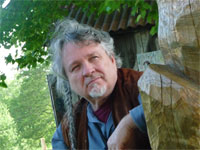
Kerry Shawn Keys’ photo by Andrius Konickis
_______
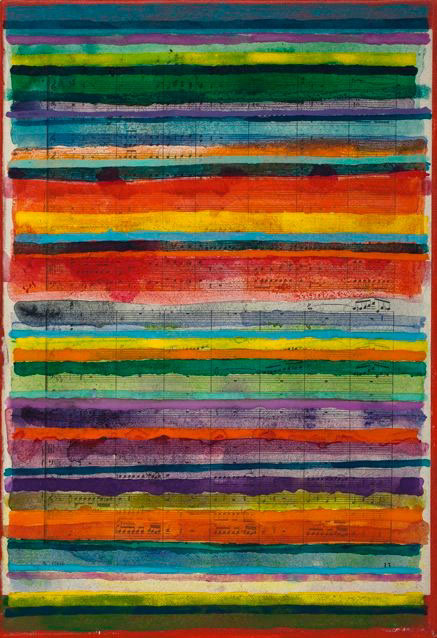
“Requiem”
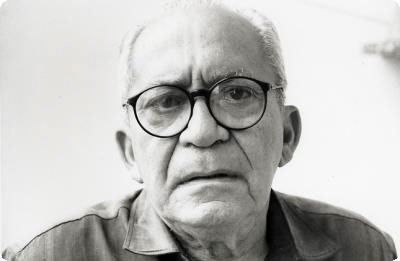
by Lêdo Ivo
Translated by
Kerry Shawn Keys
with José Carlos Dias
Translator’s Note and Introduction
by Kerry Shawn Keys
Lêdo Ivo passed his childhood inMaceió, a port and provincial capital in the Northwest of Brazil. Port andpeninsula. Blue sea steeped with boats and fish, brown earth swimming withsugar and coconuts, and the poet like the crabs that people his poems, alwaysnegotiating these two realms held together by the sun during the day, andstrung together at night by a constellation of sex and stars. And though thiscity in all its backwater seediness, and the surrounding countryside in itstorrid loveliness, are an inseparable part of Ivo’s poetry, it’s only later inhis novel, Snakes’ Nest (NewDirections), that this lushness takes on a social character and a history, acolorful if not religious decadence. The poetry stays personal, and when itstrays, it strays mostly into satire, a satire that lives on loss anddisillusion.
Like so many of his generation, Ivoleft his hometown when nearly twenty to go to Rio de Janeiro. There he workedas a journalist, and continued writing the brilliant and romantic poems that hewas acclaimed for as an adolescent. But he never really shook the dirt off hisprovincial roots. He never wanted to. However, he did shake off much of thesentimental swan’s-down so characteristic of the narrowly regional. Unlike thewealthy, parlor Bolshevik writers of that period, Ivo was rarely seduced by theuniverse of politics or the universal ideas that shunned the hardwood of lifeand community traditions for dialectics at the Sorbonne or Cambridge. For Ivo,the commonplace things around him became the windows and doors, the gates ofhis vision and existential travels. Objects were sacred objects; things werethe stuff of his dreams, the clay in the kiln was shaped by the right hand of anon-existent God and the left hand of man.
Perhaps it was Ivo’s fundamentallyreligious nature that saved him, that sustained him in the huge metropolis ofRio. Though it frightened his critics and the intellectual, urban elite, hispoetry, his incredible verbosity and brilliance, his undeniable gift havefinally distinguished him as Brazil’s most important poet. Ivo managed to slipthrough the excessive formalism of his generation, and was never later seducedby the schools of poetry spawned by the wonderful poet, João Cabral de MeloNeto, or the Concretismo poets of Saõ Paulo who were belatedly worshipping atthe foot of Ezra Pound while at the same time trying to incorporate thepyrotechnics of Apollinaire. Lêdo Ivo, to the contrary, was the student ofMelville and Hawthorne, and later, much to his advantage, William CarlosWilliams. Like Williams, he never exiled his heart from the land of his birth.
When I first met Lêdo Ivo in 1974in Rio de Janeiro, I was a young poet of 28 who had shipped off to Brazil forthe adventure of it, for the samba, for the rainforest, for the beaches, forthe exotic but earthy ambience sensed in the music and especially in the film, BlackOrpheus. I wasn’t disappointed. It tookonly a few months for us to find each other, and I immediately knew that thisman was no ordinary man, that in his nervous exuberance and hospitality, hisendless monologues about poetry and world literature, his enthusiasm forRimbaud, Faulkner, and Williams, there was some kind of battle going on, a veryreal battle with nothing theoretical in it, and the prize would be a shot ateternity. A strange but appropriate prize for a man who disdained his ownschooling, who tried to steer me away from involvement with African-Brazilianceremonies, who claimed that Gods did not exist, but carried on a conversationwith a non-existent God in his poetry, a conversation almost as insistent asCaptain Ahab’s. And the materials of this discourse were not just the languageand the rhetoric of Portuguese of which he is indeed a master, but the verythings around him, the sensual things, the mundane things, the elemental odesof his daily existence. He often spoke of Neruda and Williams, but more of thelatter, and yet I think that he has little in common with them, that thesepoets were more the bast and ballast that kept his own appetite fortranscendence in check, that their example allowed him to turn and bring out ofthe grain of his words so that they wouldn’t disappear into pure sound, thepure nostalgia of a soul lost in the walled-in jungle of Guanabara Bay.
Over the years the power of Ivo’spoetry has not diminished. If anything, his travels in the States and Europe,his long engagement with Edward Hopper and other American realists, hisfamily’s move to a forested area near Rio, his deep involvement with his lovely,now deceased wife, Lêda , and the incredibly tactile paintings of his son, Gonçalo,only strengthened his sensibility, renewed and redefined his love for thetropics, “Minha Terra”, as he calls it, his homeland of images. He still writesthe longer poems, but increasingly, short, pithy aphorisms.
And now suddenly the long poem,“Requiem” (2008), which is in a sense a string of pearls evoking and invokinghis life as a poet, his debts, his testimony, his tropical turf. And indeed,“Requiem” was awarded the Casa de las Americas award in the category oftestimonial works. “Requiem” wasfinished about 2006, and I received a letter along with the typewrittenmanuscript from Lêdo Ivo asking me to translate it. Now I translate mostly fromLithuanian and so I hesitated, not sure if I should tackle such a masterpiece,and then the Warsaw-based, Portuguese publisher and lecturer José Carlos Diascame to my rescue, and we worked on it together for several months while Lêdo played a bit with the text in Portuguese. And the result is this text inEnglish, though the poem that saw the light in Havana may have a few minoralterations, given the poet’s love to tinker.
Lêdo Ivo was born in 1924, and thepoem attempts to encompass that lifetime! His words these last decades have theconfidence of one who has become a classic in his own time, a man who can writeodes for junkyards and dead birds, and sonnets for crabs – sonnets whosefragrance may be a memory, but whose smell is still the sugar and flesh, the“landsend” of salt and water and sky that pass through the gates of hissensibility and that have always been the subject of his poetry and ferociousimagination.
Requiem Here I am, waiting for the silence. Before the rotten shipyard I catch only a glimpse of the flotsam left over from the illumination. Like all leftovers, it bears the mark of things hidden forever or of those interred at the top of the dunes; like the letters branded in fire on the flank of a horse stolen by a gipsy, or abirthmark on a much-beloved hip. Now, night descends for good. My weary gaze follows the canoe moving away from the mangroves. A light in the salt marsh. A crab in the mud. And life evaporates like the souls in a heaven that doesn’t shelter a single god. Every landscape I saw has crumbled into corroded postcards. And a dirty fingernail, dressed in black, takes the place of an ancient hand. The endless doors of the docks that stored braided onions and sacks of sugar shrink in the darkness, reduced to a single door, refractory to the dazzling clarity of daybreak. At the Sand Bar of Saint Miguel, facing the sea, only now I have understood: the longest day of a man lasts less than a bolt of lightning. The hours will no longer be celebrated among the constellations. Sky and earth will disappear in the ashes born out of the coming days and nights stolen by death. And everything I loved, dissolves. The scarlet cloud softly lands between the stucco huts and the wave-torn sea. The time has come to say goodbye to the dark water that roars in the darkness of the lagoon, and to the planetary wind that dries the fish hanging from the poles of the thatched huts, and to the virgin forest descending to the sea along the steep coastline of my lost homeland. Eternity passes like the wind. Only time is eternal. I’ve always been here amid my decimated people, and beyond the dunes my hands made the golden anthropophagical bonfire of the awesome feast. A night of ashes now follows the clamor and the joy. The sea douses all the shipwrecks and every fire quenches itself, the whole golden fire scatters and dies down into the silence of the world. Here, in the water and earth of my continual births, my shadow roams through the wrecks of ships lost or dreamt. And I search in vain the transgressed waters for the chastity of the clear and intact water that emerges fromthe sea at the break of dawn in the heart of the muted night. Oh! gate promised as life’s comfort, after such filth and such splendour! In this final night, the heavenly bonfires burn up all hope and bury in ash the foolish dreams of earthly souls and the death rattle that suppresses any paradise. In the crematory-night, death is a bonfire.
Beyond the cold and heat
and the impetuous cockroaches that spread likepetals
in the abandoned granary
and the funeral bells in the morning ofchildhood
and the swinging lights of the trucks slowlycrossing the cane fields
scaring away the raccoons,
and beyond the baskets open like corollas
in order to collect the remains of the daymutilated by hates and wars,
and far from the fallen nests on the winterground
and the waters of the unyielding rains thatsuddenly disappear
on the great tableof the primordial sea
and the feathery crystal-clear moons that rulethe passage of the mullets,
there is a nowhere which dispenses with beggingand hope
and frightens off solemnity and reverence.
Beyond the dreams visited by the restless sea
and the fetid dark of the cesspool and thesolar clarity
where bewildered we move
like flies made dizzy by the swelter of summer,
a non-space waits for us. The day
crawls in hours that open to the landscape likewindows.
The noise of the world reaches the shore
and encircles the salt flats, the treacherousreefs of shellfish,
and lagoons ofsugar.
Beyond reality, there are other realities
that unfold like rungs. Our steps
climb up and down the ladder in the miserableday,
in the gentle night.
They are like dreams that are tributaries ofother dreams
or open windows to the sea.
We don’t know where we are. We don’t know whatwe are.
We know nothing but the existence of a night
pure and empty, waiting for us. An untouchablenight
beyond fire and ice and any hope.
With its sinister hand, death crushes
our dazzling insect dreams,
and pours the purity of the water inside thevase
as the flower’s fragmented promised disaster.
Death, always death, bugging us
with the buzzing of a funeral fly.
III
I’ve always loved daybreak. The prow of theship,
the clarity that moves forward between thesparse shadows,
the lingering murmur of life in the trainstations.
A bonfire of words breaks out in the square.
A black fjord of a train crosses the city.
Day spills the syllables of the world onto thesidewalks.
I’ve always loved the thunder that tears theafternoon apart,
the rust and the rain, love that ends
and the smoke that rises from screeching tires.
The idiotic days pass like bridges.
Statues fly like birds.
The tightest doors open like lips.
I’ve always loved what passes by: crowdedtaxis,
the whistles of trains, stray clouds
and the leaves dragged by the wind.
Hail punishes the pyramids of death.
The brothel’s door cracks in the sultry weather.
A yellow sunset enfolds the shipyard.
I’ve always loved junk, the form destroyed
by time, rank as a tidal pool.
I’ve always loved the weevil hidden in thesilos.
The din of torrential rain makes the nightclearer
and unfolds between the rocks the beautifulbanners
of a dream accompanying a dismantled sun.
And I’ve always loved the love that is like anartichoke’s,
something that you peel, something thatconceals
a green unpeelable heart.
At the shipyard of Sao Miguel dos Campos
the sea gives back to the sea the claimedspoils
of the lost vertebrae of the ships.
I’ve always loved the thunder that awakensthose who are asleep.
The door of my house is open to thethunderstorm
and to the hours that lose their scales like afish.
I’ve always loved the fog that hides thelandscape,
mannequins, scarecrows, broken mirrors.
I’ve always loved rust, erosion, and junk.
Containers are deposited in ships’ holds likebaskets of flowers.
The line separating land from sea flashes likelightning.
On the immense counter of the world there isdivision and commerce.
I’ve always loved the piers that support thebridges,
ships leaving port, the lighthouses and thehoists.
I’ve always loved the Ocean and the semaphores.
Where the dead live, I will live someday,
in that nowhere place that the fleeting gods
reserved with the ashes, nothing and nobody.
And I’ve always loved snow falling among theplane trees
that hem the Seine, while the boats
pass slowly and white under the bridges.
The clear anthill of clear waters
bursts in the morning under the brilliant
blue sky braced by the birds.
I’ve always loved the mirrors of barbershops,
the flower stands, the newspaper kiosks,
the vegetables in the gondolas of thesupermarkets.
Day is a coin oxidized by chimeras.
And the bridges shake at the passage of thedusty buses
that accomplish the migrations of misery anddeath.
I’ve always loved to listen to the noises ofthe world:
the golden humming of the bee in the dung,
the noisy day and the wandering wind.
The ships whistle. It’s time to leave.
Each closed door is a port to be opened
by the triumphant wind that lacerates theocean.
I’ve always loved the light of the mangled sun
that nests in the mangroves, the fluvial lightof the day
over the dunes that walk the horizon at night.
He who has the key to dreams opens any door.
He who sails sleeping reaches any pier
and on the ships sees the abolition of death.
And I’ve always heard the voice that calls mein the dark,
the voice on the other side, coming from otherworlds
that crumble in the air, licked by the fog.
I’ve always loved this voice which is a novoice,
a whisper of nothing, startled ash,
a grain of sand that rasps on the endlessbeach.
The foliage of the night covers me while Isleep,
shroud of a pure sun always seeking the dark,
murmur of a fountain, white stone of a wall.
And I’ve always loved time and intemperateweather,
the termite that thrives in the nudity ofmatter,
in the pale colonies of the plundered night.
Fortune decided that I would always find myself
when lost, even in a shipwreck
which is always the work of the wind.
I’ve always loved what lives in the black waterof the mangroves.
I’ve always loved what is born. I’ve alwaysloved what dies
when the night collapses over the houses ofmen.
IV
The lights of the airport hurry likeharlequins.
At the railroad crossings, the whistlingfreight trains
carry mannequins to supply our dreams.
And I am the one that departs. And stays. Andflies. And remains.
A beam of a lighthouse divides the universe.
My hand hunts in the dark for a nuptial body.
I lick the secretive salt of the barely openedshells.
The lingering silence between roots and lianas
opens a solar path in an aqueduct.
Sultry weather sustains the clarity.
Day is a shattered lightning bolt.
A shadowy cone eclipses me from myself.
And the day passes like an ant. The days pass
like the breeze in unfurled sails.
The days pass and always bring death.
I say goodbye to myself in the vespertide ofdarkness.
And now the night descends. With it, the lostcause.
My hand no longer touches the beloved’s body.
A dark sun illuminates the night of my soul
but I want the other sun, the great clarity
of the solid day opening like a door.
I only feel complete with my shadow
and the mask of everything I ceased being.
My uninhabitable sun rises in any horizon.
Only to the wind that blows do I trust myamazement.
I need to be exact and impenetrable
so I can be understood by the passing day.
The flight of the falcon accompanies my steps
towards life, towards death,
under the indifference of an imperishable sky.
I see death hidden in a sunbeam:
the remains of the afterglow, the nest of nobird
and abolition of flight over any plateau.
V
Happy are those who depart.
Not the ones who reach the rotten ports.
Happy those who depart and never come back.
For I stay always half way
and my journey remains unfinished.
Happy are those who don’t know the finalstation.
Happy those who disappear in the fog,
those who open windows at dawn,
those who light the lights of the airfields.
Happy are those who cross the bridges
when the afternoon lands among the refinerieslike a bird.
Happy those who possess an inattentive soul.
Happy are those who know that, at the end ofthe passage,
Nothing awaits them, like a scarecrow in a cornfield.
Happy those who only find themselves whenwindborne or lost.
Happy are those who have lived more than onelife.
Happy are those who have lived countless lives.
Happy those who vanish when circuses pull uptheir tents.
Happy those who know that each fountain is asecret.
Happy are those who love storms.
Happy those who dream of illuminated trains.
Happy those who loved bodies and not souls,
who heard the hoot of white owls in the silenceof the night.
Happy are those who found a lost syllable inthe dew of the grass.
Happy those who crossed the obscure night andthe untimely fog,
who saw the crackling fire dancing in the bigbonfires of June,
happy those who watched the sky open like analtar cloth
to welcome theflight of the falcon.
Happy those who live on the outlying islands
and are surrounded at nightfall by a cloud ofleaf-cutter ants.
Happy those who just sat around and then oneday left.
VI
Words follow me like dogs
when I walk among the constellations.
I rise like the day, and I die at nightfall.
I am reborn from myself and to myself I return
with the promise of another dawn.
In the circle of time, I pass on and I stay.
I dawn and grow dark among the galaxies
and between two suns I drink my eternity.
Added or divided, always I multiply myself
when the constellations fly in the sky likebirds
and the truth of the world is stored in thehold of the ships.
I am the wind that blows in Maceió
and the mullet imprisioned in the fishtrap ofthe sea.
Night is a door that closes
when I pass. Day is a shipmaster’s atlas.
Before sleep and the dream, I sip the silenceof the mountains
and cross the border where death is hiding
like a fox in the forest.
Along the way, I’ve always listened to
the endless sea’s murmuring of syllables.
At cold’s eve and at the end of mystery,
I search once again for the rigging of theshipyard
and I can’t even find my own shadow
sucked up by the clouds of the crimson sunset.
The sea advances like a sword.
For this journey I bring nothing
but what’s left of me,
the wreck that verifies my shipwreck.
I walked in the crowd. I listened to the noisesof the world
in the voice of the demagogue, in the boomingreggae, in the cry of the street peddler,
inthe turbines of a jetplane, in the cursing
of the impatientpoor at a bus stop, in the whisper
oflove that clears the darkness,
in the flashing rain.
I talked with the stone and I came to know
its silence and thickness; and a tree of foam
blossomed for me in the brightness of morning.
I watched the wind blow in the lagoons
and circle the misery of the world.
Like a lumberjack, I ended my day and waitedfor night.
Night came and blunted the axe that leanedagainst the wall,
and the woodpile stayed in the shed untiltransformed into fragrant ash.
I saw the lame horse coming down the hill andneigh under the starlight.
I tried to open the door that is always closed.
I crossed the bridges of the big cities
and breathed love, and drank the universe
and saw the sea once more, a fullness like wineand bread.
I saw the lights of Europe lighting up
as night slowly fell.
I was a man among men, a visage among many,
and now I’m alone.
I was always love itself in the unforgettablebed,
and now my wandering hand only finds darkness
where before there was the beloved body.
A mute ocean surrounds me
and it’s white like a shroud.
And the rain falls and washes
the latrines of death.
VII
Sea, drums and hammer, music and salt of life,
huge resounding sea, here I am at your side!
Next to the bridge of the shipyard that creaksabove the waves,
I long for the silence of the fish that crossthe fiery red tentacle
of the coralreefs,
for the chasteness of the moon that rises inthe pale sky and for the vigil of the sea
that invites me tobe eternal,
and for the solitude of the sunken ships
that, in crustacean beds, keep the coins lostin the shipwrecks
and the lollingmew of the seagulls.
Everything I said to the foaming tide and tothe radiant seaweed
was erased by the wind that nestled between thewarehouses
and followed the sudden silence of the rainfalling in the estuary
andmoistening the damaged anchors
ofthe ships that hide in their rusty holds
thecoupled smell of salt
andsugar
and the dark hammering of the waters.
In the shipyard that jibs like a boat
when the dripping branches reach the shoals
where the dreams of men toss in graveyards oflime
and the holy sewers sip the summer rains,
I claim what I’ve lost on the long passage.
Where are the madmen of my childhood,
the madmen that escaped and danced in the asylumdevastated
by the sun?
Where are my ships and the light of thelighthouse?
Next to the waves that die and are reborn,
the eternal return and eternal movement,
once again I call you but you don’t answer.
Now, only in my dreams I see your shadow.
Surely, you have flown like a bird into thedarkness
and you went beyond the sun and the furtivethunder
and the clarity of the water. Like all of thedead
you are now where you are not,
in the nowhere that excludes all hope.
Only death teaches that angels don’t exist.
All that I lost, I lost forever.
VIII
Day falls in love with itself
like a naked body in a mirror.
Time, composition of the water that flows
in a river of rumors and desires.
Loud cry of being! The blush of dawn
in the highest sky, in clouds that are doors
in the glacial flight
far from fear and horror.
And the whiteness of the world, snow and ice
dawning into white sculptures
at a height without vertigo.
Under the dawn-white precipice of the clouds
the earth holds our destitution.
And an insolent death follows the footsteps
of men that walk beneath the sun
toward the supreme night, toward the unrulysea.
We are not in a hurry to die, yet neverthelesswe die
in the hurtling day.
And here I am, placid as the water of thecisterns.
And death is an impatient dawn,
and bursts from the wide open sky
towards the roaring dream of life.
I always lacked wisdom.
Throughout my life, I have learned little,
and now, before the exact and visible ocean,before the great prosodic sea
I know nothing about the passage.
After so many trips, this is the final frontier
that I have to overcome.
The boat without a boatman rocks on the slimywater.
And I am the dark mud full of miasmas
that supports the pile dwellings of misery anddeath.
I only got to know the endless rain
and that wind which drags the wind itself
in the delirious day, in the glowering night.
I watched the tide moving forward in thepeninsula
and the sea coming to meet me like aninvitation,
the feminine sea that fondled my feet.
There is a knowledge that escapes my footsteps
even when I step on the rotten boards of theshipyard
and look into my shadow for the prow of ships.
Time is the lord of truth and of the lie.
I say goodbye to the sultry weather. It’s timefor the arrival
of that migratory bird that only shows up inwinter
and disturbs the sedentary world with itsstrident scream.
Oh clarity, farewell! I bid adieu to the sun,
to the incomparable sea and the untimely night.
I have lived without learning that everythingis loss and passage
and that the breakers erase the names of theships
and take to the offing the rumble of life.
Now the silence of the world seals my soul.
The rosy ray of the rosy sunrise
points to the dark night.
Separated from myself by death,
that shell that doesn’t stow away the noise ofthe sea,
it’s here in the dark mud of the salt marsh
that my long road between two nothings ends.
