In this issue:
Roubaud’s Third Night from Exchanges of Light
Exchanges on Light is forthcoming in March, 2008 from La Presse.
_______
Eleni’s poetry
_______
Melissa’s chapbook Arc
_______
Interview with
Eleni Sikelianos
By
Melissa Buckheit
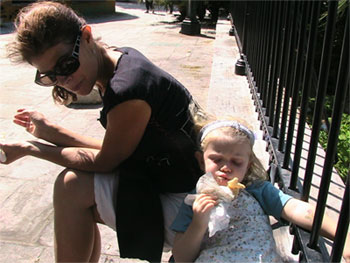
Eleni Sikelianos is the author of one book of nonfiction and five books of poetry, including The California Poem and The Book of Jon.Her poems have been translated into French, Spanish, Catalan, German, Arabic, Romanian, Croatian, Slovenian, and Serbian,and a selected poems (De L’histoire, du soleil, de la vision) appeared in French this fall. Forthcoming in the fall of 2008 is a new book of poems, Body Clock. Sikelianos has translated poems from the Greek and the French, as well as, in with scholars or native-language poets, the Chinese and the Russian. Among the numerous awards she has received for her poetry, nonfiction and translations are a National Endowment for the Arts Award, a Fulbright Arts Fellowship, The National Poetry Series, and a New York Foundation for the Arts Award. Sikelianos received her MFA in 1991 from what was then The Naropa Institute, where she studied with many of the most exuberant living poets of our times. She currently lives in Colorado with the novelist Laird Hunt and their daughter Eva Grace; and she teaches in the Creative Writing Program at the University of Denver.
Melissa Buckheit: Hi, Eleni. I was excited when I saw thatExchanges on Light was slated to be released in fall of 2007. I knew you had been working onthese translations for many years, with earlier versions of some published online, as well. Roubaudis one of my favorite poets, as well as one of yours; it was in one of your classes in graduateschool where I first encountered Roubaud. My first introduction was Quelque chose noir,which came out in 1986, translated into the English by Rosmarie Waldrop as Some Thing Black.A ‘sequel’ to that book was La pluralité des mondes de Lewis, or The Plurality of Worldsof Lewis, also translated by Waldrop. Roubaud has published many other books, particularly hisextremely popular Hortense series (of novels), as well as some historical and mathematical texts.What was your first encounter with Roubaud as a reader, and how was that experience?
Eleni Sikelianos: The first book I read by Roubaud was probably Lapluralité des mondes de Lewis, which came out in 1991. A bit out of sequence, since, as younote, it’s an extension of Some Thing Black. I may have first come across a poem from Lapluralité at Claude Royet-Journoud’s house, maybe in an edition of Claude’s totally lovelymagazine Zuk, but that may be a mis-memory.
The immediate affinity I felt forRoubaud’s work was most certainly due to the marriage between science and lyric that so appeals tome — how science becomes a further force both for understanding and, very powerfully, formystery in the poem.
Melissa Buckheit: Yes, the sense of what is absent or unsaid in poetryvibrates exquisitely with what is unknown in science, what is ‘dark’ in the universe, so to speak.What is the movement between these two other books and Exchanges? The former specificallydeal with the death of his wife, Alix Cleo Roubaud. All three seem to explore, enact and play withideas and theories surrounding existence, experience, perception: light, dark, vision, multipleworlds, energy, the intersection of philosophy and modern science, death/loss, the body, God.Roubaud seems to create a spatial and emotional landscape in the syntax, form and intimacy of hispoetry—one of reality but which also defies the permanency of what we might (think of as) callreality. I always feel like I could reach my hand through a mirror into the space of his world(s).
Eleni Sikelianos: I suppose the clearest connection between those twobooks and this one is the exploration of presence and loss. Communication between bodies,transmutation. Where do bodies go, how do they travel, how is darkness (absence) illuminated? Ifwe want to link these three books, we can see Exchanges as a continuing examination of, in asense, the after-life (both of the body that’s left behind in the presence of a body’s absence, andthe body that has itself disappeared). We can extend the trope of light/dark to animate/inanimatebodies, and to the great mystery of what happens to bodies — bodies of light, and byextension, humans. The living body is illuminated, and it illuminates those around it, the deadbody falls into darkness. How does the movement between these states occur?
Exchanges is also, as you note, an inquiry into the divine (especially by the voices ofBasil de C. and Dennis Ps.), which is of course one of the primary questions that arises whenhumans consider death. The infinite, too, is explored, now in relation to light’s capacity todistribute itself. Although the human factor is not really considered in the text (except in thathuman voices are “speaking” it and it is in some ways a history of human thought), thequestion(s) extend into that big one: what is the human place in the history, present, and futureof a possibly infinite, possibly finite universe?
Melissa Buckheit: What does Exchanges attempt or traverse, thatthese earlier two works do not? Roubaud is a mathematician and has published non-literary work inhis field. Do you feel that Exchanges is in some way a melding of both experience andconcepts, much more directly linked to mathematics? But with a new form, and thus, sensibility? Isthat sensibility something you can even name?
Eleni Sikelianos: Well, the most notable difference here isform. The other two books are clearly poetry, and this is not. What it is is hard to pindown—a conversation between six characters, one of whom speaks in poetry, a philosophicalexploration, a history of thought (a number of the characters are drawn from historical figures andtheir writings on light), a play, a mystery? Roubaud is, among other things, a formalist—notin the conservative American sense of that—but in the OuLiPian sense, a player among forms;his broad swathe of possibilities includes novels, literary and scientific essays, sestinas,dramatic dialogues, “prose orale”—I can’t even begin to list them all. He knows,very intimately I imagine, the possibilities of exploration one form allows that another doesn’t. Here, in Exchanges, we see a more historical and scientific investigation of a subject(light) that touches on some of the aforementioned questions (of the divine, loss, etc.).
I should mention dates here: as you noted, Quelque chose noir appeared in 1986;Èchanges appeared in 1990, and La pluralité appeared in 1991, so it makeschronological sense that Roubaud is working out similar questions in these books.
Melissa Buckheit: Why do you feel Roubaud chose to have these differentmale speakers ‘exchange’ perspectives, experiences, etc., on light? Who are the voices and how dothey connect with the form?
Eleni Sikelianos: There is a word play in the French that we can’t quiteget in English, which is the sense that light itself is being exchanged (propagated) as these sixvoices exchange ideas among themselves. They speak in the order of a sestina (with six voicesspeaking over six nights), so there is the sense of a mathematical formulation, just as ourunderstanding of how light travels involves a formula. The sestina is, of course, simultaneously aliterary formula, so math and the literary are automatically linked in the form (which is one ofRoubaud’s favorites).
I don’t know who all of the speakers are (we would have to ask M Roubaud), but I do have an inklingof who some of them are, and I certainly gained a sense of each of their personalities andpreoccupations through translating the text. M Goodman seems to be a kind of alter ego, acharacter born around the same year as his author, who has appeared in other of Roubaud’s texts(Monsieur Goodman Dreams of Cats, 1994; Ciel et terre et ciel et terre, et ciel,1997). As a character, he occupies a plurality of worlds in terms of his biographical facts. Sometimes (as in Exchanges), he appears to be a native Englishman, while in other texts he’san adoptive Englishman, originally German. In all texts (as far as I know), he has somehow beenmarked by the Second World War. Dennis Ps. is drawn from Pseudo-Dionysius the Aeropagite (alsoknown as Pseudo-Denys), a fifth century mystic who wrote wild theological texts. He, too, occupiesa plurality of worlds, in that he’s been identified or confused with at least three historicalfigures.
Melissa Buckheit: What do you feel Roubaud is ultimately attempting inExchanges? What is his proof, so to speak?
Eleni Sikelianos: Hmm. If attempting to touch any kind of“ultimately” or ultimatum beyond our own experiences as readers, I think we’d have to askRoubaud!
Melissa Buckheit: I love the luminous presence of space, astronomy,origin—“the red arc/ the large solar halo/. . .the parahelia on each side of thesun”—in Exchanges. His language is gorgeous and evanescent, a light/energy hiddenby apparent ’emptiness,’ like dark matter. It is a complete world which brings language, humanpassion and science (the colors and ages of stars), into echo and dialogue with one another. On theedge is that sense of flux inside what is seen and unseen. Those realms have inhabited much of mypoetry, and I know they are foundations—especially in Earliest Worlds—of your ownpoetics. What is your experience of this ‘multi-world,’ in Exchanges, and in your work?
Eleni Sikelianos: The language of science, and the concomitant worlds itproposes, has always provided inspiration for me. As you know, I was ever so briefly a biologymajor, and although I wanted to be a writer from a very young age, was inspired to come back toliterature in part through a biology teacher who combined literature and since in his courses.Scientific study offers, in even a very basic way, parallel worlds—as we are encouraged tothink about chemical interactions and events that are invisible to the naked eye but occurringright in front of us. Let us consider population dynamics in the local moth community! Itencourages an attentiveness to the many simultaneous worlds around us, and while the humanobserver’s limitation as a human is always in place, we can begin to recognize these otherrealities. Beyond these simple wake-up calls to our plural planetary condition, there are the verysophisticated possibilities of plural worlds (temporal and perhaps beyond), which Roubaud exploresin The Plurality of Worlds, coming to us from philosophy (Lewis is the theorist DavidLewis), as well as physics.
Poetry occupies a very similar space for me—inhabitingboth the foreground “reality” as well as all the dark creases and folds of possibilitybetween (linguistic and other) realities. It is itself a parallel universe (universes), althoughone that doesn’t require mathematical formulae, i.e., I didn’t have to do all the math to get toit. . .and I can misapprehend the science in my apprehension of language and the world. Likescience, it is both theoretical and real (and is not so concerned with the division between thesestates—actually, poetry seeks to collapse that division).
Melissa Buckheit: What was your experience translating this text; whendid you begin and how long did it take you? What caused you to become interested in translatingExchanges?
Eleni Sikelianos: I bought the book about eight years ago, at the oncewonderful Divan bookstore (which used to have a fabulous poetry section). (Entering the doors of,spending time in a good French bookstore is a very pleasurable activity.) I began translating thebook soon after, but other projects took over. I had drafts of the first two nights hanging aroundfor probably six years before taking up the project again in earnest. That revisiting wasinstigated by Cole Swensen, who recently founded La Press, a publishing venture dedicated to Frenchliterature in translation. About a year ago, she asked me to finish the Roubaud (and has been verypatient with how long it’s taken me).
The beautiful effervescence and strange formality of the work caught my fancy. It simply seemedthe right text for me to do—its mix of passion and intellect and its wonderment in science andthe stars.
Melissa Buckheit: What was your personal process of translation? Did youspeak to Roubaud about the text at any point, for feedback, questions or perspectives on his work?
Eleni Sikelianos: I met Roubaud just once, I think (I had him read at thePoetry Project, when I co-curated the Wednesday night series there), maybe twice. When I first started workingon the translation, Rosmarie [Waldrop] counseled me to try calling him early in the morning (5 am),since he doesn’t generally answer mail (or now that he has it, email). After a few tries, I gaveup and accepted that I was on my own on translating the text. There’s a certain liberty, and acertain terror involved in that.
I have had lots of help from Cole (who’s great at takingthe text closer to English), and invaluable comments from Jean-Jacques Poucel, a wonderful Roubaudscholar who offered insight into how this text, and some of the snarly passages in it, relate toRoubaud’s oeuvre.
I had the strange and useful experience of having a book of mine betranslated into French as I was translating Roubaud into English. I capitalized on the event,sending my translator, Béatrice Trotignon, questions along with my answers to her questions. Youcan see that even in describing it, it’s circular. Both books would have come out in the same weekif I were as industrious as Béatrice.
Melissa Buckheit: I love that avowal—of both the liberty and terrorinherent in translating alone. The process of translation requires a delicate balance betweenmusic, sensibility and meaning. I wonder if you began with a particular intention, to favor onemore than another? I think that most texts dictate priority from what leads—music, meaning,etc—in the original text, and it is simply a case of listening. Did you feel that you had tosacrifice anything. . .
Eleni Sikelianos: You always have to sacrifice. That is the nature oftranslation. That is its heartbreak. Word play is perhaps the hardest. For example, there’s aplay with the sound of the word “air” being contained in “lumière,” just as,proposes the speaker, light is carried through air. But you just can’t get (or I just couldn’tget) light and air to rhyme. In terms of what one goes for, I think it depends on the text.Although there is indeed sound play in this one, it’s not its primary poiea, so to speak. Thedelicacy of meaning, the clarity of the logic or illogic are the primary forces here. But music,image, history—so many of the muses are here, and you can’t neglect any of them.
I’m a messy translator in that I’m not particularly methodical in my habits. (Living witha two year-old doesn’t allow it.) That means I trundle blindly through the text, trying to makesense of it, going through it again and again, spending weeks on one passage, returning to it. After the “rough,” there is the comb-through process, which takes uncountable passes. Iam still coming up against little tangles here and there, where the meaning won’t unsnarl or turnitself into an English I’m happy with. The language, being steeped in physics and mathematics, aswell as the history of thought on optics and luminous bodies, isn’t always easy. I would saytranslation is one of the most painful literary activities I have engaged in.
Melissa Buckheit: There are many methods of translating out there. I havealways felt that translation was in some way a collaboration, if done properly and strictly,without too much liberty. There is always that knowledge that the text does not belong to thetranslator, and at the same time, a new text is being made. What is that collaboration? Is it likestepping inside another mind or body for a duration of time? Do you adopt another tongue and syntaxor can you remain separate?
Eleni Sikelianos: It is a dance between haunting another text and beinghaunted by it. I would say it saves you the trouble of writing a book (about light, say) fromscratch, except that translating a book is harder than writing it from scratch. You are not just aghost, you are a ghost with chains. You rattle them around in the text, trying to get somewhere,but the text itself is the semi-elastic bondage you’re in. It’s really only for masochists,translation.
But: you do get to inhabit a mind and its thoughts and imaginings that are not yours. That is a fantastic thing. The game (the frustration and joy) is trying to figure out how thesynapses fire, as represented article to noun, passage to passage, page to page, working betweenthe nodes to re-convey the constellation that is the poem.
What I have learned, besides the anguish of trying to carry a long text from language tolanguage, which is something like trying to carry a handful of water over rough terrain—itjust keeps leaking—is that translating or being translated is one of the most intimateconversations one can have about poetry. As a translator, you learn more about the poem than youcould in any other way. As a translatee, likewise, you explain things about the poem you wouldnever otherwise explain to anyone, even yourself. In either position, you feel you’ve written awhole new poem, a whole new book on top of the poem or the book that was written.
But you are not working from scratch, you are beholden to what’s there on the page, and tothe target language simultaneously. The new poem has to resemble its original, but it must carryresonance in its new language. You are in between a rock and a hard place.
By the way,besides the famous texts on translation (like Benjamin’s “The Task of the Translator”), Rosmarie’s book Lavish Absence, on translating Jabès, is wonderful.
Melissa Buckheit: Your last two books—The California Poem andThe Book of Jon—both came out in 2004. I’m curious what the influence of thistranslation—your first full book of translation published—is on your own writing. Isthere any correlation, or is it a separate movement but sharing a mutual kinship?
Eleni Sikelianos: In a strange way, I would say the influence isretroactive, in that some of my earlier texts (like Earliest Worlds), which I wrote beforeencountering Echanges de la lumière, feel more influenced by it. Just as the OuLiPians haveanticipatory members, I would hazard that there is also anticipatory influence. That said, thereare a few passages in The Book of Jon that came from purposeful mistranslations of Echanges.Strange, since that book is probably the furthest from Echanges than anything I’ve written.
The language of the Roubaud text (and also the research I did into some of his references,like, say Iblis or the Barzahks or Newton’s light experiments) has probably seeped in in ways Idon’t yet know.
Melissa Buckheit: The California Poem was a book-length poemexploring, creating and co-mingling with many realms of what we could call, ‘the state ofCalifornia.’ I loved its adventure, associative play, its ferocity and unabashed pulse, that senseof all that is alive, the many worlds in and around us. I saw many influences, but particularlyNiedecker, in your sense of exploring a deep tie to one place, of animals, plants and protozoans,little snippets of history, your own and of California. But most immediate is a sort of joy thatvibrates in the midst of the flux of the world, like the many-faceted compound eye of the fly,allowing so many planes. I love that entrance—what do you think?
Eleni Sikelianos: I think that’s a lovely description.
The poem,which is really a plurality of poems, was driven by (among other things) the sense of joy andwonder and loss of all the flora and fauna of my home state, the delirious and deliri-fying beautythere. The poem revels in a kind of excess that is much of what California is or was to me. Thepornographic flowers growing in the middle of winter, the vast ocean lapping a 1,000-mile longcoast, the earthquakes and the fortified rains, not to mention the people and their variousaffects. The language partakes in that exuberance even when it’s investigating loss or absence. Onthe other side of Niedecker in the list of writers I’ve loved are those writers of extremeebullience—Vallejo, Salamun, O’Hara. I’d even put Bernadette Mayer’s name on the exuberantside of the page, and, strangely, probably even Paul Celan. (“Exuberance is beauty,”says Blake.) All those symbionts inhabiting planet earth and their symmetries and asymmetries andthe attendant languages around them can drive me into that ecstatic state.
Melissa Buckheit: Yes, I can feel the language carrying.Moving on from The California Poem, what are you writing or inhabiting now?
Eleni Sikelianos: I’m currently finishing a manuscript called BodyClock, which explores the sense of time in the pregnant and mothering body on the one hand andthe invasion of public language in private mind space, on the other. At the moment, it alternatesbetween these Home and World states, but I’m not sure what final form it will take. Another partof its gesture is occupying a non-poem, non-professional space via very amateur drawings. I neededto find a way to make small, unskilled things, something like at the beginning of knowledge, or thebeginning of training, before we know how to handle the tools—and these bad drawings helpedme do that.
Melissa Buckheit: Interesting—art or ‘things’ created when we are‘still beginning’ do have a particular, specific immediacy and naturalness, in the sense of beingnot learned, or conceptualized yet. Even unlearned—“Some of us give our lives/ to study/the rate at which an animal can unlearn fear,” as Olga Broumas once wrote. I love thatpossibility, which you say the act of making the drawings allowed. Lastly, have you thought oftranslating Roubaud or anyone else in the future?
Eleni Sikelianos:I have been tempted by a couple of Roubaud’s relatedtexts. Maybe in another eight years I’ll have translated one. . . In the meantime, I’m working ona few scattered poems from the Greek, in collaboration with Karen Van Dyck There are lots ofinteresting things out there, but I would have to find a very good temperamental match. I think itwould have to be a coup de foudre (an expression I’ve always loved), considering what an enormouscommitment it is to translate a book; and much of what is interesting is already beingtranslated—there’s a voluble conversation between French and English poetry right now, ifanyone besides the translators takes the time to listen.
Melissa Buckheit: Thanks so much, Eleni. It is a pleasure—theinterview and your translation of Roubaud’s lumescent book.
Exchanges on Light
Paperback: 80 pages
Publisher: LaPresse
Language: English
ISBN-10: 1934200026
ISBN-13: 978-1934200025
Editor’s Note:
The correct title for this volume is Exchanges on Light though the cover image sent out by the publisher, and used in this issue,has the erratum of ‘Exchanges of Light.’ Exchanges on Light is forthcoming in March, 2008 from La Presse.
