Interview with Tony Barnstone in previous issue. _______ For more poetry
_______
Books at bn.com by Tony BarnstoneOnline work by Tony Barnstone
The Columbus Series at Exquisite Corpse
The Video Arcade Buddha
Chinese translations
translations of Li Po and Tu Fu
“The Poem Behind the Poem: Literary Translation as American Poetry”
“Technology as Addiction
Review of Arthur Sze’s The Redshifting Web: Poems 1970-1998”
Reviews of Barnstone’s Impure, by Karlene Miller
“Literatures of Asia, Africa and Latin America” by Elizabeth Blakesley Lindsay
_______
[email protected]
Tony Barnstone website
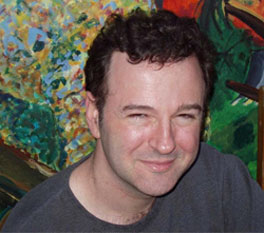 Tony Barnstone
from Sad Jazz
In a Hotel in Portugal
The drywall was papyrus thin, so when
a bedspring creaked for the first time she cried
out a small shriek, thinking, a bird and then
the rhythmic squeaking on the other side,
and then the headboard banging on the wall,
and then his father’s girlfriend called O, O,
little dove cries, little death cries, all while
they stifled laughter, naked themselves below
coarse sheets, and high on ecstasy, all in
those days when they shaved heads and started over
and spent a decade in the ocean’s mouth,
four of them rolling in cheap hotel linen,
his head held in her palms until he found
with his tongue the dark honey at the center.
She Settled for Him
She has her outbreaks when she tries to break
from him, but comes back, can’t keep her resolve.
She steps outside herself to see herself,
dissatisfied, and glowering at her make-
up mirror doesn’t see the beauty there
and so relents, and she becomes his wife
again, lives half her life, lives a half-life,
with him. There is a bubble filled with air
trapped in the glass. It magnifies, refracts,
and bends the light until the mirror lies
and shows only her flaws. Her mind of glass
distorts their love, their marriage. He maintains
she’s like the Chinese poet who says, “I
can’t see the mountain since I’m on the mountain.”
His Younger Wife
They stayed together, and she said “I love
you” every hour, said “I don’t want to leave,”
said “I would die for you, you are my life.”
“Don’t tell me that,” he said, “I might believe
you.” And he did. This was the year she wore
the little shirts cut off below the chest
to show the belly, tiny shorts, the wire
push-up bras to emphasize her breasts.
She wanted a tattoo and a pierced tongue
and navel. But piercing made him think of martyrs,
tattoos of plumbers and marines. His young
students did it to torment their fathers,
to hurt their pain. Yet what she said relieved
him; he believed at least that she believed.
He Gets Up off the Floor
That night he wanted alcohol and pills
but damn it, he had nothing, just some Tums,
some Advil, Bufferin, enough to kill
a headache or an acid twinge. Too dumb
to kill himself, he lived, and get this, now
she says,“You are the best thing in my life,”
and now she says, “I can’t imagine how
I said those things.” He’d like to trust his wife
but can’t reply, and so grins anxiously.
He thinks about the windmill in his stomach,
constantly grinding him. Amazing, huh?
She asks him in the dark before they sleep,
“Who loves you?” Then she socks him in the stomach,
playfully, demandingly. With love.
Break Up with Him (A How-to Manual)
Score limbs and torso with a paring knife,
then peel just like a mango. If the skin
resists, to pry it up place a dull blade
beneath one edge and rock it back and forth.
With the meat flayed, it’s easier to run
a slender blade between the muscles, then
to sever tendons and cut fat from flesh.
Now break the major joints with a steel hatchet,
crack bones as you would a lobster, crush
the skull with a small sledge and blend bone dust
with flesh. Wear plastic gloves, a heavy apron.
Then wait for turkey buzzards to wing in,
approach the flesh on clumsy chicken legs,
stretch their necks, watching you with burnished eyes.
Another Troy
Why should he blame her that she fills his days
with misery, like a curved hook inside
his belly he can’t wriggle off, or why
should she blame him because he loves her face?
What made her simple as a flame that eats
the heart like kindling, eating it to live?
Why did he walk into the fire, give
his chest to the barbed shaft, and ask for peace?
Because embracing flame is still embrace,
because she needs another Troy to burn,
because she needs to crack his innocence
which keeps her chained to him and to this place.
From her small smile like a taut bow he learns
how much he needs even her violence.
Antonyms
Although his love is on the incline,
she feels she just can’t breathe, not here
with him, has to decline
this life and float somewhere,
to be away
where she can stay
forever,
one,
embracing never,
wanting no one.
She’s chosen to retract
her love until his death.
He wishes she would give him back
his damage: half his life, each breath.
What He Heard
He thinks he sees the space between her words,
the unknown underneath, can diagnose
the case, so he ignores the things he’s heard
her say, the symptoms, postulates he knows
the concealed truth, and in this way resists,
playing good doctor in white coat and specs.
His precise methodology consists
of changing the results to match his ex-
pectations, treating cancers with hot glass
and distillations of cocaine and spirits
like a dense charlatan out of the past,
theosophist or vitalist, a fool.
The patient’s dead. He doesn’t have the tools
to understand. He doesn’t want to hear it.
What Her Father Said
After the barbeque the men stayed out
in the cold garden drinking sake, rum,
and whiskey, stomachs warm and fingers numb.
The yellow cat began to nose about
the chicken bones and cold asparagus,
leftover steak and daikon radish, salt
soy beans, cucumber salad. “It’s my fault,”
he said, “She doesn’t want me.” “Just give us
some time,” her father saidhis gray hair tied back—
gripped his son-in-law’s hands across the table
and held them tight, tight. “Listen to me,”
he said, “In Japan, we say a dog is able
to eat all things, will even lick its ass.
But marriage trouble, even dogs won’t eat.”
Laughing Poem
He started laughing. But what kind of laugh?
A funeral black laugh. A bad joke laugh.
A cracked man laugh. He couldn’t stop the laugh,
it came out of his mouth, a dead life laugh,
a dead love laugh, a laugh at faith, a laugh
at his sad, laughable self. What a laugh,
she said “Don’t fight for me,” and what a laugh,
she said “I’m tired of you,” and what a laugh,
she said “Let me alone.” That’s when the laugh
erupted. What a joke, he thought, and laughed
again, a tight chest laugh, a heave, a laugh
from the odd clown, from the numb mind, a laugh
and then collapse onto the couch, a ha
all teeth and tears and gasping, ah, ha, ha.
After She Sat Down on the Couch and Told Him the Marriage Was Done, He Had to Leave on a Business Trip
He drove away from her. He drove until
the city flattened in the mirror, crops
diminished in the chocolate fields, until
the sky turned zinc. He sped past the rest stops
and drove until the mountains tilted him
into null air. He saw a pile of tires
burning. A tufted owl dived straight at him,
then veered away. He almost crashed. Too tired
to drive, he drove into exhaustion. Death
was on the road and he aimed straight for it:
a zero time, a cobwebbed love, decay,
a world of dust and chalk, pathetic yet
where else to live? So he drove into it
and drove away from her, drove her away.
His Wheels Are Whining
He’s driving on the freeway. Cows and grass,
the hills like naked bodies, the phone line
towers like Chinese characters all pass
though glass and eyes and then are left behind.
Metal windmills turning like robot arms,
the barbed wire fences cutting up the fields
or stitching fields together (mend or harm
depends on how you see it). Now his wheels
are whining, now he’s bellowing just like
an animal, he’s screaming while he drives.
The windmills spin, the towers speak, he looks
at fences slicing what was joined: two lives.
He thinks he’d better pull off to the side.
He’s driving, sobbing, trying not to die.
A Children’s Tale
He thought he knew the story of his life.
His story held sweet milk, rosemary, rings
of lemon, clustered fruit, and, of course, love.
His present held her body glistening
in the dark room with an internal light.
His past was hope like swinging bells that called
him to the temple, a light smile alight-
ing on her lips, then folding wings. And all
his futures, all of them lighted by her.
But like a children’s story turning strange,
he now saw coats of thorns, wolves with necks wrung,
tarred fish and crippled angels, lizards, hair
torn out, and pins. Somehow the story changed,
his futures ever after all gone wrong.
Sad Jazz
Inside his blue cocoon, cocoon of blues
on the couch under the down comforter,
he listens to sad jazz and thinks of her.
The first disc plays Miles Davis,Kind of Blue,
the way he feels. The ceiling is a blur
of whiteness spiderwebbed with earthquake cracks.
He’s trying not to blame her, wants her back,
but listens to sad jazz and thinks of her
with someone else. When Bird comes on he sighs,
then listening to Parker play “Salt Peanuts,
Salt Peanuts,” snarls a laugh and sings “sad penis,
sad penis” to the slack sack on his thigh.
He rides a borrowed couch, falls into blue
listening to the jazz die. He’d like to, too.
On a Blow-Up Bed in the Study of His Father’s Apartment
Sleeping late. Now a car door slams outside
the window. Damn he moans and turns his head
into the pillow. No, no luck. The bed
can’t carry him across the threshold, bride
of dreams again. Unbearable to be
awake, but pressure in his bladder, pain
below his shoulder blade, and in his brain
his father’s cat is scratching, and his grief
won’t let him sleep. He brushes eaten teeth,
gets his old body clean, hides it in clothes,
medicates the rot between his toes.
Now he looks almost good. But underneath
it’s all melodrama. “My life is hell,”
he mumbles to the cat, “My life is hell.”
Cut Off
She cuts him off the way she’d cut her hair and walk away
from the dead brown curls gathered in a circle round the chair.
She doesn’t want to listen, she doesn’t want to stay,
but still his mind is tangled by her wild black hair
that migrated through blankets in their old
bedroom into his mouth and hands. It’s gone.
His hands grip air. What can he hold?
Her mole, her birthmark, trim arms, none
of them remain, she’s cut
him off until it seems
there’s nothing there
to embrace. But
he dreams
of hair.
Barbeque
Berkel Berkel’s Korean Barbeque:
the owner asks, “Where is your wife?” And he,
because the answer is too much, must do
his best not to flinch, hit himself, or scream.
He says, “She’s well, she’s with her parents now,
they own a restaurant and she’s gone there
to help them out.” But it is worse somehow
to lie with a straight face, shift in his chair
while his heart somersaults. His steaming brain
is a deep fry that cooks itself. Today
he orders beef bulkogi, kimchi, rice
and fresh bean sprouts, and then he eats his pain
and pays. “Give her my best,” the owner says,
She is so beautiful, such a good wife.”
His Niece and Nephew on the Beach
He’s standing naked talking on a beach
below a small white church with a blue dome,
vacationing with family in Greece.
He is about eight thousand miles from home
and eating watermelon with Aní,
his topless friend from Portugal who says,
“I’d never guess. You were ideal to me,
you two.” They watch as the small children play
with flippers in the surf, and then run up.
“Where is that girl, your wife?” his niece asks him.
“Shush, Maya,” says her older brother, “We
aren’t supposed to ask.” “But where is she?”
she insists. “Maya, you have to shut up!
She doesn’t like him now, so she stayed home.”
Waking Up Drunk
He wakes up drunk from ugly dreams. It’s hot
outside and fifty flies have slipped in through
the door. He watches them whirl and corkscrew.
His stomach does the twist. With half a heart
he swats the busy air with a dry mop,
but they divide like water, then close in
again and pirouette and roll and spin.
So much for booze. It won’t make his mind stop.
“My God this sucks,” he slurs, and excavates
the mini fridge. Perhaps something in there
will make it better, coffee maybe, toast.
His mind does flips, but he grabs eggs and plates
and in the copper pan a dull face stares
at him from nether worlds, a thirsty ghost.
A Cathedral in San Gimignano
Bright frescos in the candy cane cathedral
show the dead living, climbing out of caskets
and riding devils into hell. Long needles
pierce their white limbs, cut hands are piled in baskets,
a rat-faced demon rides a naked girl
and Satan munches on a pair of legs.
He loves her but to her he’s dead and whirl-
ing through red hells. He’d like to live and begs
his mind to cease this loving, lights a votive
candle. The next day in the locomotive,
a woman brushes by him in the aisle.
She only touches him with breasts and hips
and as she walks away she turns and smiles.
Perhaps this flesh will save his soul: her lips.
He Murders His Darlings
He thought of William Faulkner who once said
“Murder your darlings,” meaning be dead cold
when you rewrite. To live himself he killed
his children who had never lived. The dead
were one small boy awakening to life,
with Asian eyes, his father’s nose and dark
intense black curly hair, a girl so smart,
alert and happy she could make you laugh
with just a glance. He murdered them inside
his mind, and burned the house they hadn’t bought,
and quit the job he didn’t get, took off
the ring of white and yellow gold that lied
to him about his wife and children. Now,
alone, he should be able to live. How?
Get Zen
Get Zen, he thinks. Or try. Forget your lusts.
Think of that joke: What do you say to the man
who sells dogs at the Buddhist hotdog stand?
“Make me one with everything.” He adjusts
himself upon the couch, stares at the dead
tv and tries. He tries to be remote
as the remote control, not to emit
emotion, thinks of what the Buddha said:
“The world is flame, a burning house where poor
people incinerate themselves among
the demons, wolves and vultures. Walk out.” Young
last time he was alone, he just enjoyed
the show, the breasts and drugs like blazing toys,
but now he’s old. Is there really a door?
The New Math
He’s swimming at the public pool, his brain
filled with the mathematics of divorce,
how many months alone, how much new brawn
he’s grown through savage discipline and force
of his despair, how slender is his waist
these days, how many years he financed her,
how much it stings, the eighteen years of waste
in love with her, how long he’ll still have hair.
Problem: her passion didn’t equal his.
Solution: what if she subtracted him?
Then he would have a choice: be some guy who’s
pathetic, zero, or start a life. Grim,
ignoring a bone scraping in his knee,
he crawls hand over hand, counts one, two, three.
Worn
He’s cleaning out the trunk in which his clothes
are stored for summer, bathing suits, surf shorts,
swimming goggles, neatly folded beach shirts,
all laundered, put in plastic, and then closed
away—and finds a black and silky bra,
some short shorts with a tiny waist, a sleek
black top, all empty of her, as is he,
although she ghosts through him all night and gnaws
his dreams. They were so close he thought he wore
her like a skin, as she wore him till they
wore out. When doubt crawled in, she stored away
her love and latched the trunk and left. It seems
he catches just a whiff of her somewhere
in the blouse. No, it’s clean. Too clean, too clean.
Nathan Tells Him
in, goes on a blind date. He’s always been
the kind to dive right in. But “Look, don’t bone
her just because you can,” says Nathan. “Have
respect. Respect yourself, respect disease.
It’s plague time out there now.” So he buys wine,
Italian cheeses, raspberries, and when
she comes by they just talk, walk at their ease,
and eat. Sure, it is like an interview
and sure he blows it. When you date, do not
go on about medieval empires. But
it’s fine. He doesn’t want a wedding vow.
He doesn’t want to sleep with her tonight
(does he?) As Nathan says, “Don’t be a slut.”
Tony Barnstone is Associate Professor of Creative Writing and English at Whittier College,and has published his poetry, fiction, essays and translations in dozens of major American journals. His books include Impure: Poems by Tony Barnstone; The Anchor Book of Chinese Poetry; Out of the Howling Storm: The New Chinese Poetry; Laughing Lost in the Mountains: Poems of Wang Wei; The Art of Writing: Teachings of the Chinese Masters; and the textbooksLiteratures of Asia, Africa and Latin America, Literatures of Asia, and Literatures of the Middle East. His forthcoming books are Sad Jazz: Sonnets (Sheep Meadow Press, Fall 2005)and a number of textbooks for Prentice Hall Publishers, including The Pleasures of Poetry: An Introduction, World Literature (two volumes), and Modern Poetry: An Anthology with Contexts,among others. He is currently working on two new books of poems and a critical book titled The Poetics of the Machine Age: William Carlos Williams and Technological Modernism. Born in Middletown, Connecticut, and raised in Bloomington, Indiana, Barnstone lived for yearsin Greece, Spain, Kenya and China before taking his Masters in English and Creative Writing and Ph.D. in English Literature at UC Berkeley.
