A Translator’s Note by Laima Sruoginis follows the poems.
An essay by Laima Sruoginis
Poetry online by Miliauskaite
For more Poetry from Lithuania
For Commentary by Lithuania poets
For J.C. Todd’s Introduction to this Lithuanian feature
__________
Nijole Miliauskaite’s poems appear in Lithuanian in Labyrinth of the Soul (Vilnius:VAGA, 1999).
Available from Laima Sruoginis
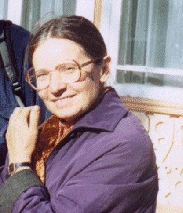 Nijole Miliauskaite
Translated by Laima Sruoginis
Orchard
it was as if you were standing before a fence
and beyond the curved slats, woven with
blossoms and leaves, over there, in the orchard,
a group of children played
barefoot, ragged, grubby
your heart
shudders, half-wild: those children
racing around, that orchard, longed for
you discover suddenly, within yourself, how badly
you’d play forgetting yourself, neither eating, nor sleeping
you start – someone calls your name
beckons you—come! You look around—do they really
want me?
You look around – do they reallythat wall, sometimes stone, tall, thick
sometimes transparent, or glass, don’t I
build it myself?
I hear
clanging coming closer, a drum
and from around the corner a group of well-wishers wind
their voices growing louder, clearer
my poor
heart
Your Faces
I never loved you, sunrise, I mean, weren’t you
terrible, waking me up with the roosters, rushing me
down the narrow dark hall to the basin
of cold water, with ice
that just managed to form during the night, when our bodies,
young girls’ bodies, still wanted
only to dream, to dream and dream? I had
only one friend, a secret friend, sunset, we’d meet
sometimes in the old linden lane, carefully
I’d chew a slice of bread, making it last, bread
stolen from the kitchen, there I’d wait for you ( I grew
too fast, and maybe that’s why I was always hungry) why
then did you give me the heart of an orphan? Even now
hunger for your embrace, to listen
to your words, whispered, you understand me,
sunset, you give such comfort, peace
but look, how I’ve changed: wake me
please, even before sunrise
so that I wouldn’t lose anything, that I’d be in time
to greet you, honorably: and why then, after all
did you give me a different sort of heart? one that longs
for that other world? you hurt me so badly! only now
realize, that there are
two sides to your face, and within those sides
an infinite number of faces, uncountable
The Weaver
I hold a silk shawl in my hands—
a weightless cloud, billowing
against my breath, if I let it go
it would simply fly away
old silk, its white
yellowed like elephant bones, an eight year old
girl wove it, her hands were swift, skilled
oh and her eyes,
dark and knowing in her yellow face,
full with life, shining, and her braids
fell to the backs of her knees, she was loved
spoiled, a real
whirlwind, you only managed
to weave three shawls, of the finest silk
your palms became too rough, too clumsy,
by the time you were just about ten
and your hands had grown accustomed to heavy work
two shawls were sold
with the third
you covered your head on your wedding day
that is all that is left—
your life’s witness—
short, hungry—
this yellowed spiderweb
***
Before Lithuanian independence in 1991, most Lithuanian poetry addressed questions of freedom, of nationality, of maintaining the indigenous culture in the face of intense Russification. However, because of strict Soviet censorship, these topics could be addressed only through metaphor and encoded symbolic language that a well-trained readership could interpret. After 1991 poets began to wonder out loud, “what will we write about now.” Whereas in the seventies and eighties a reference in a poem to a mother usually symbolized Lithuania, the motherland, after 1991 the mother could now refer to a persona or could be a biographical reference. Nijole Miliauskaite, however, was always different. Although the details of her personal life — living for a decade on the run from the KGB with her husband, poet Vytautas Bloze — were undeniably political, the essence and heart of her poetry was always intensely personal. The backdrop of many of Miliauskaite’s early poems is the psychiatric hospital where her husband was held not as a patient, but as a political prisoner; however, the topic of these poems was not the political situation but her relationship with Bloze and her tortured love for him. The sense of homelessness that prevails throughout her early poetry was the result of political persecution but, in another sense, explores her loneliness as a sensitive individual, as a poet, as a woman, as an extremely shy and quiet person, living in a loud aggressive world that was always somehow foreign to her very being. After Miliauskaite settled in Druskininkai and because of the couple’s self-inflicted exile from the Lithuanian intelligensia, the KGB began to leave them alone and her life settled into routine — the routine of survival, sewing dolls and embroidering ornate table cloths for tourists to make a living, gathering herbs, fruits, and mushrooms to can for the winter, and caring for her husband who was often ill as a result of the “treatments” he received at the psychiatric hospital. The routine of survival became the lifeblood of Miliauskaite’s poetry. After her mother and brother died in the mid-1990’s, Miliauskaite was forced to return to her childhood home to settle the family’s affairs. Cleaning up and selling the property led to a series of poems and meditations on Miliauskaite’s sad, poverty stricken childhood, and her eventual removal from the family to an orphanage. Despite the tragedy of Miliauskaite’s life, or perhaps because of it, an intense religious practice that is a combination of yogi practice, Lithuanian pre-Christian belief, and Catholocism has led Miliauskaite into a state of spiritual peace that she documents in her latest poems.Translator’s Note
by Laima Sruoginis
