In previous issues, Dzvinia Orlowsky’s:
poems
a feature
of One Obscene Brushstroke
her translation
of Dovzhenko’s
The Enchanted Desna
_______
Photo by Max Hoffman
_______
For more poetry
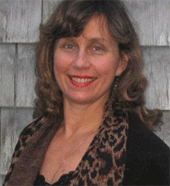
Dzvinia Orlowsky
Introduction
I have to admit I hadn’t thought about this group as a chapbook,though I love your series and concept, in general, of publishing poemsas such. The poem, “The Fox,”, for example, written at the same time asthe other poems, is not included in my new book, Convertible Night,Flurry of Stones. I don’t know if the arc of my breast cancerexperience is present with the same kind of clarity and emotionalpassage that I hope builds in the entire collection. In an ideal world,I’d love for my poems to speak directly to Lisa Katz’s terrifyinglybeautiful poems on the same subject (Breast Art). She captures that experience offinding reconciliation with an altered self with such honesty anduncompromising bravery. Almost three years into recovery, I look backat the experiences that shaped the poems in this collection and think myGod, I survived that. How do you move back toward self, toward thenatural self, after months of feeling like a walking nuclear plant? Irecall, after completing my 6 months of chemo treatment, the utterlystrange sensation of crying into my goggles as I swam laps. Moments ofhelplessness coupled with moments of great faith and resolve. One eyelaughs while the other weeps. Poetry, thank God, allows that—it makesroom for all of that, for all of us.
December
1.
Dear ,
Holding her was like holding a large fallen leaf,
her hair recentlydyed an unnatural red
perhaps the russet of Ohio’s steel mills.
This moment didn’t last long;
embarrassed, she pushed meaway.
I kept my sunglasses on,
recalling her You don’tlook good
when you cry.
2.
Dear ,
Ten minutes of storm pass over the lake, knocking
dead branches offtrees, pushing water.
Her phone lies sideways on her bed,
Long-distance voices disappear in marsh grass,
It’s yourdaughter spills
out of the receiver —
She turnsit upright as if it were a vase.
Now where will I go?
3.
Dear ,
Ablue piece of paper dropped from my Grandmother’s hands
onto thewooden floor of our house.
She died years ago, buoyant, amongthe fire burning
in my dream, through my mother’s waking
screams, grass fields rippling not toward
but away from our house.
Have faith, faith will protect you
Where did it comefrom? On my floor?
4.
Dear ,
I’m just trying to get to heaven, and I think I’m getting
closer
a man mumbles past me
in the treatment room.
Others, too— children
wearing startled adult masks
& still others waiting to be born,
for me to vacate my chair.
5.Dear ,
They could’ve carried you on their shoulders
for hours, your bodyrocking gently
from side to side as if in a boat.
Before they closed you for eternity,
I saw your thumbs move,
but not enough.
6.
Dear ,
Be still,
ants cast lions’ shadows to entertain themselves,
branches scrape music
against windows,
each dayprognosticated —
living as if.
Another Waiting Room
The breasts here, too, are horrifying,
lit by the same master-planbulb
that could bleach our teeth, our skulls
long before we’reburied.
Some, I imagine, emit an inaudible scream.
Mine, Ithought, small enough to be left alone.
The mammogram plate liftsand presses
until I can’t breathe,
until the technician’sconvinced
she’s clasped everything on metal.
It’s skin thatholds us all together,
soft and dreadful.
I turn my faceuntil I can’t look any further.
to see what it was I was —afine black thread
still crimped from the strain and snap.
I’m back in it.
Outside it’s cold, snowing.
The floor rises up in my throat.
Mybody dissolves into a million grains
to be decoded by a passingwind.
I don’t know what’s been written
in the yellow margins
aftershe’s through and I’m returned
like a weeping child to myself.
All Gone
Among first words kids learn to say
tipping their empty bowls andsipping cups.
After that, Disney producers remind them
Moms, too, have to go —
on hospital beds, in mallaccidents,
just before a rodeo.
Dads remain strong in plaid shirts
capable of handling a combine,moving everyone
to the country to begin again, the neighbor,
Not Mom, new to town (or not) —
maybe the town’slongstanding vet,
sensitive with horses, stroking their long necks
& more like a friend. She knows she’s not Mom,
who,except for being dead, is always there present,
over-expressedas a split milkweed pod.
After dinner, Not Mom tucks the kids in.
She doesn’t have to check her weight or blood
or kick thebucket on Lifetime Channel.
Not Mom knows when it’s time togive it all a break.
She turns toward Dad, lowers the heat under thekettle.
Good Cells
Make them as true as Father
pointing to heaven knowing
he’s leftno one behind,
tenacious as my mother
looking out of awindow at a lone
resident tree. Hand her a paintbrush.
Let herdrag its bristled hair
across a white page.
Let them carry myhusband’s
snow dampened wood,
be the passing flickeringflashlight.
Let them be my son
and my daughter, the scent ofwhite soap.
Let them be my working dog, Laika,
the flurry ofstones as we walked.
Let them sound for my sister
Monday’schurch bells,
a piano’s felt-covered hammers,
her husband’sthroat, 7 years cancer-free.
Let them carry light suitcases
tomy nephew and niece,
to industrious cities,
where they may
applaud fruit ripening on a table
without its tree.
The Cop
I wasn’t the sassy red head he thought he’d pulled over,
blackframed designer sunglasses hiding the fire in her eyes,
thewoman whose car he’d walked extra slow to,
passenger window loweringas she turned to speak to him
ice slipping from the safetyglass as from a square fin,
hiding deep inside the car door,smudge-less, ready to rise.
He looked directly at my mouth tosee what it might
be, a warm, welcoming silence, or a dog caughtwith a bone.
But my lips are too thin, slightly purple likemorning
glories choking along their white line.
And thatis not good, the same line of logic
as what you can tell by the sizeof a man’s hands.
His hands were large. He spread his legs,ripped the ticket
out of his book as if he was about to strip andthe ticket
was the first accessory to go. I wasn’t thewoman
he thought he pulled over, but a spinning out of control
strip show coming at him. I pulled off my wig, held
it out tohim like a scalp, a sacrifice, an enormous spider mashed
onthe dashboard. Holy Jesus he muttered. sorry, sorry, sorry,
stepping back from my car. He didn’t know where to look —
no eyelashes, no brows, no face to match the face
on the driver’slicense, no deep sky blue backdrop curtain
to highlight theeyes. My hands shook on the steering wheel.
A woman can bedismantled, yet she moves or dies —
The cop is thankfulhis kids or his wife are not me,
this woman for whom he now wishesGod speed toward
her prayers or the Mother ship or the ocean’swhite lip,
his large hand holding back traffic as together we pullout,
gravel kicking up from behind his tires,
siren blasting birds liketorn paper wavering in the air.
By nightfall I’ll convincemyself it is a gift:
this life so thick it sticks deep in my throat
parched and yellowing, overgrown shoulder
like weedsrippling throughout my body —
a cop home and showeredwith a story to tell,
his family gathered inside their dinner halo.
The Fox
At night I hear it screaming as if it’s being robbed.
There aresigns of other wildlife too.
It must be that I’m dreaming —headlights, a car coming to stop.
Who unlocked the gate, on mypillow last sobbed?
A deer stands motionless — lost, but inview.
At night I hear it screaming. Is someone being robbed?
Coyotes break from a shadowed mob,
Raccoons, opossums, waftingpool of skunk.
It could be that I’m dreaming, the sound of a carstopped.
Whose flashlights unearth each barren den?
Daylight witnesses are too few.
At night I hear it screaming, asif someone’s being robbed.
I lived so long without it—
Fire streak, a flick of russet tail. Perhaps I was only
dreaming, no blood trail found or stopped.
How brief thewilderness at last had come.
Awakened, it wouldn’t stay.
Atnight I hear it screaming, as if being robbed.
It must be that I’mdreaming, the sound of dreaming stopped.
Wolves
To touch the back of such a man —
my mother whispers —of course
it means he belongs to a club
that has sexwith wolves —
a wolf’s paw prints tattooed
upwardto the right of his spine —
Don’t be so naïve.
His secret trail hidden;
how vivid the unseen,
the nape ofhis neck —
a few stray curls, underbrush.
He hands mepink dumb bells.
How many women has he seen
like me,avalanched, quick
to turn from mirrors?
On the benchpress, my
right arm buckles in;
too much has been cutaway.
You’re so tiny, he says — code for
slight, small-boned,soft-spoken,
wish-boned, muscle-deprived?
But I know howsome wolves
never get past hunger,
ribs stabbing throughtheir
blotch-gray fur.
Into the first clearing
they run, head down.
Sunken deep into the cold
they’ll ripice from their paws
as if hard water alone could feed them.
Yes, Back
Hastily pre-dye-shampooed in the afternoon queue, some strands
turndeep sapphire blue. She calls it yes, black.
Otherstwirl stray silver tape down her neck, the color of
witheredshingles outside of her new room, not the home she
refused toleave, where undesignated envelopes returned, marked:
betteraddress needed. Her dreams answer: yes, back.
Shepoints to her calendar, then to the clock. She remembers
clearlywhich daughter never comes on time and which leaves early.
Mysister brings her walking shoes, I bring her my one
month ofrecovery, my Joan of Arc Released Before the Fire look.
She lifts a paper place mat to show us how carefully she has drawn
avase of flowers with a thick black crayon like the one she used yearsago,
the light gray appearing like endangered dune grass.
The bottle touches its point to her white skin, uneven lines,
attempts to color in the shoreline just above her eyes.
Yes, theypull me in, their back, black.
DzviniaOrlowsky is a founding editor of Four Way Books and a contributing editor to Agni, The Marlboro Review,and Shade. She is the author of four collections of poetry, AHandful of Bees, Edge of House, Except for One ObsceneBrushstroke, and Convertible Night, Flurry of Stones(forthcoming, Carnegie Mellon University Press). Dzvinia Orlowsky hastaught as Faculty Fellow at the Mt. Holyoke Writers’ Conference, as wellas the Boston Center for Adult Education, Emerson College, Gemini Inkand the Stonecoast Writers’ Summer Conference and MFA Program forCreative Writing at the University of Southern Maine. She currentlyteaches at the Solstice MFA Program for Creative Writing of Pine ManorCollege. Her poems have appeared in a number of magazines includingColumbia, Field, Ploughshares, The American Poetry Review, andThe Massachusetts Review. Her poetry and translations ofcontemporary Ukrainian poets appeared in numerous anthologies includingDorothy Parker’s Elbow: Tattoos on Writers, Writers on Tattoos(Warner Books, 2002), A Map of Hope: An International LiteraryAnthology (Rutgers University Press, 1998) and From Three Worlds:New Writing from the Ukraine (Zephyr Press, 1996). She has alsorecently completed a translation from Ukrainian of Alexander Dovzhenko’snovella, The Enchanted Desna forthcoming from House Between WaterCollections. Dzvinia Orlowsky is a 1998 recipient of a MassachusettsCultural Council poetry grant, a 1999 Massachusetts Cultural CouncilProfessional Development grant, and a 2006 Pushcart Prize for poetry.
