“first story” was originally published in the print journal NEW AMERICANWRITING #24
“polyglot incantation” is forthcoming in ZOLAND POETRY’sAnnual, 2007.
_______
Photo credit by Peter Dressel.
_______
Website
Blog
_______
To order books:tinfishpress.comspdbooks.org
_______
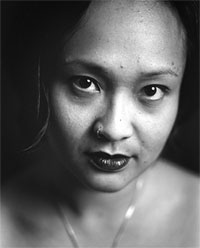
Barbara Jane Reyes
Excerpts from Diwata
noong unang panahon there once lived a strange deity who was onlystrange because few strove to know her. ¡bárbara! ¡extraña! taunted hereldest brother, who was lightning, kidlat. her own light was confined toa glass vial. she knew stars an ascension of pearls hung by higante onthe highest tree boughs. when he danced, earth descended beneath hisfeet. there below, a vain woman, earthbound, bereft. she knew tongues ofmany men, those who brought boats and steel, those who brought silks andjade, those who brought the cross.
but this story lacks propersymmetry.
a woman’s hands make fine threads dance. withneedles of carabao horn, of bamboo, she embroiders names into silk —serpent ulap scale luna fire lihim gem azul eye liwanag river mariposalight bituin— when she weaves these words into the fabric of sky,agimat against forgetting. with ink and thread she draws her own handspero siempre estas manos desaparecen; she weaves enkanto contra palabrasvaporosas, poemas contra vacía alma. and when her face begins toresemble the porcelain virgin’s face, for this firelight causes much toappear, still she sings: o diwata, ang inyong mga salita ay aming diwa!o diwata, ang aming mga salita ay pag-aalay sa inyo!
*
some say kulog, child of the earth calls to kidlat, child ofthe sky world because they are twins, split in two by their spiritfather. as the mortal woman ascended with her lover, the path throughclouds to sun burned. her flesh also burned. the child below thevillagers wished to keep, so that the spirit father would always returnto them.
yes, he cleaved his son in two. and from thesehalves, the one skybound grew a new self just as the butiki who’s losthis tail. the one below would have perished had not the spirit fatherdescended and breathed his breath into the lifeless half body. this one,how his voice booms when his twin brother streaks across all kalangitan.
and their sister, the strange diwata whose light remainscontained. witness she is, and weaver. if she would only speak, then shewould tell you — these stories i give you, i swear they are the truth.before this time, langit was high as a tent. children poked clouds withbamboo sticks. some could jump high enough to touch it with theirfingertips. when headhunters danced around the bonfire, keeping vigil,their blades pierced the skins of the gods.
…oo nga, hija,we were headhunters once, our tribe…
there, the battlefieldbetween kagubatan and tabing-ilog, littered with headless bodies. theheads they took to their own village for they believed kaluluwa residedthere. beyond the distant lowlands, a god whose winged head bathalaburied with the remains of the serpent who ruled the clouds. the orphanspirit, whose body bathala set afire. this is how bathala invited hisenemy’s soul to be his spirit guardian.
some also say, thiswas how the first coconut tree came to grow.
*
once a diwata stole fire. he brought it to the riverbanks where theearthdiver shivered, unclothed. this, her fate for peering through thehole in the clouds while her father hunted the usa and barako. she hadgrown tired of animal bones scattered, a house of musk and taut skins.how she’d wince as her father’s sharpened teeth pierced prey’s liver.
there is no secret in fire, diwata told her years later, afterthey had wed, after the oceanfloor’s black mud bubbled to the surface,birthing islands. others say the maya taunted sky, that ocean revealedits hidden contents in epic warfare. but the earthdiver remembers itthis way: mighty lawin dropped her upon the back of the eldest pawikan.masqueraded as dove, lawin cooed, paloma, dalagang paloma! amorcitapaloma, minamahal kita! he took her there, he gave her child. she fleddeep into the glowing darkness of salt caves, where the virgin draped insky wept silver tears. she taught young village girls to guard itsentrance and wail. o diwata, kaawaan mo ako! but he pursued, capturedher. dalaga, dadagitin kita! a tent of skins and tools carved of animalbones, these were her dowry.
*
he took me, from myhole in the clouds. he took me, gripped between his talons. i fearedthat if i tried to escape, i would fall into the deepest, the bluestocean. i knew for sure i would drown, for i had lived my entire life inmy father’s realm and had never before touched water. when mighty lawincame with his sugared words, i leaned farther over the edge than ishould have. but so pretty, his words. upon the shellmound of kindpawikan, there, lawin took me and took me, and pawikan could do nothing.i knew my brothers too would do nothing. there, i was torn.
my child, your father’s eyes. my child, one day you will fly.
In the beginning, a man of dust and fire became bone, and viscera, andflesh. The deity of the wind blessed his lips and he came to take hisfirst breath. Within this strange vessel, I opened my eyes, and withinthis, your darkness, I learned to weave song. Do you remember mefluttering inside your chest, tickled by the cool air newly filling yourlungs. Do you remember exhaling song on this first day.
On thesecond day, the unseen hand from above cleaved you in two, exactingpenance for our joy as you awakened from the deepest, most deliciousdreaming. On the second day, my love, I was torn from the haven of yourblood, the cradle of your flesh and tendons. A smarting wound strewnacross our garden’s sweet grasses, I lay raw and aching. On this secondday, my hands and feet learned the relentlessness of cold.
Onthe third day, I found river, and plunged the wisp of my body into itscurrent. As I learned to breathe without you, as I mimicked the river’slullaby, you appeared upon its banks, your body so fissured, your eyesthe ravaged jewels of an umber earth. There were no words for the sorrowbolting through me then, as I watched your hands touch the scarringplace where I began. On this third day, my mirror, we learnedlamentation, and shadow.
On the fourth day, I sang a dirge,and the river was my harmony. From afar, you watched me, as the unseenhand from above offered you reparations for your brokenness. More thananything, I thirsted to embrace you in our ocean, for its saltwater toheal us both. But my mirror, the memory of your darkness welled upinside me every time I drew near. On this fourth day, I learned to weep.On this fourth day, the scars hardened over your heart.
On thefifth day, I dreamed a conflagration, the birth of suns and thunder. Idreamed this garden, reduced to ash. I dreamed that from loss, we beganagain, a we that knew only of being whole, of sharing heart, and breath,and salt. A feast of we, luminous as the secret of fruit and seed. A weimpervious to cleaving, to fracture. On this fifth day, I opened my eyesand I came to know of hope.
On the sixth day, I came to you,and told you of this dream. I touched your scars. You whispered aprayer. I gave you my secrets. You gave me your words. I asked for yourbreath. You gave me your seed. And as our bodies folded into each other,we dreamed the same honeyed light. Upon awakening, you named me for themorning. But on this sixth day, the unseen hand from above wrested youfrom me, cleaved us in two once again, and weighted the heaviest sorrowupon me. Never once did he show himself.
On the seventh day,my love, I surrendered.
siya ay nakatayo sa balikat ng bundok
she stands upon themountain’s shoulders
langit ay kulay ng ginto at dugo
sky’sthe color of gold and blood
sumisigaw siya ¡mira! ¡el sol!
seehow the sun weeps
tingnan mo! umiiyak ang araw!
how thismountainslope burns
nag-aapoy siya rin
sky’s the color ofblack pearls
iyan lagi ang sa aking panaginip
this have iprophesized
ang mukha ng araw ay umiiyak
and what are these glyphs
wikang matemátiká
some humanmachinery
símbólo, enkantada, o gayuma
maker of souls andtongues
anong pisi o balat ng ahas
what twine or serpent skinbinds
silangan at kanluran
pearl of the orient
esta puntodel embarco
fractured archipelago
ang mga anak mo aynakakalat
your children have scattered
cielo el color de perlasnegras
do not forget that they have names
may sarilingpangalan ang aming diwata
we bring her tobacco whenshe calls shrill bird trill carried upon air as though her voice were abody’s warm ribcage we could wrap our arms around tight. we drop ourweaving, we leave the fields. elders once brought her tobacco rolled andbound with abaca; now we bring marlboro blue label cartons. once palmwine fresh in glass jars; now spanish brandy, ginebra san miguel,calamansi and camote in baskets, salted fish bundles hung from huts’rafters. now she is old but this firelight glows upon the face of awoman whose skin is sunned and taut; in her wide eyes we see sharp lawingaze, in her eyes we see sky. her dancing wristbones so delicate as iffine fingers have known no field nor farmwork.
she has taken ablade to her own hair once hung heavy to her waistline, now falling inher eyes in jagged tresses, now exposing earlobes and neckline, herrough woven white blouse, its polished bone clasp undone, exposing oneshoulder. she is young in the night’s firelight though we dare not callher maiden. our mothers say she snares others’ husbands, ourgrandmothers whisper her father a bird of prey, our fathers lament sheis the one they could not marry for she would not have them. she scoffedat offerings from the hunt, from the river, whose warm humid nightsfilled with serenade. raising one index finger to her lips in a shhh sheconfesses she has many times swooned to the verses of lovers underslivers of moon, ribbons of stars arranged into hunter and bow. smokecurls from her lips, her eyes are faraway gazing, the diwata hasarrived.
*
and then she is the star maiden. and now she is the first woman, baringher breasts to feed a poisoned land. and he is the first man, father ofblack soil, bamboo blossom windstorm pestilence stone and confession.and she opens her body, the place from which all word grows. and heenters. and he enters. and he enters.
the whites of his eyeswhen he discovers she is a wolf who is a woman who is the prism in histhroat. the immediacy. this wanting.
and from the wind’swhirls we would call her silken breath, she brings a feast of word. treebranches bend, she pulls them to her. and then she is a window, avessel, a fork in the road, a fragrance lifting from tangerine skin. therustle of a single page, the stillness of ocean before a typhoon. andthen she is the fire, around which we all gather. and ever is she loverand beloved.
the whites of his eyes when he discovers she is ashark who is a woman who is his gravity. the immediacy. this wanting.
a poet, yes. a conjurer of words, some have said. a trickster,i have also heard. for i am keeper of words. i birth them and care forthem, and when these words grow strong, a bridge. just like that, abridge. those who come to listen to my stories, they fall into wakingdream, hovering between the very earth upon which they stand, and theplace where the spirits dwell.
story, yes, for that is whatpoets make, story into song. we interpret what the birds say, what thespirits of the wind speak. they step into my dreams. they come to me infirelight, when i bathe in the river, and when i bed my lovers. theytell me things no human voice has spoken. secrets hidden in mountaincaves. steel and blackened stone, the noise of machines. but the birds,yes, the birds, they tell me the sky.
and what of the sky,sighs the wind, for if not for me, you could not know her touch.
often, she speaks of the one-eyed cat, natty-haired, gangly andgigantic. it visits her and corners her there, between the tomatopatches and the rickety fence. it springs from the dirt and into thelemon trees’ boughs. it stares with its one milky eye, and yowls like nocreature she has ever known. a cyclone, she imagines, but even moremenacing.
as its wailing body finally disappears with thewind, news arrives of a loved one’s departing soul. an elder succumbingto illness, an accident in the fields, one’s flesh sliced and broken byso many rusted blades. invading armies’ torches and gasoline. theharvest, an offering to the war gods. young women, roped and gagged.many times, it happens like this. from fruit trees’ branches or curledabout her ankles, the cat stares through her with its milky eye. itsother eye, half scab, half absence, stares at her too. then theunavoidable tragedy.
“your death shall involve fire,” sheweeps to her robust grandfather, and without speaking, he places aroundher neck his silver amulet — saint michael sashed in crimson and swordglinting. the following day, uniformed men with torches.
tugging at his shirt and forcing words between sobs and frantic breaths,she knows her father will not hear. unfaithed by street corner whores,and nursing the cheapest gin, he still suspects his own father’s spiritwill make visitation upon him in the night. a wisp of old man floatingat the foot of the bed, blessing the blisters of his feet with touch.call it talisman if you must. though sadly, our elders’ ways have cometo pass. no, child, this is certainly no talisman. it has protected mefrom no village foe nor invading army. here, the blind old man tappedthis marking into my left arm and breastbone. he used his tapping stickand his sharpened irons. these are leaves and grass blades. these aresunbursts of flower petals, the flitting eyes of mothwings, of cicadas.this here, the soothsayer and her seeing stones. the glass eye withwhich she viewed the heavens. above her mountain village, the starsarranged into hunter and bow, arrow aimed at mighty lawin.
this is not thunder. no, only men are marked with thunder. he marked myflesh with the swirls of our village stream. here, on my right shoulder.what i see is no stream, but a blade which women conceal beneath theirskirts. even today, we do this. though it is not proper, the elders say,for women to be marked for war.
it is no secret. women didindeed fight alongside the men once. few talk about it these days. theblack robed and hooded ones who carried more curses than prayer, sofeared armed women, they branded it savage and sinful — women who tuckedskirts between their legs, wielded knives and tilling tools, thenreturned home to nurse their babies after washing clean their bloodiedhands.
*
no, child, these are no talismans upon my flesh. the blind old manwished to give me markings in the patterns of my father’s fields, for hewalked my father’s lands, from new growth’s edges to the greenestcenter. every sunrise in wordless prayer. many years, he did this, neveronce opening his eyes. but by the time i grew old enough to marry, allhis fields my father lost to the fire, and to the papers of the wealthy,not of this land but of grey cities far away from here.
hemarked my flesh with the swirls of our village stream, though its cool,sweet water, its bubbling no longer gives us music. it has long sincebeen fenced and dammed, but by whom, no one who ever shows himself. itsmusic we have all of us forgotten. and the flowering trees that oncedipped its branches into the water to drink have all withered. there isno sense in my very body carrying a reminder of all that is lost to us,for no healer of scars, and no magical markings could save any of it.this is no stream, no. it is the curve of a warrior blade.
*
this is how my flesh was marked with the ash of burnt coconut husk andsugarcane, so that i could marry. but all the young men had neither landnor wealth, and invading armies came from farther than the seas. withbayonets and bullets, they claimed they worshipped one who was descendedfrom the very sun itself. though they harbored no love for things ofthis earth.
when my grandfather’s father was still a youngman, an army with skin white as ghosts came to our forest. but our mentook their heads with ease. running dogs, whimpering, they were.cowards. and even the lowlanders, some marked with the talismans oftheir own elders, some who had grown their hair down to theirwaistlines, hid in our forests with rifles and the sharpest knives. theyfought those white ghosts for many years, until those white ghostsnumbered so few, they boarded their steamships and they fled.
but these sun worshippers, they were cruel. they used the young women aswhores, slid loaded pistols between their legs, gave them sores andfevers which none of our medicines could cure. the sun worshippers alsotook heads, but left these to rot where they fell. no hunters werethese, but mercenaries, beasts. this is why the sun wept a sky the colorof black pearls. this is why he weeps still.
*
he took me, from theriver’s edge, where i washed clothes for the missionary’s daughter. hetook me, gripped between his fists. i feared that if i tried to escape,i would fall, pierced by the sharpest bayonet. i knew for sure i wouldbleed, for i had lived my entire life in my father’s house and had neverbefore touched man. when the soldier came with his vulgar words, ileaned farther over the edge than i should have. but so venomous, hiswords. upon the banks of the river for which my father was named, there,the soldier took me and took me, and the river could do nothing. i knewmy brothers too could do nothing. there, i was torn.
my child,your father’s eyes. my child, one day you will curse his name.
Barbara Jane Reyes was born in Manila, Philippines and raised in theSan Francisco Bay Area. She received her MFA at San Francisco StateUniversity, and is the author of Gravities of Center (Arkipelago,2003) and Poeta en San Francisco (Tinfish, 2005), for which shereceived the James Laughlin Award of the Academy of American Poets. Shelives and works in Oakland, CA. Her author website is barbarajanereyes.com.
