
Gregory Orr Photo Credit: Trisha Orr.
________
Gregory Orr’s poems in this issue
________
Mary Ellen Redmond’s poems in this issue
________
Contributor Notes
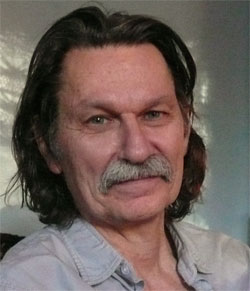
Gregory Orr
Interviewed by
 Mary Ellen Redmond
Gregory Orris the author of tenprevious collections of poetry. His chapbook, The City of Poetry will be published by SarabandeBooks in the summer of 2012. Among his other volumes are: How Beautiful the Beloved(Copper CanyonPress, 2009), Concerning the Book that is the Body of the Beloved (Copper Canyon, 2005), The CagedOwl: New and Selected Poems (Copper Canyon Press, 2002), Orpheus and Eurydice, City of Salt (Finalist, LA Times Poetry Prize), We Must Make a Kingdom of It, The Red House, Gathering the BonesTogether, and Burning the Empty Nests.He is also the author of a memoir, The Blessing (Council Oak Books, 2002), which was chosen byPublisher’s Weekly as one of the fifty best non-fiction books of 2002. His personal essay on hisexperiences as a volunteer in the Civil Rights Movement, “Return to Hayneville,” appeared in theVQR and was subsequently reprinted in Best Essays of 2009, Best Creative Non-fiction 2009, andPushcart Prizes.In addition he is the author of Poetry as Survival (University of Georgia Press, 2002), aconsideration of the existential function of the personal lyric. His personal essay was chosen tobe broadcast on National Public Radio’s “This I Believe” series in the spring of 2006. He has beenthe recipient of fellowships from the Guggenheim Foundation and the National Endowment for theArts, and an Award in Literature from the American Academy of Arts and Letters.He is a Professor of English at the University of Virginia, where he has taught since 1975 and wasthe founder and first director of its MFA Program in Writing. He lives with his wife the painterTrisha Orr, and his two daughters in Charlottesville, Virginia.
Mary Ellen Redmond is entering her 18th year teaching English on Cape Cod, MA. In June 2011, she earned her MFA in Writing and Literature from the Bennington Writing Seminars. She was a regional finalist for 2011 Cape Cod Cultural Center’s poetry contest, as well as a 2010 finalist for the NCTE Poet of the Year Contest. A former member of the Cape Cod Poetry Slam Team, her poems have been published in A Sense of Place, An Anthology of Cape Women Writers; World of Water, World of Sand: A Cape Cod Collection of Poetry, Fiction and Memoir; Capewomenonline; The Larcom, Primetime, and Sahara. Her non-fiction articles have appeared in Cape Cod Travel Guide and Cape Cod Life Magazine.
Introduction
by Mary Ellen Redmond
Mary Ellen Redmond: In your workshop yesterday, you spoke about the covenant between the word and the world. Can youspeak about that in regard to contemporary poetry?
Gregory Orr: The term covenant between the word and the world probably comes from a book by GeorgeSteinercalled Real Presences. He uses it to stand for a naïve but functional assumption thatthere is aconnection between the words we say and the things in the world. He takes it back to the mythicscene where Adam names the creatures in the Garden of Eden as God parades them before him. If youwant to be skeptical of this mythic event, you can point out that this is the place where Adam took“dominion” over the world. The whole idea of man’s dominion over the world, overnature is bad news. But what Steiner would be stressing is the positive aspect: that words connectus to the world, that they cling to the things of this world. Steiner says there was a certain historical moment when this covenant was broken and thismagical assumption that there was a connection between words and world, was broken by two Frenchpoets. By Mallarmé in one direction and Rimbaud in another. They had different ways ofdisintegrating the self. Rimbaud disintegrates the self because he wants to become a visionarypoet, and Mallarmé wants to transcend the world because he wants the pure essence. Another waytothink about it, this covenant being broken, is to go to the French linguist Ferdinand de Saussure,who gave this course in linguistics in the early part of the 20th century and where he said thatthe connection between signified and signifier is arbitrary, and for some reason people got reallyexcited about this idea: that there was no connection between the word “maple” and thattree over there. It is an arbitrary connection. That was an incredible oh that blows mymind kindof thing. From that, and this is my take on the subject, it’s as if there are always twothings in every word. One of them is the music of the sound, and the other is some part of the wordthat wants to go towards something else in the world or something inside us. It doesn’t workwith abstract nouns, but it certainly works with “clover” and “grass” and“maple” and “sparrow.” It works with a lot of things. With “person”and “dog.”
Whitman has this wonderful poem where he talks about a “a noiseless, patientspider.” And the spider is there all alone on a promontory and it sends out from itself“filament, filament, filament” to connect up to things. It’s not a web-buildingspider; it’s the kind that sends out the single threads. And Whitman says: That’s me. Iam all alone like an isolated spider unless I can send out these filaments of language to connectme to things. To bring about that connection which is the basis of all meaning. Well, that’swhat language does.
If you say, oh language is a game. Words are just music. Syntax is a joke. Communication: whoneeds it? Let’s have fun. Let’s play with words. Of course, play is an important part ofpoetry. But to turn it all into play, to turn it all into sounds and to give up this aspiration toconnect meaningfully to the physical world, to the past or to objects and people seems to mesolipsistic, narcissistic, [and] nihilistic. Now, you can do all those things and have fun, butultimately it seems to be the end of meaning. To be nihilistic would be to say there are nomeanings.
So, at that point, I got off the contemporary linguistics train, the experimentalist train.[Here is] a sort of psycho-biography of my poetry. As a poet and person, I come from a place wheretrauma is a primary experience, so when any theory announces that the world doesn’t meananything, I’m thinking—I already knew that. I knew that when I killed my younger brother in ahunting accident when I was twelve. I knew that when my mother died overnight when I was fourteen.That’s when I realized that the world doesn’t mean anything. That it’s filled withhorror and violence, an arbitrary meaninglessness. So meaninglessness doesn’t have anyattraction for me. In fact, it’s the name of the horror. It’s the name of isolation.It’s the name of everything that made life unbearable for me when I was a young personstarting at the time of my brother’s death and not changing until I discovered writing poetryin my last year in high school.
At first, writing for me, as it is for many of us, was an outpouring of emotion in languageonto the page. I had no ability to shape that language, no clue that the bringing of form andcoherence would be gratifying to me, would bring me back toward the world of meaning. But from theoutset, I understood that one function of language is to be expressive of what a self feels, sees,thinks, remembers. From the outset, I was excited to feel I could write about what I saw; writeabout I felt. I couldn’t make much sense of the world at that point, but merely turning theworld into word was exhilarating to me.
Then, I also think about the way that early on some of the first poems that I wrote in my lastyear in high school. First I was just amazed that you could create a world out of words. I stillthink it’s so thrilling. The world I wanted to create was one very, very far from where I was.In other words: escapist fantasy. Whatever you want to call it. I also had this early experiencewith my high school teacher/librarian who looked at one and said, Oh that’s nice. I thought:I’ve communicated with somebody! I’m not trapped alone in this horrible place, which ishow I had felt ever since my brother’s death. So I’m just rehearsing my own individualversion of a very standard story of where expressive poetry comes from and how it can come to be anincredibly exciting connection first, between yourself and what’s confusing inside you;second, between yourself and the world; and third, between yourself and other people. And then youhave someone say, Oh that’s interesting. Emerson said somewhere that it always comes back tobeauty and no one has any idea what it is. But without some dream of it, it’s hard to thinkabout what to do.
I am not a religious poet, and the term covenant is a religious term. I am a secular humanist.I believe that the only thing that is sacred is the human project to survive against huge oddsincluding the basic nature of what it is to be human, the evil in us, the joy that many of us seemto take in destruction. But I don’t believe in any thing in the way of God or soul orafterlife or any of those things. I do believe in the secular religion of poetry. My beliefs inthat regard are almost standard late 19th century or Romantic perspectives. Around the 19thCentury, a number of people in Western culture noticed it was getting harder to believe in God anda divine Jesus and heaven. It’s hard to believe in those things.
Mary Ellen Redmond: So you created the Book.
Gregory Orr: Yeah, that’s what I believe in. It just came to me oneday, this idea of a Book. And as soon as it came to my head I thought, of course. I know it’sa secular bible. I know that Blake thought he was making a bible. I know that Whitman consideredhis Leaves of Grass to be a new American bible. He wanted people to go out and study it likeasacred text. I don’t think I am creating a bible. I’m not that kind of grandiosevisionary like Whitman and Blake whom I adore. I’m not interested in making a system thatpeople believe in. But I do love Emerson when he said: “Make your own bibles!” He sayseveryone has to make their own bible. That’s the thing I like. So, all I’m saying is makeyour bible out of the Book. And the Book is everything—it’s this giant, impossibly hugeanthology of songs and lyric poems gathered and gathering itself since the beginning of our abilityto record and preserve poems. It’s a giant anthology containing all this testimony, this densetestimony we call lyric poetry—this testimony that’s there for us to choose from: choose thepoems we most need, most love—those that help us live. We make our personal versions of theBook—just those we need and love.
I mean we are sitting on this bench, but we can go to early Yeats or we can go to T’angChinese poetry, Eskimo lyric. We can go all over the world, all over time. There is Aztec lyricpoetry, which is oddly enough, really beautiful. Here is this Aztec culture which is sacrificinghumans every day in order to make the sun rise, to give the sun potency. And then, there is thiswhole other segment of Aztec culture that is saying: “These military people are crazy withtheir violence. What is really important is just to be here, to sing songs, to see what isbeautiful in the world and be sad about the fact that we die.” That’s Aztec lyric poetry:Be here, feel love and companionship, admire what’s beautiful in the natural world, and feelpretty bittersweet about when we die knowing that maybe this is the last world we might ever see.That’s cool. I mean Aztec poetry! You can pull an Aztec poem from the Book and put it in yourbook.
Mary Ellen Redmond: In How Beautiful the Beloved you write:“Praising all creation, praising the world: / That’s our job—to keep / The sweetmachine of it / Running smoothly as it can.”
Gregory Orr: Yeah, and the sweet machinery of it… I think the humanproject is the sweet machinery of it. It’s not just the natural world. Most of our attempts tokeep the natural world moving smoothly tend to backfire. The sweet machinery of it would be to say:yeah, we need to be more loving; we need to do less destruction. You know all the clichés. Butwhatelse is there? So what if I repeat the obvious. What’s the harm in that? But I have to say itin an interesting way.
Mary Ellen Redmond: I am intrigued by a section of your book Poetry asSurvival called Readers and the Personal Threshold. Here’s a segment for those unfamiliar with the text: “Some readers have a higher threshold for disorder and need more disordering in the poemsthey read. Others have a lower threshold and need a larger proportion of order to disorder in thepoems that give them pleasure or that resonate meaningfully with their own experiences. Theessential point is that for a poem to move us it must bring us near our own threshold. We must feelgenuinely threatened or destabilized by the poem’s vision of disordering, even as we aresimultaneously reassured and convinced by its orderings”(55).
Now I’d like you to read Rae Armingtrout’s poem “Paragraph.” As a reader, Icouldn’t find my way into this poem. Am I understanding you to say that my threshold fordisorder in poems is low and therefore the poem will not give me pleasure or resonate meaning inme? So I need to read poems that have a larger proportion of order to disorder? Do I understand youcorrectly?
Gregory Orr: I think threshold is one way of understanding when poemsdon’t work for you or when they do. I don’t think it’s good to approach poems withan idea about threshold. Does that make any sense? First, you have to read the poem without anylenses or preconceptions. It might be best to say: the few preconceptions I have about this poetare not very useful to me. They are just vague pieces of information and possible prejudices andstuff. I am understanding her to be an experimental poet. Just a word I am using.
Mary Ellen Redmond: What does that mean exactly?
Gregory Orr: Well, it doesn’t mean anything exactly. Inexactly, itmeans for me, what I would also call a post-Language poet. Post-modern. It’s where thecovenant has been broken. Where the poem is likely to say: “sincerity’s a sap’sgame. It’s for jerks. Sincerity is just a pose, not a possibility.” That’s a verypost-modern thing. My daughter tells me about that all the time. You’re still back with irony.If you’re not going to go with sincerity, I think you’re stuck with irony. Sincerity iswhen you trust your feelings. Trust the possibility that people can speak from a feeling placeauthentically. Irony is when you’re too smart to fall for that delusion. Make any sense?You’ve gotten smart. You can see through it. You can see through yourself. You can see througheverybody. Pretty soon, the problem becomes again: how do you get out of it, how do you get to theworld of feeling again if you are ironic? To me, if you get too ironic you’re getting trappedin your head, in your mind. It’s the mind blocking the heart. If you can’t use the word“heart”(“heart” is now for jerks), then you’re in trouble. Then,you’re going to work from this place up here (gestures toward head), the head that is notconnected to feelings. I’d rather work from the feelings up toward the head. I don’tworry about my head. I’m smart enough to know what I know and what I don’t know. I amalso smart enough to know that thinking and being incredibly smart and ironic has never donediddly-squat for me as a person in the world. I teach in universities and I know irony. I knowpeople who live and die by irony and it seems like not a very good meal to eat every day. Make anysense?
The danger of going with feelings is sentimentality. But one person’s sentimentality isanother person’s deep feeling. Who knows? Who’s to judge? Ok, the truth is, each of us isto judge. Back to the question of threshold and stuff. Thinking about threshold: if you read a lotof poems you don’t like, what are you doing? Your saying that there is something here…andI’m not getting it.
Mary Ellen Redmond: Or I have to work real hard to get it. Suddenly, I ampresented with a poem in a workshop and I have to crack the code. I am a patient person, but howmuch time am I going to put into trying to resolve this puzzle? I don’t think that poetry is apuzzle.
Gregory Orr: See, that’s it for me, too. The puzzle, the game.Poetry is so much more than that. I think even the really good poets that are working in theexperimental mode feel that, too. But the mode of working experimentally is too much work for me.And my question is: how much work to I have to do in order to get a certain amount of pleasure?Does it pan out?
Mary Ellen Redmond: Mystery, I love. Let me in a little bit. I lovemystery in a poem.
Gregory Orr: We all do. But it’s got to be that right…
Mary Ellen Redmond: Balance.
Gregory Orr: Balance for us. One of the reasons we read and read andread…is to find a poet that we love and when we find them we read everything they wrote. But wealso try to read widely looking for either other poets we love and also for other poems we love.There can be a poet whose work I don’t really care for, and they’ve written this onepoem. Robert Duncan is a poet who died about twenty years ago. He’s sometimes thought of as afollower of Pound, but also an experimental poet on his own. He was very helpful to the SanFrancisco poets and Beat poets as a kind of older mentor. He wrote all sorts of poems. I don’tget most of his work at all. But Duncan has this one poem: “Often I am Permitted to Return toa Meadow.” I think it’s one of the greatest poems ever written in English. That one poemof Duncan’s and all the rest I don’t get. But what I’m trying to say is: Who we areis a mystery to us and one of the ways we solve that mystery, rather than breaking the code ofobscure poems out there, I would rather gather the poems that I really love. Maybe not even thinkabout them a lot, just gather maybe twenty to thirty poems before I started thinking about them:Look, these are the poems I really love… Then sit down one weekend and look at them. And say: Ok,what’s going on here? What are they about? What do I love about them.? What interests me aboutthem? Do any of them have a common theme? That would be so much time well spent.
I was saying yesterday that Keats’ “Ode to a Nightingale” is one of my favoritepoems. I almost parody it in a poem called “Solitary Confinement,” about being in jail in1965, when I was working for the civil rights movement, joked about how my poem could be called“Ode to a Night in Jail.” But Keats’ poem is about the agony of being a person,being a body in time. And that agony resonates for me—it has to do with my brother’s death andso on. Keats’ poem is structured around the need to escape this mortal, body-bound world—torise up in ecstatic release. There are different ways people try to be somewhere else, toexperience ecstasy: drugs, alcohol, imagination. That ecstasy of being transported to anotherplace—“already with thee! Tender is the night”—that happens in poetry. It happens inmoments of beauty. When I look at Keats’ Ode, I don’t love it because it’s a poemabout a bird, I love it because it has to do with that longing, that awareness of being a bodytrapped in time and having that intense longing to be outside… and the beautiful thing about theKeat’s poem… at a certain point he is out there with the bird and then he is describing hisrelease in an incantatory rapture and he says “opening on the foam / Of perilous seas, infaery lands forlorn./ Forlorn! the very word is like a bell / To toll me back from thee to mysole self!” He comes crashing back into the body when he accidentally says the word“forlorn.” I mean the word forlorn, it’s like…loneliness turned really bad.
Mary Ellen Redmond: As opposed to solitude
Gregory Orr: Yeah. Yeah. Solitude is when we are alone and feel thatsomething good can come of it. But forlorn…
Mary Ellen Redmond: has desperation in it.
Gregory Orr: So anyway, back to threshold, though… It’scomplicated because there are two kinds… It’s possible to have a formal disorder as well asa subject matter disorder. I mean when someone is writing about suicide or death they’rewriting about a thematic disorder, but when they’re writing experimentally they’reworking with a formal disorder and… Some people also need a formal disorder as well. EverythingI’m thinking about the notion of threshold, I wouldn’t want it to be a lens, but I wouldwant it to be a tool.
Mary Ellen Redmond: It helps me articulate… why I can’t go anyfurther with a poem. That’s how it helps me. And I also understand as a writer, I may have athreshold, and I try to push myself to a certain degree and try to waiver between my comfort leveland pushing myself. And as a reader, I have a threshold.
Gregory Orr: Absolutely. And sometimes you can have a wonderful momentwhere something has been consistently out past your threshold and then ten years later and you readit again, and you think, wow, I get it. Theodore Roethke was that way for me. Christ, Whitman wasthat way for me. Dickinson. Dickinson and Whitman are two of my favorite poets in the world now.Both of them I didn’t get at all when I first read them.
Mary Ellen Redmond: Who does when they’re younger?
Gregory Orr: Dickinson I still don’t get, but I love it. Idon’t care that I don’t get it.
Mary Ellen Redmond: On page 84 of Poetry as Survival, you write“Readers are only ‘saved’ by poems that enter deeply into them and this happens whensympathetic identification of reader with writer takes place.”For people who don’t read poetry, can a viewer be saved by a painting or sculpture? Is it adifferent process with visual art than the written word?
Gregory Orr: I don’t know about that process. I absolutely believeit. My wife’s a painter. I know paintings enter her deeply. That’s how it happens forpainters. We even have a poet testifying to the way art enters a viewer deeply—Rilke’s“Archaic Torso of Apollo.” Do you know that poem?
Mary Ellen Redmond: No
Gregory Orr: Ok, you need to know that poem. He looks at it and it’sa torso, only part of this Greek statue of Apollo. Head, arms, and legs are off. He is looking atit so intensely and at a certain point it starts to look at him. At the end of the poem, it’sa sonnet, he says: “For here there is no part/ That does not see you. You must change yourlife.”
He’s looking at it, and suddenly it’s looking at him. It changes him. In terms ofaesthetic encounters, that’s an incredible kind of thing…. What I’m talking about, thesympathetic identification is much more of what Whitman says in “Song of Myself”: “Icelebrate myself and sing myself and what I assume you shall assume. For every atom belonging tome, as good belongs to you”. It’s an invitation for us to identify with him. I thinkthat’s what lyric poetry does. When we are talking about lyric and narrative. In a narrativepoem, you are seeing the story from a certain distance. In a lyric poem, that personal pronoun“I”—- if it’s present or not present—- the same thing is happening. You are beinginvited to go inside the experience. You are being invited to “become” the “I”of the lyric poem. Do you see what I mean? A narrative is much more like seeing a movie. I mean itswonderful, but there’s a certain distance from it. You may identify with a character in thestory… Identification is a hugely important process. We don’t talk about it much. Wedon’t think about it.
In Leaves of Grass, he [Whitman] does a lot of work in which we as readers or as separatepeoplebecome involved in an imaginative project… When he says, “What I assume, you shallassume,” sometimes it sounds like you have to accept my assumptions about democracy orsomething. The assumptions he’s making, they’re not necessarily just mental—theyaren’t just astounding mental assumptions like: “body and soul are equal. Men and womenare equal.” These are astounding conceptual “assumptions” Whitman makes in his book.But he also “assumes” other identities: “I do not ask the wounded person how hefeels, I myself become the wounded person. My hurts turn livid upon me as I lean on a cane andobserve.” The wounded person is there in front of you. Instead of looking at his wounds, youdevelop your own wounds through a sympathetic identification.
This is Francis of Assisi. Remember him? St. Francis… What happens to him? He gets stigmata.Right? He’s the first saint to receive the stigmata—the wounds on his hands and feet thatChrist received when he was crucified. Francis is meditating on top of the mountain, and a seraphimappears. Rays of light shoot down from the seraphim to Francis’s body and he gets the woundsof Christ on the cross. Including the wound on the side. Why does he get that? He gets that becausehe totally identifies with Christ. That’s what Francis’ whole life was, in the 12thcentury to decide to be as much like Jesus as he could. They call it the “apostoliclife.” To become one of Jesus’ apostles. What did Jesus say to the apostles: Follow meand be like me. Which is to say, be me, become me. It’s crazy, but true.
This thing about identification and lyric invitation (where the reader is “invited”to become the “I” of the lyric poem for its duration). Not enough, for some reason, iswritten about these things, or thought about them. But they are amazing phenomena. We’rehumans, we’re separate selves but we so easily identify with… We go to a movie and wedon’t enjoy the movie unless at some level we identify with the characters. But [if]you’re watching a movie and don’t identify with anyone, its an absolutely horrendousexperience. It’s a just a waste of money. Have you ever had that thing where every characteris in one or another way repellent to you?
Mary Ellen Redmond: Yes.
Gregory Orr: The thing is, identification happens all time. I meanit’s even hardwired into our brains. I think it has something to do with mirror neurons. Theway when we are talking to someone, we mimic their body. We echo each other’s bodies…
Mary Ellen Redmond: [Eleanor Wilner] “in a speech given at DrexelUniversity in 2004, describes the overuse of the “I” pronoun as a uniquely Americanproblem—a result of the emphasis on the individual who must revisit childhood to figure out whattheir parents did wrong.” (From an online article in poetryfoundation.org by Rachel Aviv(Editor’s Note: to read an interview with Eleanor Wilner in a previous issue where she discusses this issue and“cultural memory”)
Do you agree with that statement? Why is the “I” getting so bashed now?
Gregory Orr:I loveEleanor. I have taught with Eleanor at Warren Wilson. American culture is probably the mostextremely individualistic since the Greeks. I’m just guessing on that. I might have to thinkabout that more. Individualism is the source of all that’s good and strong and trusting aboutour culture, but it also seems to create monsters of narcissism and selfishness, egotism. Allthat’s wrong in American culture also seems traceable to the “I”. But the“I” is not going to go away. You’re not going to scold it and make it go away likeEleanor is doing. I don’t think. We could disagree on this…
I like to remember how Thoreau begins Walden by saying this book is going to be like everyother book you’ve ever read, except you are going to see the first person singular more often.He says something like “We commonly forget that it is always first person singular who istalking.” Ok. So to me that’s a warning. It’s like saying, wait a minute.You’ve got to realize that all language emanates from an individual perspective, and if youstart using the collective pronoun too quickly, “We Americans.” Next thing you are is askunk of a politician or a snake oil salesman or somebody. “We on Wall Streetunderstand…” You’re in this collective criminal pronoun. “We good Nazis and Germansrecognize the need to get rid of unproductive members of society.” So there is no hope in thepronoun “we”. Once we have a “we”, we don’t have individualresponsibility.
I’ll tell you another thing. I think Eleanor is looking for a positive mythic power of acollective pronoun. I think she is still, bless her soul, in the dream of sisterhood is powerful.That we can come together and understand a positive collective, I think, unless I am mistaken,gender specific energy that can go toward positive things. I think a number of her poems aremythic. And that makes sense if it works for you.
I remember going to Yugoslavia in 1983. It was well before the Yugoslav civil war and I was avisiting writer traveling around with another poet. Traveling around means going around to thesedifferent federated republics like Serbia, Bosnia and Croatia… They were all held together in asingle Yugoslavia that was created after the Second World War by Tito as a kind of benevolentdictator who had a dream that they could all get past all their ethnic and religious differences.That they could all become Yugoslavs instead of Crotians or Serbians or Bosnians. This other poetand I are there, the civil war hasn’t started yet, but Tito is dead. There is a joke that theonly Yugoslav that ever existed was Tito himself. Long story. Here’s the anecdote. We get tomeet this poet Vasko Popa. A very famous Yugoslav poet. Charles Simic translated his work. When wemet him, he started to give us a lecture in a park in Belgrade. The lecture was about how Americanpoets need to use the pronoun “we” instead of all these “I’s.” Accordingto him, we American poets used the singular personal pronoun too often. He said: “InYugoslavia we have learned to use the pronoun “we”. We all share this kind of commonpronoun and this common mythic identity as Yugoslavian poet. We have transcended difference.”Popa is a Serbian poet, but he’s not presenting himself that way—he’s claiming he’stranscended ethnicity and become a Yugoslavian poet. But I didn’t accept that, and besides—hewas being rewarded for speaking collectively and trying to persuade his fellow South Slavs thatthey were all in this game together.
Well, I was thinking while he was saying that: Oh, these silly Americans. All this“I” talk. Then I thought, you know, that’s what Walt Whitman did. Walt Whitmanalmost never says “we.” He says look, this is what I believe. You like it or youdon’t like it. I think men and woman are equal. I think it’s as cool to be a woman as tobe a guy. You don’t like it, buzz off. You know? He’s speaking from this “I.”It’s a very enlightened “I”. Maybe it’s an egotistical “I”, maybeit’s not. The jury is out on Whitman.
Emily Dickinson’s “I” is a pretty weird “I”, but it is pretty muchonly her when she says “I.” Whitman — I think he was an “I” that invitedpeople in and he also identified out with. I think that’s cool. I think that’s dynamic. In the preface of Leaves of Grass, he talks about pride and sympathy. He says you need both. Thoseare the two pillars of poetry. Pride is the ego, is the self-celebrating self. Sympathy isrealizing that others are just as important as you are. And you go back and forth between pride andsympathy. You kind of dance between them. So, if Eleanor is saying don’t get trapped in justthe me me me me, I agree. Narcissism is boring and lonely. The answer isn’t just to abolishthe “I.” You can’t. You have to grow through it. We’re Americans. We’reborn with it.
I mean, here’s this guy Vasko Popa… and eight years later, these people are doingunbelievable things to each other. And they’d still be doing it if they weren’t forced tostop. So to me, the dream of mythic identities is as full of dangerous solutions as the creepynarcissism of the “I”.
Mary Ellen Redmond: About your poetry (How Beautiful the Beloved): Whenyou refer to the “beloved” you never capitalize the word and use both “he” and“she” as personal pronoun references. Sometimes I believe that you’re talking aboutGod or the Divine Creator, and sometimes I think it refers to a human being. “And when thebeloved/Is a person/So much the better/So much the worse.” The beloved is also found in nature“faithfully / Returning each evening / As the moon.” Speak to be about your use of this word “beloved” and its origin. This is your secondbook about the beloved. Where did the beloved come from? What’s its origin?
Gregory Orr: I just woke up one morning and this phrase was in my head:“the book that is the resurrection of the body, the beloved, which is the world.” I justheard it. It’s what we call an auditory hallucination. (He laughs.) I immediately understoodwhat it meant. I knew exactly what it meant. The whole phrase was there. I was captivated by it.But I also understood: this is what the Book is. The beloved is the world. The beloved needs to beresurrected. The book resurrects the beloved. And I started writing poems. That morning.
