Melissa’s review of Bone Light in this issue.
_______
New work by Orlando White in this issue.
_______
On BoneLight:
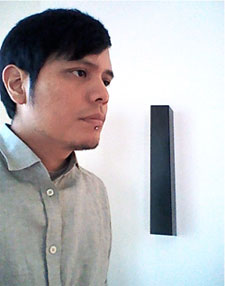
An interview with the poet, Orlando White.
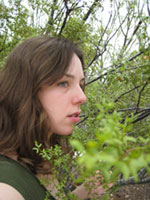
By Melissa Buckheit
MB: Hello, Orlando. Thankyou for taking the time to talk to me about your first book, Bone Light,and about your writing and life. To begin, I’m curious where your bookbegan—both in terms of a physical geography and perhaps a year, but alsoinside yourself and within the world. How did you come to write it? It feelsyou were given to write it—at least that is the experience of a reader;the book inhabits a very particular corridor or dimensions in space.
OW: I am fond of a quoteby Edmond Jabès where he says, “When, as a child, I wrote my name for the firsttime, I knew I was beginning a book.” It was immediate and profound for me inunderstanding the idea of the ‘book’. Reading this quote, I imagined the firsttime I wrote something, my name for example, and thought, was that the moment Iexisted, because of written language? Jabès also says, “You are the one whowrites and is written.” I like the idea of how written language is ouridentity—a word expands our experience of who we are and where we arefrom. These concepts I feel were what gave some structure to Bone Light. A couple of months before publication,my notion of a book was abstract, but what gave it shape and physicality wasperhaps an idea that when we look at the ‘book’ we are looking at ourselves.
MB: Yes—our languageboth is and reflects ourselves. Bone Light begins with a short narrativepoem, a parable as it were, about your first experiences with language, thealphabet, and familial relationships with speech. You were six years old andjust beginning to learn letters. The idea of how your relationship withlanguage was formed—a tenuous one it feels, which you fiercely and firmlygrasped—is something which is energetically echoed as the book progressesthrough sluices of poems, letters and people. This first poem reminds me ofsomething the poet Rebecca Seiferle has said, when speaking of both her ownexperience of language and a historical one. To paraphrase, she spoke of theway language can or may carry the weight of history and historical narratives,how language itself can adopt movements like and be reflective of thosenarratives, both trauma and liberation. I feel this reality is at the surfacein the beginning of Bone Light. Yet, your movements with lettersthemselves, language and the stories inside etymology and the origin oflanguages, a sweetness and a present death, transform this entrance (the weightof language).
OW: I think RebeccaSeiferle is right in that words do carry narratives. I am reminded of LeslieMarmon Silko when she said there is always a story within a single word, andbecause story is made up of words, then those words used have other storiesinside them too, and then what emerges is a web of narratives. It is in thesingle word, which has a duty outside of the writer, to express somethingurgent. And perhaps as a writer it is also our responsibility to work with theword’s imperativeness. I think at a very young age for me, the importance ofwriting words was crucial to understanding self and imagination. I alwaysremember an urgency of apprehending the art of writing letters, words and itwas difficult, the complexities of shape and sound that each demanded. Before Iwrote, “To See Letters,” I asked myself where does my interest in language andwriting originate? As a child I was nourished through viewing my mother playword puzzles, and, also, being submitted to write letters correctly by the force ofmy step-dad’s hand. Aware of these experiences, I began to grow with poetrywriting—it provided space to imagine a word or letter first as an imagerather than as sound. The impulse of the opening narrative-like piece originatesprimarily from these two occurrences.
MB: Your second poem, “Sentence” positsalmost a thesis in Bone Light, although I hesitate to use that term, forits technicality. Nonetheless, there is the sense of logic, of a postulateopening the book, a world of direct relationship: the paper screen, the page, the blankness of both, before ahuman form or a letter graces each, touched by ‘light’. After, “letters canappear / as bones,” there is a link between the letter and the human body, and “noimagination / without / its imagery.” What emerges is the origin ofletters and their ideogram forms, shapes and images in human culture,experience and development. How does this reality exist for you, in order foryour work to inhabit it throughout the book? Can you speak of where these ideasbegan?
OW: In Stephane Mallarme’s, The Book, Spiritual Instrument, heexpresses that, “The book, total expansion of the letter, has to extract fromit, directly…” As I read this line, I found myself rewriting that phrase in myhead thinking, “The sentence, a total expansion of the shape of a letter, it hasto extract from it, directly…” I like the idea of a complete thought emergingfrom a more visual perspective in which a sentence exists because of the shapesof letters— much like how the body is made up of its parts, skeletal system,anatomy, and how visually detailed each is. I see words and sentences in thesame way; I am much more interested in the detailed layers/fragments of languageon paper. In exploring English I try to re-see it through an objective eye, sothe physicality of language is on the page and my imagination is a microscopeexamining it.
MB: A certain vocabulary suffuses BoneLight. Some are intangibles—light, for example; others inhabit asub-vocabulary related to the body and language: bleach, zero, ink, cloth, skull, skeleton, dot, bone,calcium, foam, period, sentence, punctuation mark, O, tooth, skin, book,tongue, eye, milk. Please speak about this vocabulary—so many of thesethings mimic or follow each other in shape, substance, shade or sensibility.
OW: There are repeatingwords and images throughout Bone Light,and I wanted to create a sense of a language economy and meditation. I like theidea of using a minimal amount of words in a short amount of space and time. Inso far as how koans and aphorisms function, there is an immediacy of an emotiveand intellectual intensity within a limited use of language. Almost every wordand phrase repeated throughout the book is an item of introspection, because Ithink concrete and abstract objects reflect how we perceive ourselves too.
MB: Again and again as thebook progresses, as a reader I am engaged with a sense of what is left aftereverything else has been removed—the silhouette of the human skeleton,the skull itself, just the ink or shape of a letter without its sound ormeaning, necessarily—this feeling of the bareness of components, almostlike photographs in negative. The body is without flesh, adornments, the colorsin Bone Light are shades—white, black, variances thereof. The‘instructions’ or actions maintain this state—the line “Soak wash cloth /in bleach. / Put it on face,” for example.Within these shades and shapes (when I close my eyes after reading, I can seetheir shapes on my eyelids, as one does after staring at a bright light or thesun), is the apparent presence of death. Where is this ‘death’ and why? Whatare your thoughts and feelings about this sense of ‘life in negative’?
OW: Coming back to EdmondJabès, he mentions something to the effect that the moment someone writes onpaper, she or he reveals an injury, that somehow ink is a type of bandage andthe page is a wound. I understand this as a writer’s process of creatingletters, words, sentences, and as this happens with the action of writing, awriter removes layers of her or his external self, too. Ink (rather than asbandage) is skin/flesh and vice versa, and the page is the skeleton—so inBone Light there is a process ofdehumanization perhaps. A lot of the poems enact a method of beingdeconstructed by language, but at the same time we are that language too.
MB: That substitution fromJabès’ idea is fascinating. But a sense of life (in the flesh) does emerge asthe book progresses. In “Analogy,” the letters i and j become acouple, “a man the size of a letter / wears a white necktie and dark suit” and“Next to him, a woman the size of a letter, too; / she wears a white scarf anda black gown.” The couple is in love; they are human but created from a slightplay on the shapes of two similar letters—the slight difference in maleand female form. Poems with i and j, later in the book, seem atransformation or creation from the barer components/vocabulary in thebeginning of Bone Light, where they were not connected or whole things.Now, “See them on the white bed of a page, how they hyphenate, / how they willcreate language together.” Language is possible because of human relationship,co-habitation, warmth, spirit. I feel like this echoes the first poem, “To SeeLetters.”
OW: Where I am from the origin of languageoriginates from sound, and if you listen to the Diné language and understandit, like the poet Laura Tohe would say, the language is very onomatopoeic. Ifeel that sound is what breathes movement into the verbs of Diné Bizaad, italso has many diacritical marks. And I think each high tone, nasal tone,glottal stop, and slash are visual representations of movement. Without thesemarks it would not make any sense, it’s much like how words and sentences needpunctuation to be understandable. How the word and image of a “hyphen” is used inthe i and j series performs not just as a symbol but also as a kind ofdiacritical verb (if that makes any sense!). The hyphen exists in order toadjoin both letters for them to make sense on the page. So in a certain way the“hyphen” is crucial in understanding iand j and their existence.
MB: In the book’s finalpoem “Writ,” death points the gun of language at your skull, filling its emptyholes with dark ink. You say that you “saw the white door of paper” and were“there forever it seems, / thinking of the origin and end of poesis.”This poem seems both serious and humorous to me; there appears to be commentaryabout human experience and about poetry, itself. I’m curious if you werethinking of the Greek root for poetry? Can you speak about this poem?
OW: Actually, the poem“Writ” I wrote after an intense dream I had; in my dream someone was followingme and that person was a dark silhouette, he had no eyes or mouth, no facialexpression, just a complete shadowy figure. I remember the dream smelled of hotink, it felt humid, and I was trying to run away from this person. I don’t knowwhy I was trying to get away, but I knew my fear fed my desire to hide, and myinstinct told me to hide behind a white door which appeared in front of me.Eventually, the person finds me and shoots me in the head. The dream shook meup not only emotionally but intellectually as well, so I wrote a poem about it.I just took the basic idea of the dream and reinterpreted it by relating it tolanguage and writing.
MB: There is such avisceral sense in that poem, in the way that dreams can feel so real when weare in them. Lastly, I wonder if you can speak about your earliest influencesas a writer and what, in particular, influenced the writing of Bone Light? What were you reading and studying?
OW: My earliest influencescame from poets like Charles Simic and Mark Strand. In particular, Dismantling the Silence and The Orphan Factory by Simic; hiscreative thoughts on objects and his use of the poetic image expanded myimagination. I also loved Reasons for Movingand Darker by Strand; his poems allowedme to meditate on the conditions of the self. Of course, The Black MountainPoets manifesto Projective Verse, writtenby Charles Olson and Robert Creeley, was crucial to me in terms of how form andmovement of line perform. Certain aspects of literary theory influenced me aswell, mostly from Structuralism and Deconstruction. Lastly, Edmond Jabès in hisBook of Questions was quite amazingto me and still is. When he says things like, “I get up with the page that isturned. I lie down with the page put down. To be able to reply: ‘I belong tothe race of words…’” His poetics freed up my process so I could interact more betweenthe texts I write and myself as a writer.
MB: When did you beginwriting poetry? Your reading for the Edge Series of Emerging and YoungerPoets, which I curate, was quite powerful—I could feel the weight, aswell as the emptiness and music, in each poem read. This denotes a life spentwith language as aural and oral, in my mind; song and page exist, hand-in-hand.What does the spoken form of your poetry signify?
OW: I love the idea of thecaesura as a line break, the pause between words. Its impulse to fragment asentence and reveal the white space of the page, for me, is a visualrepresentation of silence. There is a relationship between speech and the pageand I do my best to emphasize silence because I feel there is a musical formwithin stillness, an unseen rhythm informing the text, the listener, and thewriter.
MB: Since your first bookwas published, please speak about your current work and your second book, as itis coalescing. How does your current work bridge or connect to Bone Light, with it preoccupation andinsistence on the experience of language, history, and self, as well as themovement of language on the page?
OW: The second book I amworking on now is an extension of BoneLight in that I write about other letters besides i and j. But a section ofthe book focuses on letters and their pictorial singularities. And I think whatdrives my second book is the idea of re-seeing language again as pictorial andsound, rather than as something seen as an object and somewhat peripheral.
MB: What are some of thethemes and preoccupations of your current work, and what other disciplines orfields of study have been informing you in your writing from the past couple ofyears? Who have you currently been reading and thinking about?
OW: In another section ofmy second book I will be looking at the origin of sound according to Dinéthought. The idea that in the beginning language was sound, not the word. It’sreally nothing new, but I hope in exploring my Indigenous language, it will addmore depth to that idea. There are also a few books like Letter by Letter by Laurent Pflughaupt which examines letters froma more artist perspective; another is Wordplay:The Philosophy, Art, and Science of Ambigrams by John Langdon, which looksat how the shapes of letters can play with the imagination; also, reading up ontypography and other languages in general have inspired me to write poetry.
MB: Thank you so much,Orlando.