
Interview with Orlando White by Melissa Buckheit in this issue.
_______
New work by Orlando White in this issue.
_______
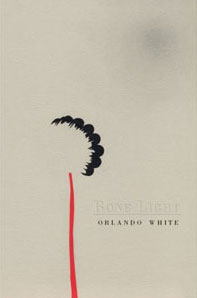
Bone and Letter, Image and Thought: A Review of OrlandoWhite’s Bone Light
By Melissa Buckheit
White, Orlando. Bone Light. Los Angeles: Red HenPress, 2009.
BoneLight opens into the array of human history and existence, from the earliesthuman acquisition of language and communal ritual, to any moment in timethereafter, a white expanse like an unmarked map or a vast plain, shorn ofgrass and bare, in winter. We are not placed in any one moment in time, nor anyparticular physical geography, but rather in the space of transformation ofthought or imagination, the space of the mind alongside culture as it creates language,meaning, signs, alphabets and characters—from narrative, the quotidianand the liminal. Within this space, the subject of the written word, and itsinnate relationship to the human form, emerge. The foundation of Bone Lightis therefore built upon the idea that the letter and the word are more than shape,form or sound; they create meaning when put together into words and sentences,but also begin from individual meanings and narratives, in their ideograms. Yet,the letter is always an object too, in its shape on the page. The ‘under-world’of language therefore reveals our stories, associations, and collectivenarratives, from the past through the present and future.
Itis into this glittered and littered field that Orlando White creates poems, asthey emerge like bone through flesh into the light or like a letter cutting thepage with ink, at scattered points in the field. It is ironic that the letterbegins with narrative and accumulates narratives, hidden or visible, silent orvoiced, at peace or seeking redemption. At the heart of White’s source andimpetus for this book, seems to be the link between language as the organized,revered, and controlled high written word, and language’s most natural originin the quotidian and the oral. I cannot help but feel that identity is notwithout relationship—so many of White’s poems seem to contain theresurrection or display of the remnants of death— echoing the story of anoccupation and/or erasure of a people among many peoples, a sadly commonnarrative since the beginning of human history. Within this history, thesilencing and distortion of language, among other distortions, seem intrinsicfor White, a Native American poet, specifically Diné (Navajo). In Bone Light, poems are never arequiem or the simple act of witness or retelling only; they are alive, like askull brought back to life through imagination and breath. They are woman or man,the parts of the human body or letters moving across the flesh of the page, inaction or commanded to action by the poet. This is a very singular instinct andinclination—one that knows that language was alive all along, awash inshades, but perhaps hidden to preserve culture, identity, the language itself.Here, the underbelly of the language emerges, stark, carry stories of beginningand stories of surviving, alongside one another.
Justas bodies move across space or letters may occupy the page, most of White’spoems are spare—words, short phrases or images dropped onto the page,like human speech is created in discernable yet unremarked daily patterns. Thebook lends itself to being read aloud by the poet (ideally) or the reader, inany space—a city park or a room with the door closed. Having heard Whiteread, the intentionality of his inflection and rest returns language to itsmost natural space, gracefully and with ease. Yet, his poems are not easy, forall their spareness, nor for their varied repetition;these ‘limits’ remind me of algebraic equations—mathematical or evenphilosophical— particularly a preoccupation with the zero. So veiled orimpenetrable at times are some poems (qualities which I prefer and which occupymy own work), that I feel I can hardly say anything about them, nor would Inaturally seek to analyze them. I can say that the mind of the poet is foremostin this book, seeking to engage the reader, and unlike many books of poetrytoday, Bone Light does not close but opens in its practice. It createsand continues, like a circle, without saying what any one thing isabsolutely—any narrative, person, or emotion— or assigning itpositive or negative status. There is neither answer nor any desire for ananswer—there is an emptiness which is a natural milieu and reality. Thebook, as an object or reading experience is not boring, and it is not marked bythe public personality of the poet and his or her ‘take’ on various dailymoments. Instead, Bone Light is a cool and warm and vivid act ofimagination, a most authentic movement of poetry, one which listens to the manyvoices echoing in the din of human experience, which is an almost reflection(but not exact) of ourselves, our shapes and forms, stripped down to our mostelemental bones and phonemes, as
Below the skull there is a part of a letter
shaped like a bone. But the skullis not a skull;
it is a black dot with white teeth.And the piece
of the letter under it is notreally a bone,
rather a dark spine. This is notthe end of language …
The way a word tries to breathe inside
a closed book; the way a lettershivers when
a page is turned . Becauseunderneath sound
there is thought. Language, acomplete structure
within the white coffin of paper.
~excerpt from “Ats’ííst’in,” by Orlando White