_______
The Spanish original follows the English translations in this selection.
_______
Poems
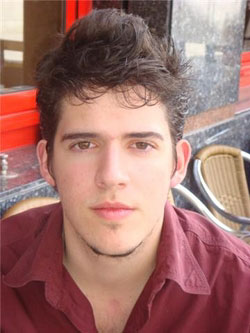
by David Leo García
Translated by
Sara Sams

Translator’s Note
Throughthe empty archway a wind of the spirit enters, blowing insistently over theheads of the dead, in search of new landscapes and unknown accents: a wind withthe odour of a child’s saliva, crushed grass, and medusa’s veil, announcing theendless baptism of freshly created things.
−−FedericoGarcía Lorca, “Theory and Play of the Duende”
More than any contemporary Spanish poetry I’vehad the opportunity to read, David Leo García’s poems seem to seek,throughcareful playfulness, the same path as the duende—that “mysteriousforce that everyone feels and no philosopher has explained” Lorca put at thesad and buried heart of all Spanish art (Falla as qtd. in Lorca). In thissearch, the poet has “neither map nor discipline”; as in Lorca’s description ofthe duende,“We only know it burns the blood like powdered glass, that it exhausts, rejectsall the sweet geometry we understand, that it shatters styles and makes Goya,master of greys, silvers and pinks of the finest English art (3). My job as atranslator, then, has been to re-trace those inscrutable steps—to divedown to the duende of his poems and to bring back not simply his masteredgreyness, but the greyness precisely in its moment of transformation intosilvers and pinks, a flower just before it’s dead.
The initial tracing was nothing but pleasure:reading a David Leo García poem is as delightful as placing the last,snout-shaped piece in a puzzle of a cocker pug. Digging into “Dessert Menu,”for instance, I found absurd carrot after absurd carrot, chomped by absurdcharacter after absurd character. The comic action began to overwhelm mysenses; I was in an assembly-line of carrot-eating—a sensation emphasizedby the repetition of “comiendo zanahorias” at the beginning of four lines andthe ceaseless enjambment of the various chompers. It’s an odd and fun onslaughtof images from a very Wonderland-esque world, but the poem’s speaker ends upsomewhere completely surprising: right beside us, tilting his head to the sideat the same strange sight, sighing in what might as well be my ownexasperation.
Forgive me, ma’am, but why
would I want two perfect eyes
if—regrettably—the only thing I cansee
is fields of men eating carrots (9-12,translation mine)
Afterreading these last four lines, what might have been an easy rendering of absurdimages became a much more difficult task. Where exactly had that mysteriousforce crept into the blood of the poem, making tiny explosions of powderedglass? There is a sadness here—an awareness of the speaker’scircumscribed perceptive faculties, a loneliness in his ease of dismissing soimportant a sense as sight. There they all are, those people, who cares whatthey do,they’re all doing the same thing. But it’s a sadness felt only in the undercurrentof a flippant interaction with a waitress—and precisely in thatundercurrent the speaker exhausts, rejects the vividness of imagination.
How was I to import his very smart lines ofcheeky annoyance— “Perdone señorita para qué/ quierodos ojos en perfecto estado/ si lo único que veo a mi pesar/”—into English without giving them a much too dramaticsense of futility? The key, for me, ended up being in the translation of thatfinal image. I held on tightly to the to “plains of men eating carrots”as an English version of what the speaker sees in the end; I loved theambiguity in the Spanish llanuras, as in plains or lowlands or flatness, the two-dimensionalabstract quality that seems to be the lament of the poem. But it was muchtoo-elevated diction for a crucial moment, and the substitute “fields” was asimple choice that made an enormous difference. It kept the visual imagepriority without losing the connotations of a flat expanse. The speaker seemedless like a bigote-cladhipster who spoke at inopportune times about geography; he became an ambiguousSeer of all of the disparate people in Spain eating carrots, the baseingredient of a carefully chosen dessert, having a special knowledge of it,aware of this keenness, reacting with just the right gradient of irony as thewaitress (who has becomes much more ambiguous too, a sort of Deliverer ofDesserts, an enforcer of enjoyment) who tells him to pick what’s yummy and goodfor him, to be a comrade, and of course he thinks, eh, what’s the point?
Of course I had many other obstacles inproducing a satisfactory translation of “Dessert Menu”—how to import alist of Spanish professions into roles an English audience would be familiarwith, for instance, while keeping the same sense of arbitrary social division(counselors became politicians, pedants professors). But I was astounded on howa translation can hinge on a single word and the journey it’s made “over theheads of the dead”—that though you might not be able to map the work of apoem or ever truly understand the poet’s own turns and bends, if you’ve luckyou will eventually hit a magical hotspot; touch, for a second, the duende.
I’d also be a carrot-chomping dullard if Ididn’t mention the subtle and genius use of form Leo García wielded in a lot ofthese poems. Unsurprisingly, the sonnets were especially hard to import fromSpanish over to our clunkier, anglo-saxony tongue. I abandoned the attempt torhyme at all in “Pink Moon,” but found that very discipline to be the onlything that helped me open up the world of “Sign.” More often than not, Iabandoned the stricter guidelines of a form that in his Spanish seemedeffortless for the benefit of carrying across more vividly the images of thesestrange little worlds—little worlds that nonetheless manage to drop agreat arsenic lobster on you when you least expect it.
DESSERT MENU
Frozencarrots. Politicians
eatingcarrots. Boxers
eatingcarrots. Professors
eatingcarrots. Wallflowers
eatingcarrots. Some or other
specimenpicking carrots
fromstreetlights and sacks of cement.
Goodfor your sight. Of course.
Forgiveme, ma’am, but why
wouldI want two perfect eyes
if—regrettably—the only thing I can see
isfields of men eating carrots.
CARTA DE POSTRES
Zanahoriasheladas. Consejeros
comiendozanahorias. Boxeadores
comiendozanahorias. Los pedantes
comiendozanahorias. Los medrosos
comiendozanahorias. Algún que otro
espécimencogiendo zanahorias
defarolas y sacos de cemento.
Buenaspara la vista. Desde luego.
Perdoneseñorita para qué
quierodos ojos en perfecto estado
silo único que veo a mi pesar
esllanuras de hombres comiendo zanahorias
UPON REGISTRATION
Iknew that this city wanted to contain me
withceramic tile and blackbird squads
whenI saw the deaf commissioners
liningup to convert me;
theyfollowed me to the urinals
todocument my gestures and advise me
thatthe proper forms are hanging from the poplars,
thatthe wind will shake them till I sign.
Oneafternoon I stumbled upon my jokes,
archivedwith all of my tardies
beneatha hodgepodge of disappointed dust.
Allof my doings will be registered
preciselywhere ungiven kisses burn,
wheresmall grudges can be managed.
AL REGISTRO
Supeque esta ciudad quería cubrirme
debaldosas y mirlos legionarios
alcontemplar a sordos comisarios
endesfile hacia mí por convertirme;
meacompañaban a los urinarios
parainscribir mis gestos y advertirme
quedel álamo cuelgan formularios
queel viento agita para que los firme.
Casualmenteuna tarde vi mis chanzas
archivadascon todas mis tardanzas
bajocharcos de polvo defraudado.
Irántodas mis obras al registro
dondearderán los besos que no he dado,
lospequeños rencores que administro.
RUNNING WATER
Asmuch to tap the water as to see it run— the water
thatnourishes what you take from what’s perishable; what
watersyour incalculable thirst; the water
thathelps you see everything anew,
asif you’d never blinked,
asif the invention of objects had ceased—
hopingnot so much to be forever but to have been forever; water
toconnect your organs, to clean your skull and
convinceyou that you’re not an object, not a sink—to convince you
thatyou have to spend your days as a man; the water
youdrink to obtain an eternity,
asif being eternal would absolve us of being clumsy,
asif, by being eternal, we could avoid
thecrash of a glass and the water on the floor.
AGUA CORRIENTE
Tanto arreglar grifos para ver correr el agua, el agua
que riegue tu simbología de las cosas que perecen, el agua
que preste agua a tu sed incalculable, el agua
que te ayude a mirarlo todo por vez primera,
como si no hubieras pestañeado jamás,
como si los objetos hubieran dejado de inventarse,
esperando, no ya ser hasta siempre, sino haber sido desde siempre,agua
para comunicar tus órganos, para limpiarte el cráneo y convencerte
de que no eres objeto ni lavabo y convencerte
de que tienes que cumplir tus días de hombre, agua
para beber, ara procurarte una eternidad,
comosi ser eternos nos eximiese de ser tropes,
comosi por ser eternos no se nos fueran
a estrellar los vasos de agua contra el suelo.
DOMESTIC ZEBRAS
I canusually find them in hospitals,
in crosswalks, everywhere,
adrift between plays and throw-aways,
mapping lands, transient plans.
I often notice them in auditoriums,
and, when they raise a banner brusquely,
highup—either for Science or Arts—
they can give intimidating speeches.
People: a huge mass of news,
of buried jealousies and common things;
to define them without onomatopoeia
would be impossible: they crunch from caresses…
…the squeak of a cough… bottle babble.
CEBRAS DOMESTICAS
Suelo encontrarlos en los sanatorios,
en los pasos de cebra, en todas partes,
a nado entre jugadas y descartes,
trazando planos, planes transitorios.
Suelo notarlos en los auditorios
y, cuando elevan bruscos estandartes,
en la altura las Ciencias y las Artes
dictan discursos intimidatorios.
Son gente. Ingente masa de noticias,
de envidias aburridas y plebeyas,
que definir sin onomatopeyas
no puedo: son crujido de caricias,
chirriar de toses, ruido de botellas.
SIGN
When a stormbreaks, skilled in its salting
of twobodies, don’t shield your face—
the currentthat forms will embrace
both thenames and clothes of things;
when themoon moves bit by bit
withoutknowing itself, towards a chase
of preyhunting prey, races
across thenight, reinventing it;
when wekiss, life is more dignified,
it stopsbeing a sign in order
to be life.It is kept in a hundred beliefs
that a mouthnever pronounces,
the moon isa moon and shines and fills the ages,
the hand ishand and loves what it touches.
SIGNO
Cuando vence en doscuerpos la tormenta
su destreza con sal, nola coraza,
y la corriente de seruno abraza
los apellidos y lavestimenta;
cuando la luna seencamina, lenta,
sin saber de sí misma, hacia una raza
de cazadores presas enla caza
y cruza por la noche yla reinventa;
cuando dos nos besamos,lo más digno
es la vida,que deja de ser signo
para servida. Queda en cien verdades
lo aún nopronunciado por la boca,
la luna esluna y luce y llena edades,
la mano esmano y ama lo que toca.
DEDICATION
I don’t know how to both talk and point atthings.
I don’t know how to say you are as real
as a pinprick,
real as a design to die.
Objects and you. Objects exist
because I need them
or because I haven’t yet realized I don’t.
Real, like the palm of a hand
demands a reality.
A hand on a nape,
what’s solid on what’s solid—
I’d like
to be less evident
than this map of pores. I want to be
imaginable, but only with effort;
to be as tiny
as your notion of infinity.
DEDICATORIA
No séhablar y señalo los objetos.
No sé cómodecirlo, eres real
como unalfilerazo,
real comoun intento de suicidio.
Los objetosy tú. Los objetos existen
porque losnecesito
o no me hedado cuenta de que no.
Real comola palma de la mano
que piderealidad.
Una mano enla nuca,
lo sólidoen lo sólido
y a mí
me gustaría
ser menosevidente
que estemapa de poros. Quiero ser
imaginablepero con esfuerzo.
Serdiminuto,
igual quetu noción del infinito.
NOCTURNE
Holding the garbage bags
like toxic dolphin skin,
culling from the trash
that is our months, fromthe trash
of our plans, all of thegarbage
most worthy of beinggarbage…
The neighbors on mystreet run around like this,
leave at a bugle’ssound, slip
between the air and thegalaxy’s pajamas.
The truck will come. Thedin
will pass like amnesia through the street,
an exterminating angelin uniform.
I’m livid; I’veforgotten
to anoint this soliddoor with compost.
Missing in our house:
the shadow of afirstborn
sitting on the sofa, ourdelight,
our archangel of orangepeels.
NOCTURNO
Sosteniendolas bolsas de basura
como lapiel de tóxicos delfines.
Seleccionandode entre la basura
que son losmeses, de entre la basura
que son losplanes, toda la basura
más dignade acabar en la basura.
Así van losvecinos de mi calle,
todossaliendo al toque de corneta
entre airesy pijamas de galaxias.
Y llegaráel camión. Todo el estrépito
pasará comoamnesia por la calle,
exterminanteángel de uniforme.
Quedolívido yo. Se me ha olvidado
conestiércol ungir mi puerta rígida.
En nuestracasa
falta lasombra de su primogénito
sentada enla sofá, nuestro deleite,
nuestroarcángel de mondas de naranja.
PINK MOON
Nowthat the city has scattered
wewill have to trust pink moons.
Thecrowds have stopped elbowing us—
weshould file our rosy nails.
Thesigns encourage you to cough
asyou tiptoe through the puddles;
Ifyou ask me to show you a disorder
Iwill take a rose from my bag.
Yougo on without hope, but the dead envy you,
thedead long dead under these tiles;
everyoneloved the white moon
buteach moon’s only pink powder.
Thegirls are always running around, self-absorbed,
squeezingcolorless gazelles.
Thepeople of this city are dazed.
Noone will get to die with roses.
LUNA ROSA
Ahoraque la ciudad se ha descompuesto
habráque confiar en lunas rosas.
Ahoraque los dos codos ya no irrumpen
tendremosque afilar las uñas rosas.
Caminasde puntillas por los charcos,
losrótulos te incitan a que tosas.
Pídemeque te enseñe los desórdenes
ya mi equipaje quitaré una rosa.
Sinesperanza vas, pero te envidian
losmuertos muertos bajo las baldosas.
Todosamaban a la luna blanca
ysólo hay lunas hechas polvo rosa.
Correnlas niñas siempre ensimismadas
paraestrujar gacelas incoloras.
Enla ciudad la gente está asturdida.
Nadietendría una muerte entre las rosas.
García,David Leo. Urbi et Orbi. Madrid: Hiperión,2006.
GarcíaLorca, Federico. Theory and Play of the Duende. Trans.A.L. Kline. Poetry in Translation. 2004. Web. 5 Feb. 2011.
Villena,Luis A. La Inteligencia y el Hacha: (Un Panorama de la GeneraciónPoética De 2000). Madrid: Visor Libros, 2010.
