Also in this issue, translationswith Stephen Miller
The Ocean of Suffering
___________
Audio archive of poems
and Q & A
From the Fishouse
Reading between A & B
Gratefulness.org
Ploughshares
American PoetryReview
Keats recording and essay at RomanticCircles
Four Way Books
Reading at Kelly Writers House, 2/10/04 PENNsound
Author Page at Ausable Press
The Charge atAmazon.com
___________
Note:
Bismillah, Arabic:
“in God’s Name;”
Alhumdulillah, “praise God.”
___________
Contributors
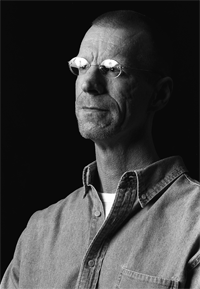
Patrick Donnelly
Mysteries of the Corn God
On this lakepresentations of his sufferings are made bynight;
the Egyptians call them mysteries. About these things I have seen
thereis much to be told, but let secrets be kept.
—Herodotus
The second grade came to the bakery
to learn about bread,
then charged shrieking past me out the door,
each kid clutching abuttered rusk.
Hold on tight, little refugees.
If nopriest sacrifices you
to make the young stalks grow,
asthe old belief was and is,
maybe after fifty years
you’llunderstand better than I do:
why or how every ungratefulmorning
those beaten elements can wake up drunk
from amash of spent grist, strap
onto themselves salt, yeast, and heat
and climb to the marketplace to explode.
Received Wisdom
I thought my mother gave me words,
because she loved and brandishedwords
between the smoker’s ash of her laughs
and her narrativesighs, audible
at the back of the house like those
of anyreally good tragedienne.
So when the time came, it was her
interesting chromosomes I thanked
in those places acknowledgements
are made,
and never mentioned the father
whose words to meseemed dull
and desolate.
Not until I learned
how theworld is built between its poles
did I understand that he alsohelped
fund that cursive fountain in me:
by laying the Yof his ice
next to her X of fire.
Mudra
Who
gives you authority tospeak? Who
died andcrowned your head? Where
in hell do you getoff?,
asked an undermining spirit named Mara
one day as Isat to write, in a hoarse baritone
just like my mother’s at the end,when
from her curtained bed she spat by now
I shouldn’t besurprised at your pompous side,
how you puff out your chest when youtalk—
only by luck not her last words.
Whogives me right?
No teacher, not anymore;
not my father,who spoke few words,
none of the judges who choose
whose wordsto set in type,
and nobody’s notion of god.
But from longpractice
noticing what I was told not to notice,
practicetouching my forehead
to the bellies of forbidden strangers in thedark,
practice extending sympathetic embassies towardeverything
low and dangerous in myself,
I’m able at lastto point, oh happy fault,
at the germ of my authority—
thechafe that bled a pearl—
in you, mother,
as I forgive the carbon
of your shadow in myself, my dear
andmortal adversary.
My Mother Tries to Quit
My mother is an animal of smoke.
I’ll do better now, hermessage says,
I’m not strong but
I’ll be better now.
My mother’s house is sixty years of smoke,
the box she sent exhaledwhat she inhaled,
the book in the box exhaled her breath,
thepoems in the book exhaled her breath,
the poems she wasn’t strongenough to speak aloud,
she sent to me, still smoking.
Finally, she said, I could hold it in my hand,
butcouldn’t inhale.
The book was Yeats;
I put him in the window to breathe.
The Truth about the Way and the Life
What if the way cheap tape
was stuck to her cheek to hold theventilator
what if the way that tape chafed that cheek,
and left white crap there
like when you can’t get a label completelyoff
and after, the gum draws every kind of dirt to itself,
soyou can hardly stand to look at the thing,
it’s ruined for you
what if the way a nurse said no, there’s no other way to holdit
what if holding it there was something
about whichshe had suddenly changed her long-standing written order,
witnessedand notarized in rooms where breathing was easier
what if theway she wrote 911 over and over into his palm
after they hadalready brought her as far as those numbers can take you
whatif the way her mind gave way
in fury at giving way,
she who wasprouder of nothing
than the way she knew and thought
whatif the battle that ensued,
the ugly dial tone interrupting
thesentence
wasn’t just the way she died
but the way wedo
Crying the Divine Name in Arabic on Highway 80
Bismillah leaning away from the demon hauling gas;
Bismillah seducing the governor over seventy-seven miles perhour:
Bismillah threading every narrow gap; with everyfrail thing we hope
crossing high over the Susquehanna boltingthrough her gorge, flooded and muddy:
Bismillah after alonged-for piss, then again to wash my hands; Bismillah
sweetening my speech, too often ironic, certain, barking and large forour little cab:
In That Name,
In That subtly vibrating,taken-for-granted-and-in-vain Name
lifting our fat bag everynight from the truck,
lifting spoons of soup to our fond, humidmouths:
Bismillah that ever we met; Bismillah ontiptoe of duty and dread
at the door of your mother’s slowsuccumbing:
Bismillah Who slipped the world drippingand perfect onto its mighty hinge:
Bismillah Who put medelicate in my mother’s pocket:
Alhumdulillah when weaccomplish
as we sleep the years-sought hush of the other and theother’s breath:
Bismillah for dangers I expect,
Bismillah for dangers I dream not of:
for dumbcreatures, crossing safely or not
(oh poor meat, poor pelt,Bismillah):
one moment after the crack-up that tears me
however it must out of us
(though not now, not soon, not crash
anywhere along here in the wetditch)—blown and broken
apart from this rough praise, Godwilling Bismillah
and not shit the final cry Imake—
Author’s note to“Mysteries of the Corn God” and Other Poems:
Four ofthese poems (“Received Wisdom,” “Mudra,” “MyMother Tries to Quit,” and “The Truth about the Way and theLife,”) are from an extended sequence about my mother, who died inMay of 2005. I’ve provisionally titled this work-in-progress, in my ownmind at least, with the German word Mutterkreis—“MotherCycle” —thinking of Schumann’s Liederkreis, a songcycle I sang in college. Even as I give the sequence this title, Iimagine the voice of my best poetry buddy Adrian Blevins asking, as sheoften does about some aspect of the new poems I show her: “Is therea way this could be in English?” The answer to that is yes,probably—but for now let’s call it Mutterkreis, because ofhow the word Kreis, even though it means “cycle” or“circle,” sounds like “crisis.” And though I’m sureGermans are fully capable of writing sentimental poems about theirmothers, the word Mutter, to my American ears, sounds usefullylike mud, mutt, muttering and all things harsh, vulgar andvividly Anglo-Saxon. Just the kind of sound one needs to keep poemsabout one’s mother on the up-and-up.
The title of“Mudra,” as I hope is at least a little clear from the contextof the poem, is a Sanskrit word that refers to the symbolic handgestures in representations of the Buddha and other Buddhist and Hindusaints. Likewise, the name “Mara” in the same poem is areference to the mythological character who acts as adversary or tempterin several Buddhist stories.
PATRICK DONNELLY’s collection of poems is The Charge(Ausable Press, 2003), about which Gregory Orr wrote “. . .everything he writes is suffused with tenderness and intelligence,lucidity and courage.” He is an Associate Editor at Four Way Books,and has taught writing at Smith College, the New School University,Clark University, and the Bread Loaf Writers’ Conference. He wasThornton writer-in-residence at Lynchburg College for Spring, 2006. Hispoems have appeared in The American Poetry Review, The Yale Review,The Virginia Quarterly Review, The Massachusetts Review, Ploughshares,The Marlboro Review, and have been anthologized in the Four WayReader #2, The Book of Irish American Poetry from the 18th Century tothe Present, and elsewhere. From the Bread Loaf Writers’ Conference,he received a scholarship in 2003 and a fellowship in 2004, and grantsfrom the PEN Fund for Writers in 2000 and 2001. Donnelly teaches writingworkshops and coaches writers to give public readings; for moreinformation, or to schedule a workshop near you, contact him at [email protected]
