Also in this issue,Patrick’s poems
_______
TRANSLATIONS OF EIGHT BUDDHIST POEMS FROM THE JAPANESE IMPERIALANTHOLOGIES
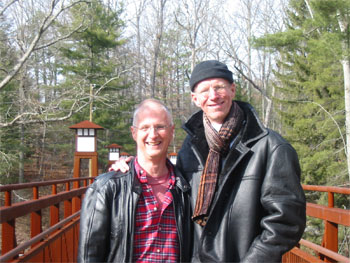
Translated by Patrick Donnelly and Stephen Miller
Senzaishû 1208: “Written on the Spirit of the Verse‘Turning to the Moon Brings Paradise to Mind,” by MinamotoToshifusa
Senzaishû 1222: “From a Hundred Poems onthe Law, This One on the Verse ‘Only the Boddhisattva of Wisdom WillNever Abandon Me,’” by Shikishi Naishinnô
Senzaishû1227: “On the Meaning of the Teaching ‘Secretly Inside He Is aBoddhisattva’ from the Lotus Sutra,” by Sakon Middle CaptainYoshitsune
Shûishû 1328: “Noticing a Paintingin the Monks’ Hall in Which the Priest Chûren Weeps Over a Corpse, theAuthor Speaks as the Priest,” by Minamoto Sukekata
Senzaishû 1210: “Written Before the Poet Endured Troubles onPilgrimage to Present a Lotus Sutra in Gold Ink,” by FujiwaraAtsuie
Senzaishû 1232: “Written When the Ministerof the Right Came to the Paradise Hall of Sensai Shônin’s Temple,”by Jingihaku Akinaka
Shûishû 1338: “WrittenWhen the Tenryaku Emperor’s Plans for a Celebration in His Mother’sHonor Were Cut Short by Her Death, and a Ceremony to Recite the SutrasWas Held Instead,” by Gyosei
Shûishû 1347:[untitled] “the debt I owe the breasts,” by Gyôki
WRITTEN ON THE SPIRIT OF THE VERSE “TURNING TO THEMOON BRINGS PARADISE TO MIND”
people who think
I’m onlywatching
moonset behind the mountain:
when I face the West,
I’m composing
my will
—Minamoto Toshifusa
Senzaishû 1208
iru tsuki o
miru to ya hito wa
omouran
kokoro o kakete
nishi ni mukaeba
on the night
whenI leave home
forever—
an out of this world trip—
I hear it’s moonlight
willlead the way
—Shikishi Naishinnô
Senzaishû 1222
furusato o
hitori wakaruru
yûbe ni mo
okuru wa tsuki no
kage to koso kike
ON THE MEANING OF THE TEACHING “SECRETLY INSIDE HE ISA BODHISATTVA” FROM THE LOTUS SUTRA
you didn’t need to cross—
were helping others across—
did they think you crossed it alone,
the ocean of suffering?
—Sakon Middle Captain Yoshitsune
Senzaishû 1227
hitori nomi
kurushiki umi o
wataru to ya
soko o satoranu
hito wa miruran
my fate
brought me
to this corpse—
who will
visitme
when I’m in this shape?
—Minamoto Sukekata
Shûishû 1328
chigiri areba
kabanenaredomo
ainuru o
ware obatare ka
towan to suran
while I wait fordaybreak
to wake me out of this dream
light thedark bedazzlement
of the Law
(—found by someone
in the poet’s house, after he
made his offering
on the mountainand died)
—Fujiwara Atsuie
Senzaishû 1210
yumesamemu
sono akatsuki o
matsuhodo no
yami o mo terase
nori no tomoshibi
looking down into
theflawless pond
I saw my face
reborn
when for so long I was sure
I’d fall into hell
—Jingihaku Akinaka
Senzaishû 1232
isagiyoki
ike ni kage koso
ukabinure
shizumi ya sen to
omou waga mi o
I wanted to hurry them
toyou
for your journey—
the tender
shoots of spring
I pickedtoday
—Gyosei
Shûishû 1338
itsu shika to
kimi ni toomoishi
wakana o ba
nori nomichi ni zo
kyô wa tsumitsuru
[Gathering young herbs was a springtime ritual at the court. The poemalso alludes to the Buddha’s teaching (in the “Devadatta”chapter of the Lotus Sutra) that he reached enlightenment in a previouslifetime by performing tasks for others: gathering herbs, chopping wood,carrying water.]
the debt
I owe thebreasts
my mother in tender mercy gave—
to one hundred stones
add eighty—
Irepay today
— Gyôki
Shûishû 1347
momokusa ni
yasokusa nosoete
tamaiteshi
chibusa nomukui
kyô zo waga suru
[This poem is thought to be based on a sutra called the Shinji-kangyôwhich gives thanks for the four blessings of parents, sovereign,sentient beings, and “the three jewels” (Buddha, Dharma, andsangha). The version of this poem in the Shûishû reads“one hundred grasses” rather than “one hundredstones,” but commentators suggest this is a miscopying.]
Note on the Poems and Translation:
Between the early10th century and the 15th century, the Japanese emperors ordered thecompilation of twenty-one anthologies of poetry. These anthologiescontained anywhere from a few hundred to several thousand poems. Ourtranslations are drawn from the third such anthology (the Shûiwakashûor Shûishû for short, the “Collection of Gleanings ofJapanese Poetry,” completed at some point between 1005-1011), andthe seventh anthology (the Senzaishû, the “Collection of aThousand Ages,” compiled between 1183 and 1188).
Thecompilers of the anthologies, in addition to arranging the poems underthematic headings (seasons, love, grief, travel, etc.), gave many poemsa short prose preface. These prefaces, which addressed the poems’thematic content or the occasions of their composition, are nowconsidered aesthetically inseparable from the poems. In ourtranslations, to join preface to poem in a way analogous to Englishpoetry, we’ve presented prefaces as the poems’ titles.
Ourtranslations are all of poems with Buddhist themes, called shakkyô-ka.The Senzaishû was the first imperial anthology in which shakkyô-kaappeared as an independent category; our translations from theSenzaishû are all drawn from this section, the 19th book. OurShûishû translations are from the Aishô-ka section(“Laments”), the 20th book. This group of poems isparticularly concerned with death and other forms of impermanence andtransformation, a common focus of shakkyô-ka. The poems make frequentreference to Buddhist scriptures, such as the Lotus Sutra, and toBuddhist concepts or personalities, such as the bodhisattva, acompassionate person or heavenly being dedicated to seekingenlightenment for everyone. (For instance, the poem by Yoshitsune makesreference to a passage in the Lotus Sutra in which the Buddha explainsthat someone was a hidden bodhisattva.) Likewise, because they wouldhave known that the moon sets in the west, Japanese poets and readers ofthis period would have easily associated references to the moon ormoonlight in these poems with a Buddhist desire to be reborn in theWestern Paradise of Amida Buddha. (This goal was the particular focus ofthe “Pure Land” teachings that were popular with thearistocracy—the writers of these poems—during the Heianperiod.)
The Japanese originals of these poems (like mostpoems in the imperial anthologies) are waka, the thirty-one syllableform that was predecessor to the haiku. Because Japanese poetry iswritten in vertical columns, there are no “lines” as such, butin waka the syllables are broken into groups of 5 – 7 – 5 – 7 – 7syllables. These groupings are often rendered as five lines in Englishtranslations, but we chose to let the syntax in English take precedenceover the poem’s original form. Likewise, our translations don’t imitatethe syllabic form of the originals, on the reasoning that there isn’t astrong tradition of syllabics in English poetry. In part, this isbecause English, unlike Japanese, is a language in which the alternationof strong and weak stresses is important, a fact that gave accentualrhythm precedence over syllable-counting in English prosody. Our goalwas to create interesting English poems that convey the emotional andspiritual arguments of the Japanese originals.
PatrickDonnelly
Stephen Miller
South Deerfield, September 25, 2006
Translators:
PATRICK DONNELLY’s collection of poems isThe Charge (Ausable Press, 2003). He is an Associate Editor atFour Way Books, and has taught at the New School University, ClarkUniversity, and the Bread Loaf Writers’ Conference. His poems haveappeared in American Poetry Review, Ploughshares, The Yale Review,The Virginia Quarterly Review, and The Massachusetts Review.With Stephen Miller he has translated the 16th century Japanese Nô playShunzei Tadanori for Translations and Transformations: theHeike Monogatari in Nô.
STEPHEN MILLER is assistantprofessor of Japanese language and literature at the University ofMassachusetts, Amherst. He is translator of A Pilgrim’s Guide toForty-Six Temples (Weatherhill Inc., 1990), and editor of Partingsat Dawn: An Anthology of Japanese Gay Literature (Gay Sunshine Press,1996). He lived in Japan for nine years between 1980 and 1999, in partas the recipient of two Japan Foundation fellowships for researchabroad. He is currently working on a study of the Buddhist poetry in theJapanese imperial poetry anthologies.
Donnelly and Miller aremarried and live in Western Massachusetts.
