Robert Friend’s poetry in this issue
_______
Gabriel Levin’s Essay on Robert Friend’swork
_______
Anthony Rudolf’s Obituary and Tribute
_______
For all photos of Robert Friend: Courtesy of Jean Shapiro Cantu
Robert Friend’s translations and poetry.Copyright © Jean Shapiro Cantu
[email protected]
_______
Editor’s Preface to Dancing with a Tiger: Poems 1941-1998
(The Menard Press, 2003)
By Edward Field
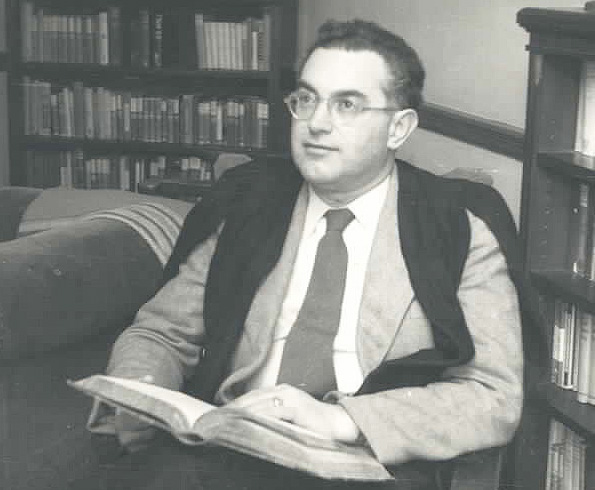
When I read thepoems of Robert Friend, I always sense the relationship to my own poetry. He was the father who passed on to methe key, and his own poetry is the mother ground I started from. It is true that W.H. Auden andConstantine Cafavy were major influences on me almost from the beginning, butfirst there was Robert Friend.
Acrowded floor of couples at a dance
andonly I,
histail wrapped round us both,
dancingwith a tiger.
Softlights, music,
socialhappiness,
butsuddenly
—what had I said to him —
thestrong grip loosened,
thetongue at my ear
stoppedlicking,
andhe growled….
—“Dancing with a Tiger”
But like dancingwith that tiger, our relationship, if vital, had rarely been an easy one.
I met him inl948. I had dropped out of collegewhere my attendance was becoming more and more erratic, and had booked passageon a converted troop ship to France, where I hoped to stay for a year on thethousand dollars saved from my flying pay during the war – this budgetingwas not unrealistic in that era of a Europe on the edge of bankruptcy. By chance and the imperatives of thealphabet, Field and Friend were seated next to each other in the ship’s diningroom. I quickly learned that thedistinguished, professorial man next to me was a published poet, and though Ihad no grounds for claiming that I too was a poet, except that I wished to be,desperately, Robert Friend accepted me at face value. Ten years older than me and a native of Brooklyn, he hadbeen teaching in Puerto Rico and Panama for some years, and after getting hismasters at Harvard, had finally landed a job at Queens College, a lucky breakthat would bring him back to New York again. So he was celebrating by going to Paris for the summer. A mistake, as it turned out, forpost-war Paris turned out to be even more seductive than New York.
During the tenday voyage, he gathered, or rather, there gathered around him, a group of youngwould-be artists and writers who were taking the thrilling leap into theunknown of a Europe that had been closed to the outside world during the longyears of the war and promised the intellectual thrill of a new movement, Existentialism. Robert Friend was a natural teacher,and it was with evident pleasure that he led the group’s discussions throughoutthe voyage. It has been truethrough the ages and in all cultures that when there is sexual interest on thepart of the teacher, the student blossoms in the particular glow of hisattention and learns. I myselfthrive on being paid attention to, and one of the reasons for my failure incollege was the hopeless anonymity of sitting in the large post-war classesswollen by returning GIs, trying to concentrateon the drone ofthe professor’s voice. Face toface with Robert Friend discussing literature was not like studying and nothinglike school. He was “just” afriend. And I blossomed.
Robert and Icontinued the “class” for several months on the left bank in Paris. Escaping our unheated hotel rooms inthat spartan post-war period of rationing, we sat in cafes for warmth, poringover the poetry in the Oscar Williams anthology of modern verse. From Friend I learned to probe thewords like a talmudist to discover the often elusive meanings in modern poetry,whose battle cry was obscurity, which only served as a keener goad to figuringit out. Further, I studied Robert’sown poems through draft after draft, as his poems emerged from their chrysalisin the endless rewriting and he showed them to me. Even in more recent years, when both of us began to writemore easily, his language had the weight of consideration, rather than thethrowaway language that is the mark of the fashionable throwaway poetry oftoday. Of course, in that era ofThe New Criticism, the more you re-wrote your poetry, we all believed, thebetter it was bound to become. Itwas also a period of political re-thinking, when the certainties of the Depressionwere being questioned. Thisaffected Robert Friend personally.
For RobertFriend was a product of Depression-era New York, and a poverty-strickenchildhood, when his father deserted the family, and many nights his mother hadnothing to feed her children and had to send them to bed hungry. He told me that he didn’t realize it atthe time, his head was so in the clouds, but when he started at BrooklynCollege his clothes were ragged.
Becausehis family could not pay the bill,
theelectricity had been cut off,
soin the evening the boy of seventeen
hadto write his poems by candlelight….
Hismother wrung her hands, his father fled
tothe warmer darkness of woman after woman,
buthe, luxuriating in the candles’
shadowyromance, went on writing.
–“History”
Brownsville,where he lived, was a Jewish immigrant slum, and typical of Eastern EuropeanJews then, street corners were lively with political discussions. After the isolation of the Jewishghettos and shtetls, in the immigrant world there was a hunger for what wascalled “culture.” Robert formed apoetry group called the Houynyms, named after the enlightened horses of Swift’sGulliver’s Travels. The readings he inaugurated in hismother’s kitchen became so popular, he told me, that people crowded onto theporch outside, in hopes of catching the magical syllables.
The years afterhis graduation from college, the height of the Depression, involved initiationinto the activist world of the Communist Party, which was reflected in hispoetry:
“…and the cash,
went sliding down Park Avenue in the crash.”
–“Subway”
It was theDepression that sent him to Puerto Rico on a teaching assignment, which was hisopportunity to discover his sexuality that had been stunted by his deprivedbringing up, the antagonism of the Communist Party to homosexuality, and theunreal romantic landscape of poetry he wandered in. Not just sexuality, but a sensuality that his aestheticismhad blinded him to — an appreciation of his body.
Theperfect paradigm
ofthe young poet —
quivering,sensitive,
painfullysincere…
Dr.Williams was waiting
atthe San Juan hotel lobby,
andhaving listened
somewhatimpatiently
soondiagnosed the case…
heled him to the terrace
thatoverlooked the sea,
andsaid:
Look,
pointingto the bathers
runningalong the beach
andsporting in the waves.
–“ArsPoetica”
Good advice fromDr. William Carlos Williams. Helearned to swim, play tennis, and take advantage of the less puritan moralityof the Caribbean by making out with those bathers. But by the evidence of the poems he remained the professor,even in bed:
Thatafternoon
hewas wearing nothing but a crucifix
thatdangled from his neck
I,not even that.
Betweenthe fervor of our probings
thatwere somehow turning metaphysical,
Ibegan to question God.
Startledout of our embrace,
heleapt onto the floor,
wherekneeling by the bed
hemade the sign of the Cross.
Hemust have been absolved,
forjumping back into our bed again,
hefinished with the blasphemer.
–“TheCatholic Lover”
After our summerin France in 1948, he could not make himself return home, even to thelong-desired teaching job in New York, and though his funds were dwindling, hestayed on and we continued to meet at the Café Pergola on the Boulevard St.Germain. Again, as on the ship, heattracted a group of French students, with whom he discussed philosophical andliterary issues with a boldness that his clumsy French didn’t discourage. When he finally ran out of money, hehad no trouble, with his academic experience, getting a job in occupied Germanyteaching American soldiers. But therehe learned that because of his brief membership in the Communist Party a decadeearlier his passport was going to be taken away, forcing him to return to theStates, where the country was in the grip of Cold War paranoia about aCommunist conspiracy to take over the government. One step ahead of the American authorities, he emigrated toIsrael. Even without therevelation of the horrors of the holocaust in Europe, American Jews of ourgeneration were still so traumatized by the recent immigration of our parentsto America, living in poverty and suffering from anti-Semitism, that thecreation of Israel was miraculous. Astonishing, too, that in Israel Jews cleaned the streets, deliveredmilk, taught school, even were street walkers! Living on a kibbutz he studied the Hebrew language, and soongot a job on the faculty of The Hebrew University.
“My way of beinga Jew is to live in Jerusalem,” he once told me, when I asked him about hisreligious beliefs. But while astaunch believer in Israel, he also was open to the culture of the Palestiniansand studied Arabic.
“Ahel,” Arabic for “family,”
cognateof “ohel,” the Hebrew word for “tent” —
fordesert dwellers a home:
grandfather,grandmother, father, mother, kids —
afamily,
allunder one roof —
theirfloor sand
coveredby mats,
theirroof and walls skin
flappingin the wind.
ABedouin living in our kind of house
solidagainst the weather
complains,
“Ican‘t sleep. The walls don’t move.”
–“ArabicLesson”
Here is revealedyet again the scholar, as well as an understanding and appreciation of theMoslem world, the essential ingredient that seems to be missing in Israelis intheir dealings with Palestinians. And here again, sexuality was the bridge to understanding, for Palestinianlovers introduced him to life in the West Bank.
Friend was theultimate cat person, feeding and caring for innumerable stray cats in hisneighborhood, in defiance of Israeli laws against this, and out of these felinerelationships charming poems emerged.
Mylittle Columbus
mylittle da Vinci of cats,
experimentalnibbler,
longlistener,
retriever
of(from the garden grass)
anallusive feather,
of(from the kitchen pail)
ateasing odor…
wherehave you gone?
…Wherehave you absconded
withyour shadow?
–“MyLittle Columbus…”
He suffered manyother losses besides his cats, and drew the correct conclusion:
Your father dies, your mother too.
Now you are next in line….
—“Next”
We continued ourfriendship over the years, though not without stresses. As in his Tiger poem, he would suddenlygrowl and rake me with a paw. Robert had a difficult side, looking too closely (from my point of view)for slights and betrayals. He analyzed my behavior as if it was the text of apoem. And perhaps I, with my ownsensitivities, was an unreliable friend, retreating into unreachable cornerswhen I should have been responsive. Once, when he was on a leave of absence in New York City, I waspreparing dinner for a couple of friends who were due at any moment and hetelephoned that he had just broken up with his lover Pete, and could he comeby. Thinking how he wouldsit there and pour out his tale of woe all evening, I told him, hard-heartedly,that it was impossible with friends about to arrive and barely enough food forthem. He was devastated, sayingthat all I had to do was “lay another plate.” I heard about my inhospitality again and again, as well asthe time in France, thirty years before, when….but it’s too tedious torepeat. He was simply likethat. He made demands on me like alover, which I wasn’t, though I always considered him my teacher, and honoredhim for that. Then he complainedthat I respected him more as a poet than as a friend. He never stopped listing my derelictions in friendship. Finally I told him I was not perfect,my faults were indeed many, and gave him an ultimatum: I’d rather we didn’t communicate witheach other any more unless he would drop his litany of my betrayals. I was trying it on, of course, hopingto get him to lay off the nagging, but he was stubborn, and it actually led toa hiatus of several years in our correspondence. Finally neither of us could keep it up, and broke down andresumed.
But with theyears, in spite of the strains and our differences, both of us evolved into amutual admiration society. I, whowas never comfortable in the educational establishment, on either side of theclassroom, as teacher or student, found it remarkable that Robert continued hisacademic career over his whole lifetime, finally getting his doctorate with athesis on E.M. Forster. Of course,Hebrew University was an ideal employer, giving him long leaves of absence forstays in England and the U.S. Buthe even enjoyed playing the student as well as the teacher, seeing it as a game,and would ask me to give him ten words. He continued to send me copies of his poems for suggestions, though hedidn’t always take them. For onething I tried to discourage him from using slang. He did it cleverly, but the slang was often horribly out ofdate.
His own loyaltywas immeasurable. I will neverforget that in 1971, when I had spent the summer bumming around Central Asia,more dead than alive with all kinds of intestinal bugs and a deep bronchialinfection — I knew if I could just get to Israel, and Jerusalem where Robertlived, I would be saved. I barelymade it to his door – and he took me in, got me medical treatment, caredfor me, and restored me to health.
It is every poet’swish to write until the end. Robert Friend did it. Hislast poems were reduced to the simplicity of the circumstances of his dying,shed of all vanity, as well as the dregs of personality. I can only wish to emulate such amaster.