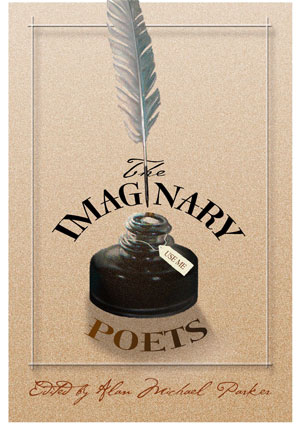
The Imaginary Poetsis available:
$19.95 pb ISBN: 978-1-932195-20-0
Tupelo Press
A selection of Aliki Barnstone’s Eva poems
Her essay Poetics of Witness
Eva and Chagall
Introduction:The Imaginary Poets: 22 Master Poets Create 22 Master Poets
ByAlan Michael Parker, Editor
Translate a poem into English, offer a biography of the poet, and thenwrite a short essay in which the poem, the poet, and the corpus areconsidered—and make all of it up, without once indicating you havedone so. Thus charged were the twenty-two contributors to this volume,who in response produced poems “translated”from eighteenlanguages including Dirja, Vietnamese, Yiddish, and even from Egyptianhieroglyphs, poems that may be read in the grand literary tradition ofheteronyms and alter egos. Calling into question the axioms oftranslation and the use of fiction-in-poetry, the work that followsallows the contributors to slip between speaker, self, and other. Iinvite you to do likewise: read these poems aloud, speaker, self, andother.
Writing as someone else seems fundamental to whatwriters do. That a fiction writer invents his or her characters couldeven be a commonplace, notwithstanding such moments when a character ina work of fiction leads us to believe that he or she might be someversion of the author, as in Jorge Luis Borges’s “Borges andI”or Tim O’Brien’s The Things They Carried. The poet asdramatic monologist seems a familiar pose as well, as can be seen in thepoems of Robert Browning, C.P. Cavafy, and Robert Frost, or in the workof contemporary writers such as Ai and Carol Ann Duffy. And of course,any literary history of imagined authorship must pay homage to themonumental and brilliant work of the Portuguese poet Fernando Pessoa(1888-1935), whose forty-four heteronyms—invented characters overwhose signature the poems appeared— account for almostthree-fourths of his life’s work.
More complicated, thepublication of poetry under a false name or a nom de plume—such asW.D. Snodgrass’ anagrammatic use of S.S. Gardons, “author”ofthe charmingly entitled 1970 volume Remains, published by theequally charmingly named Perishable Press—invites us to pay noattention to the man behind the screen, at least until such time as thetext’s provenance becomes known. Yet another possibility exists forfabricating a self, a more subversive and perverse approach, and that isthe hoax, of the kind most notably perpetrated by the bored Australiansoldiers Lieutenant James McAuley and Corporal Harold Stewart in 1943,whose invented poet, Ern Malley, had his Modernist poems championed byan equally invented sister, Ethel. More recently, another hoax hasrenewed our faith in skepticism—the forging, oft-attributed to theAmerican Kent Johnson, of a non-existent Hiroshima survivor and poet,Araki Yasusada.
But The Imaginary Poets offers anotherway to think about the writer as ventriloquist, one both serious andcarnivalesque: the contributors here have written poems that needed tobe “translated”first, that is, written as though translatedfrom another language. As a result, the ways in which these poets seetheir imagined others offers a distorted view that also constitutes aself-portrait of sorts. What is “translated”as an act ofimagining might thus be understood as the self seen prismaticallythrough an act of imagined translation.
Readers familiar withthe poems of any of these writers will surely find affinities betweentheir self-signed work and the work of their imagined poets; perhaps itis perverse and true that no matter what we do, we cannot run fromourselves, even though we can hide. Such affinities between the“original”poetry and the works here were, in part, the impetusfor this project: from the outset, The Imaginary Poets has aimedto inform the reading of its contributors’ self-signed works, to tell usmore about the poets whose imaginations have been excited by this callto charms.
Other affinities abound. A number of contributorshave chosen World War II as the scrim for their projections, anddepicted in moving fashion various crimes perpetrated during theHolocaust, a few of the poems written from the point of view of victimsand others from that of the oppressor. Something might well be made ofthese decisions, were a reader to be inclined to psychological analysis.The writing of political poetry, at times self-censored as a result of agiven poet’s own lack of suffering, here finds an outlet, theimagination allowing for a shift in content (if not subject). What onecan imagine, after all, turns out to be horrific.
Notincidentally, many of the imaginary poets collected here are dead.Perhaps a reader might see this phenomenon as mere coincidence in lightof the volume’s limited sample, and how the affinities among the entriescould be treated as anecdotal rather than empirical evidence. But onemight also understand the coincidence as emblematic: the past remainsmany poets’ great subject after all, the present turned into the past assoon as writing happens, the future unknowable. To imagine a deadspeaker is to allow oneself access to the past without the problem ofnostalgia—to avoid idealizing experience simply because it wasone’s own, trauma and triumph aggrandized alike.
But therendering of an experience in these scratches and scritches called“words”necessarily fails to be the experience itself, a notionPlato knew too well, the poets barred from the Republic on the groundsof their dissembling. Words might be a problem, as such. And so, anotheraffinity between the various entries in this volume bears noting, andthat is, the number poems presented as a version of something lost, inthe tradition of the signifier as palimpsest. When asked to invent, thepoets here responded cheerily, and their inventions were full ofdelightful moments of absence, slippage, and decentering. Poetry doeshappen in such moments as well, and yet the preponderance of thosemoments within the construction of these imaginary cultural artifactsspeaks directly to the ways in which language isn’t “real,”anotion the authors of The Imaginary Poets understand.
And thus, with serious glee, here they are: the poets the poets haveimagined. I wish them and you, dear reader, well.
* * *
Alan Michael Parker is the authorof three books of poems, including Love Song with Motor Vehicles(BOA, 2003), and a novel, Cry Uncle (Mississippi, 2005), andco-editor of two reference works on poetry, including Who’s Who in20th Century World Poetry (Routledge, 2001), for which he served asEditor for North America. His poetry, essays, and reviews have appearedwidely, in journals including The American Poetry Review, TheNew York Times Book Review, The New Yorker, ParisReview, and Salon; his awards include the 2003 LucilleMedwick Memorial Award from the Poetry Society of America, and aPushcart Prize. Parker teaches at Davidson College, where he directs theprogram in creative writing, and is a core faculty member in the QueensUniversity low-residency M.F.A. program.
* * *
The Imaginary Poets presents exceptional work from major poets whodelight in assuming a new persona. But the book’s ultimate goal is toexplore the nature of creativity: what is it to make a poem? to make upa poet? To “translate” a work—is that rewriting or writing? What abouttranslating a work that never existed? What does it mean if you createthe creator? In the tradition of Pessoa and Borges, The Imaginary Poetsdelves delightedly into the very act of invention with a wink, a smileand tremendous respect for the art.
Contributors include Aliki Barnstone, Josh Bell, Laure-Anne Bosselaar,Martha Collins, Annie Finch, Judith Hall, Barbara Hamby, JenniferMichael Hecht, Garrett Hongo, Andrew Hudgins, David Kirby, Maxine Kumin,Khaled Mattawa, D.A. Powell, Kevin Prufer, Anna Rabinowitz, VictoriaRedel, David St. John, Mark Strand, Thom Ward, Rosanna Warren, andEleanor Wilner
* * *
$19.95 pb ISBN: 978-1-932195-20-0
Tupelo Press
