Exchanges on Light is forthcoming in March, 2008 from La Presse.
_______
Also in this issue:
Melissa’s interview with Eleni Sikelianos
Eleni’s poetry
in this issue
Melissa’s chapbook Arc
_______
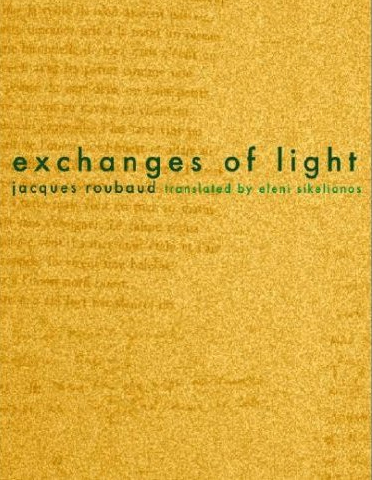
Exchanges on Lightby Jacques Roubaud.
Translated by Eleni Sikelianos.
In the Presence of Light
By Melissa Buckheit
Where does the mind go after the death of the beloved? Andthe heart? Do we try to find our partner in another realm beyond an ‘earthly’one, their vibration both vivid and ungraspable, as light moving through thefingers always does leave?
Many years ago I lost a lover in the chance occurrence oftime—two bodies on opposite trajectories, in this case, coasts. She didnot die but it nearly felt like it, and I felt myself transformed in the waythat things leave us, even parts of ourselves, evanescent and intangible. Sincethen, I’ve felt a great presence within what might be called the unseen life ofthings, although these things are no more material in flesh or atoms than lightmay be; nonetheless, they are real. How might things like the dark and light,shadow, stars, the vacuum of space and the invisible movement hidden in eachatom, seem just as real as the firm wood of our house or the breathing bodybeside us on the subway? If what was flesh and heart to our heart has left, ‘disappearedinto’ the unseen, would not that world then contain a portion of us, like thetip of finger may disappear into the edge of a dark room?
We would examine it, learn of it, touch its energy andpresent light, its palpable darkness so that we may know and speak of death. Tobe closer to the beloved, the body may seek even the cold heat of some stars.
Jacques Roubaud’s Échanges de la lumiére is the middle book of three written after the deathof his wife, Alix Cleo Roubaud. Some Thing Black and The Plurality of Worlds of Lewis, having been translated by Rosemarie Waldrop, EleniSikelianos’ translation of Échanges,Exchanges on Light, brings forwardthe middle book in an English both clear and humanly awake, sober yettransfixingly harmonious with Roubaud’s luminous yet elusive language, elusivein the sense of his presence—body, limb, tongue—within a world ofthe unseen he explores. Roubaud’sFrench in Échanges is one mostkindred, of kin with what is visible and invisible in the air, the assonancesof light and the body, the cold arrival inside death, dedans la mort, that has always been possible in the Frenchlanguage—from Mallarmé to Baudelaire, Camus to Proust to Jabés. To liftthis inclination from French and travel with it into English takes a careful, vitalear and tongue. Sikelianos abandons herself to none other than absolute coalescenceinside Roubaud’s text, in moments fighting tooth and nail a millimeter closerto the unremittingly humane yet incandescent logic and dialogue of the French.Yet her translation is also aware of the necessity of the English, of what mustbe traversed as well as translated to make a new book in a new language.Witness,
Lewis de B.
The only beautyconceivable in light is, as in all things, the beauty that comes to us fromknowledge: to know how light, to know how it moves, I ask no further beauty.
M. Goodman
As for me, Iwould say: the beauty of light is its pain. I name light more than I see it. If I name light, I have named pain.
Exchanges is theintersection of mind with the world, after the death of the other. If SomeThing Black spoke on the most immediate,personal and intimate level of the self in the flux of loss, and ThePlurality of Worlds of Lewis investigatedthe boundaries between possible worlds, the earthly, the ‘unseen,’ and the phenomenologyof the self’s own perception of the body of what is lost (a woman’s), and themind left behind, Roubaud’s, Exchanges on Light seeks enter into a conversation inside not only thepersonal and the perceptual, but inside philosophy, physics, the history ofideas, religion, mathematics and poetry, situating itself at the center of amovement which collapses outward, traveling in all directions. The book is setover six nights, with five speakers engaging in dialogue about the nature oflight. One of Roubaud’s characters, M. Goodman, begins the introduction,placing the speakers and the reader in two real settings—a house in thecountryside nearing dusk, and the air which holds the subtle light, the realspaces of stars and of the imagination, perception,
M. Goodman
I’veasked you all to gather here for the next few evenings, just when the lamps arebeing lit, as the natural light is dying, leaving the outside world indarkness. Imagine that these windows open to the west, that right out there isthe grass, the cultivated grass, of a park laid out by, say, Capability Brown,or perhaps Humphrey Repton, with its orderly disorder of trees and, farther on,the low hills in the soft English distance.
Buteach of you might imagine another landscape, one beyond these windows facingus, one pierced by stars and lamps in which their lights meet, fight, trade,and leave even as we speak. It’sof light that we speak, that you speak.
What is the light? We seem to think that light is the bodytransmuted from its corporeal form, light is a medium through which energy moves,not literal energy of joules but the waves and particles of sense, the sense ofthe other. The light moves through air in changes, la lumire in French, as it would seem to before our eyes, so the air and thepresence of the light are evidence of some tear or rip in the space around us,some gateway. The other speakers respond, each with a different enumeration oflight,
M. Goodman
Tobegin:
Nolight, no world; and it’s not just the world that’s not, without light, but allthat is, which is but light. Objects are of worn-out light. The total of light is the world.
William H.
Lightis the boiling point of things.
Basil of C.
Lightis an emanation from God; as emanation, it is an eternal process; it is notcreation at each instant; for creation is ex nihilo and takes place in time; and light is natural whilecreation is a deliberate act.
John PH.
Everythingyou have just trebly said is naught but this: the world is luciforme a luce prima: formedof light, derived from First Light. Light is the first bodily form. It is not objects but forms that are light, the only substance of thephysical world that is nearly pure form; since all form is a form of light thatmanifests in the object that it informs.
Dennis PS.
Lightis what cannot be touched; untouchable even as lightning. The cause of all beings, itself nothing,being overessentially cut off from everything.
Lewis de B.
Beserious, let’s not get carried away: when the sun, after hovering majestically on the horizon, sinks andsuddenly disappears from sight, we understand that between this star and us existsa mode of communication that, without our having to touch it, brings itspresence to mind. This mode ofcommunication, which exercises itself over incommensurable distances and istransmitted via the eyes — this, and this alone, is light.
But we may never fully know light, Roubaud seems to say in Exchanges, and of course we cannot. The questions asked of thenature of light range from it origin (who made it and whence did it begin), itsnature (is it infinite or finite), out to the inhabiting of light, bodies oflight in space, the space we are in, as well as light’s inverse—shadow,darkness, loss—and the variance between lights and light, a metaphysics,
M. Goodman
Butisn’t that what light is? There is light and there are lights; lights are objects, light isarrow. The first change, not thesecond.
Dennis PS.
Not-lightis also the being of beings-of-light. We mustn’t call them the simple reverse of perceptible light. If one reasons thus, one transformsthem into their opposite, that is to say, into what is, in itself, darkness;instead of being that-which-manifests, that-which-illumines, they become onlysomething manifested, the sign of a light other than that light which informsthem. Contrary to what Aristotlesaid, all contingent realities, like the simple lights which appear on thehill, or those reborn in Mr. Goodman’s memory of London, each accidentalconfiguration, must be preceded by a more noble being: it’s the illuminative exigency restingon the unconditional hegemony of illumination in relation to the object that itreveals.
Roubaud speaks both of the properties of ‘dark bodies’, aswell as the human body after death. An inquiry against the human fear that allis lost with this dissolution, he preserves the soul, the essence of light. InSikelianos’ translation, arrives,
Dennis Ps.
Visible light, although moving(because of our own slowness) imperceptibly, is no less essentially slow. For it doesn’t emanate directly from anabsolute luminous core, but from a dark body (dark like ours, like all materialbodies). A body, a dark body, is a sponge for light; it absorbs real light andadulterates it. Heated like the stars, it goes from red to white, but the glowit emits, which we call light, is only a distortion of the true light it hasswallowed and which we force it to give back.
Which is most real, life-life or the other life? Perhaps abook composed of questions is most aptly engaged with questions. We can notknow, but we may follow, perhaps even inhabit a ‘dark’ light; as Dennis PS.says, “If shadows had no light, we wouldn’t see them.” Sitting here in themorning, as a pale winter light shudders through my curtains, I am led to thinkof a short poem by Akhmatova from her later work,
Itis not with the lyre of someone in love
thatI go seducing people.
Therattle of the leper
iswhat sings in my hands.
(trans.Jane Kenyon, from Twenty Poems of Anna Akhmatova)
Roubaud is no leper; yet as a poet and a writer in thesociety of OuLiPo, he sings. The fragile luminosity of changes and Sikelianos’ Exchanges, brings beauty to such a pitch it might shatterglass. Yet, it is the unbearable beauty, the truth of great price, only arrivedat by passage through the fire of great loss. This is some other transaction;Akhmatova’s emotion is true also for Roubaud, who sees beyond what existedbefore, into new forms. The compassionate fire of his intelligence burns withthe sharpness of inquiry and the pleasure of encountering natures andexperiences which cannot be completely known. Yet, there is no blood in Exchanges, not the blood of the body, the quintessence of Eros.These are different worlds, between which exists a portal. The act whichbridges is the act of writing; if not of the flesh, then of theheart—memory, as the cipher which you read on this virtual page, is illuminatedby light.
M. Goodman
To call light beautiful one mustbe able to say: what light tells me is itself, but of this I cannot, can nolonger, speak.
. . .
William H.
Just beforelight, time takes place, just after, beauty does; during light, light.
Exchanges on Light
Jacques Roubaud
translated by Eleni Sikelianos
ISBN: 1934200026
Paperback
La Presse
Editor’s Note:
The correct title for this volume is Exchanges on Light though the cover image sent out by the publisher, and used here,has the erratum of ‘Exchanges of Light.’ Exchanges on Light is forthcoming in March, 2008 from La Presse.
