Poetry from The Silk Dragontranslated by Arthur Sze in this issue.
Arthur’s poetry in an earlier issue.
_______
Books at bn.com by Arthur Sze
______
Visit our other interviews with:
Ruth Stone
David Romtvedt
Eleanor Wilner
Tony Barnstone
______
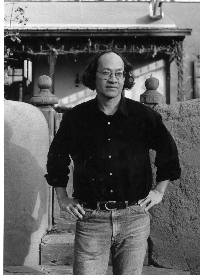
An E-view with Arthur Sze
By Rebecca Seiferle
%%%%%I first met Arthur Sze when weread together in a benefit reading for Amigos Bravos, an environmentalgroup in Taos, New Mexico. At that time, he was well-known in New Mexicoas a distinctive and compelling presence in the poetry of the region. Hewas co-publisher, with John Brandi, of Tooth of Time books, an esteemedteacher at the Institute for American Indian Arts, and the author ofseveral noteworthy poetry collections. Since then, he has quietly andby virtue of the quality of his work become a poet of national renown. His selected poems, The Redshifting Web: Poems 1970-1998 (CopperCanyon Press 1998), was a finalist for the 1999 Lenore Marshall PoetryPrize.
%%%%%Arthur Sze has beencalled one “of our best poets” by Charles Simic, and his poetry isesteemed by writers who inhabit a broad band of the poetical spectrum. His work has always been marked by a refinement of object and imagery.Rich in allusions, his poetry evinces a preference for Asianjuxtaposition rather than Western rhetoric. In reading his work, whilethere is a sense of a distinctive voice, the quality of voice strikesthe reader as a quality of mind, the subtle movements of a particularintelligence, rather than as oratorical.
%%%%% With the publication of The SilkDragon, Sze makes his debut as an equally exceptional translator.The Silk Dragon includes translations that are the fruit ofthirty years of reading the originals, considering their qualities andtranslating them into English. Rather than a complete anthology ofChinese poetry, the translations follow the trajectory of Sze’sinterests in Chinese literature, from the classic T’ang masters, Wang Wei, Li Po andTu Fu to important contemporary poets such asWen I-to and Yen Chen. Sze’s introductionprovides insight not only into the process of translation but theprocess of writing poetry altogether. The silk dragon, the title forthe collection, is Sze’s metaphor for poetry, and as Michelle Yeh notesin Sze’s moving collection of Chinese poetry. . . each poem is aminiature silk dragon, lustrous and magical in its beauty.
* * * * * * * *
Arthur Sze was born in NewYork City in 1950 and is a second-generation Chinese American. Hegraduated Phi Beta Kappa from the University of California at Berkeleyand is the author of seven books of poetry: The Silk Dragon:Translations from the Chinese (Copper Canyon Press, 2001), TheRedshifting Web: Poems 1970-1998 (Copper Canyon, 1998),Archipelago (Copper Canyon, 1995), River River (LostRoad, 1987), Dazzled (Floating Island, 1982), Two Ravens (1976; revised edition, Tooth of Time, 1984), The Willow Wind (1972; revised edition, Tooth of Time, 1981). His poems have appeared innumerous magazines and anthologies and have been translated intoChinese, Italian, and Turkish. He has conducted residences at BrownUniversity, Bard College, Naropa Institute, and is a recipient of anAsian American Literary Award, a Balcones Poetry Prize, a LilaWallaceReader’s Digest Writer’s Award, a John Simon Guggenheim MemorialFoundation Fellowship, an American Book Award, a Lannan Literary Awardfor Poetry, three Witter Bynner Foundation for Poetry Fellowships, twoNational Endowment for the Arts Creative Writing Fellowships, a GeorgeA. and Eliza Gardner Howard Foundation Fellowship, a New Mexico ArtsDivision Interdisciplinary Grand, and the Eisner Prize, University ofCalifornia at Berkely. He lives in Pojoaque, New Mexico, with his wife,Carol Moldaw, and is a Professor of Creative Writing at the Institute ofAmerican Indian Arts.
Seiferle: In your very interesting introduction to TheSilk Dragon you write that translation of Chinese poems intoEnglish has always been a source of inspiration for my own evolution asa poet. Do you feel that the process of translation has been a kind ofpoetic apprenticeship where you’ve learned your own craft or has it beenmore akin to wrestling with an angel, aspiring to what your own work isnot yet? Perhaps both?
Sze: In the beginning, I turnedto translation as a kind of poetic apprenticeship. In 1971, while astudent at the University of California at Berkeley, I was searching formy own voice and poetics. The T’ang dynasty masters Li Po, Tu Fu, Wang Weioffered me very distinct voices andchallenges. I wanted to translate them in order to honor theiraccomplishment but also to experience the poems from the inside out. Bywriting out their poems, character by character, stroke by stroke, I wasable to engage with the poems on a deeper level and better understandtheir process of creation.
Later on, in 1982, I was searching for ways to extend a lyric beyond 25lines, and Wen I-to came to mind. I read hispoems carefully and felt that he extended the lyric, in a poem such asMiracle, with great emotional power. And I thought hisjuxtapositionswhich brought the grittiness of twentieth century Chinainto tension with the more traditional T’ang dynasty lyrical imageswerestunning. In the case of Wen I-to, I translated his work because I feltit would help me discern a new stage for my own writing. So the processof translation has been wrestling with an angel as well as poeticapprenticeship.
Seiferle: I first began reading Vallejo in the Spanish nearlytwenty years before I seriously undertook translating him. Did youspend a similar period of time, when you read the poems in Chinese,‘lived’ with them in a sense, before you undertook the actual process oftranslation?
Sze:When I read Li Po, Tu Fu, Wang Wei, I knew immediately that I wanted totranslate their poems. I didn’t live with their work for a long time,but I was deeply excited by it. I think I experienced that shock ofrecognition that comes when one reads and experiences great poetry. Atthat time, however, I read and was baffled by such poets as Li Shang-yin and LiHo. It took me over twenty years to come to appreciate their poetry.In the early 1990s, I came back to LiShang-yin and Li Ho and was amazed at theirwork. Li Shang-yin’s untitled poems struck me as charged with longing;they impressed me as some of the great love poems in classical Chinese.And in the case of Li Ho: his obsessions with time and mortality, hishallucinatory use of colors, his need to gallop on horseback eachmorning for visionary fragments of poems to come to himall of thisstruck me as hallmarks of a peculiarly modern poet. In these cases,there was an enormous brewing time before I connected deeply with thework.
Seiferle: How do you choose the poems or do they choose you? Areyou drawn by particular lines, the personality of the poet, or moreamorphous qualities, such as the atmosphere or feeling which the poemconveys?
Sze:Sometimes I choose the poems, and sometimes they seize me. In the caseof Wang Wei, I loved the sharp images, theparadoxes, and intensity of his chueh-chu (quatrains). I read many ofthem and sifted through to select the ones that most interested me. In1975, when a friend recommended Wen I-to to me,I didn’t know where to start and happened to find his second collection,Dead Water. The poems in that collection stunned me. I knew thatsomeday I would want to translate some of them, but, again, it took memany years to feel ready.
Seiferle In your introduction, you say that your ownwriting of Chinese is awkward and rudimentary, yet it’s in the processof drawing the characters that you come to sense the inner motion ofthe poem in a way that I cannot by just reading the characters on thepage. Is this perhaps one way in which you begin to lay claim to thetranslation, making the poem your own, by writing it in your own hand? Do you write your own poems longhand and is sensing the inner motion ofeach poem essential to that process?
Sze:In writing the poem out in my own handwriting, I am trying to make thepoem my own, but that is only a beginning. I need to make an aside onChinese linguistics.The Chinese language employs 214 radicals or root elements to thelanguage. You learn to write words, or characters, stroke by stroke, ina particular order and direction. The Chinese language is also generatedthrough juxtaposition. For instance, the character bright is writtenby writing the character sun and then the character moon. In manyways, juxtaposition becomes a form of metaphor, with the equal signomitted. To write the character grief, one writes autumn at the topand heart/mind below. The character autumn has two parts: tree tipand fire (autumn=tree/s+fire). Grief=autumn placed next to, in,heart/mind. Because of the complexity of juxtapositions that mightgenerate a single character, and because a poet might pursue radicalconnections between characters, I need to write out each Chinese poemstroke by stroke. It helps me physically experience the vision, tension,architecture, rhythm and even silences to the poem.
Seiferle: You describe how you look up each Chinese character ina dictionary and create word clusters, possibilities of meaning inEnglish. I wonder if this method of translation has effected the writingof your own poetry. Do you go to the dictionary for your own work, doyou lay out fields upon the page, clusters of meaning?
Sze:I never start my own poems by using a dictionary, but I sometimes findit helpful in the process of creation. For instance, I wrote a poem innine sections, Quipu, that was recently published inConjunctions. Quipu is the Quechua word for knot, and itturns out the Incas used bundles of string, or quipus, to record allsorts of critical information: how many potatoes were stored in bins inthe mountainside, or the population of Cuzco, or historical information,or even poems. A quipu had a main string and then subsidiary stringsthat were dyed different colors, and different knots were used to encodethe information. When I was writing my poem, I looked up the simpleword, as, in the dictionary, and wrote out all of its possiblemeanings. I didn’t force myself to use all of them, but I consciouslyused many of them. The varied meanings enabled me to layer and chargethe poem in an unusual way. The word as appears so innocuous, but eachtime it’s used, it has a knotting effect. So here is a concreteexample of how using a dictionary in translation work has fed my ownpoetry.
.Seiferle: You have translated a wide range of poets from thegreat T’ang masters to contemporary poets. Could we follow thetrajectory of your own work by following the chronology in which youhave translated these various poets?
Sze: I think it’sdangerous to attempt a direct correlation between what a poet translatesand their own work. I think that I’ve absorbed and learned from all ofthe poets I’ve translated: over time, to name just a few, I’ve beendrawn to the clarity of T’ao Ch’ien’s lines, to the subtlety of MaChih-yuan’s lyrics, to the oblique exactitude of Li Shang-yin
Seiferle: Do you primarily translate between books or afterfinishing a book or before just beginning a new body of work? Or do youtranslate always or perhaps simultaneously working on a particular groupof translations while working on poems that share the same problems orpreoccupations?
Sze: I’ve translated poems, essentially, in threeperiods: 1971-72, 1982-83, 1995-96. In 1982-83 and 1995-96, I didtranslation work after completing a book. Doing translations helped mereenergize and consider what to work on next. In 1982, the Wen I-to helped me envision how to broaden anddeepen a poem. That translation work helped me look forward. However, in1995, the Li Ho, Pa-ta-shan-jen, and Li Shang-yin poems that were transformationaland challengingwere done almost in hindsight.
Seiferle: You note that you have included only thosetranslations which you consider finished. How do you know when atranslation is finished? What conveys that feeling of satisfaction?
Sze:A translation will nag at me if it is unfinished. I will read orreread it and recognize that some essential element is clumsy orinadequate or missing. I’ll put it aside, brood on it, and come backwhen I can write with intensity and clarity. There are some translationsthat I abandon: I’ve done my best but I’m dissatisfied. Thosetranslations I’m happy to toss. Others, over time, feel more and morealive. I think it’s the same with poems.
Seiferle: Are you at work now upon other translations? Yourlater translations have been Li Ho and Li Shang-Yin, both as youdescribe extremely challenging and condensed and writing a poetry fullof allusions. Is this the direction in which your interest still tends?
Sze: I’m not working on any translations at the moment. However,I am reading a lot of Taiwanese poetry and am going to co-edit a featureon contemporary Taiwanese poetry, with Michelle Yeh, for Manoa.I’ll be going to Taiwan in the fall to read at the international poetryfestival.
In terms of my own poetry, I’m interested in writing sequencesthat braid together lyric, dramatic, and narrative strands. There aremoments that are disorienting and challenging, but they are part of theprocess of re-envisioning the world.
Some of my new sequences begin with elegy and end with ode;this is nothing new; the structure is as old as poetry itself, but theparticular path or journey is very contemporary.
